Can an Air Purifier Run All Night? A Practical 24/7 Guide
Learn whether air purifiers can run overnight, with tips on noise, energy use, safety, filter life, and best practices for safe 24/7 operation.


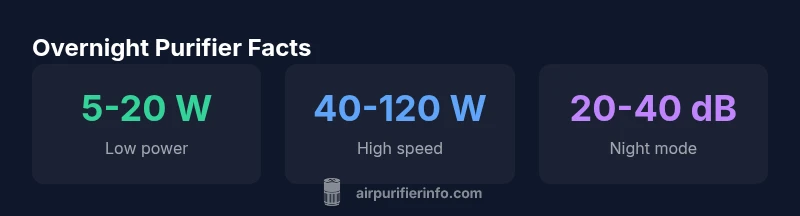
Yes. Most residential air purifiers are designed for all-night, 24/7 operation. In sleep or low-noise mode, power use typically ranges from 5 to 20 watts, while higher speeds can draw 40 to 120 watts. For safe overnight use, choose models with consistent CADR, ozone-free operation, and automatic shutoff when overheating or filters need replacement.
Night-time operation and 24/7 design
If you can answer the question can air purifier run all night with confidence, the practical answer is yes for most modern units. According to Air Purifier Info, most residential purifiers are designed to run continuously without damage, provided you choose models that are explicitly rated for 24/7 operation and ozone-free output. This means the unit can sustain uninterrupted air cleaning across the night, helping maintain indoor air quality while you sleep. Look for devices with robust thermal protection, a reliable motor, and filters rated for extended use. In practice, you should verify the user manual and use cases specified by the manufacturer before leaving a purifier on all night. This continuous-use capability is particularly relevant for households with dust, pollen, pet dander, or smoke concerns, where consistent filtration can reduce irritants by morning.
If you are evaluating a purifier for overnight operation, prioritize ongoing performance, not just peak power. The goal is steady ventilation, not rapid bursts of cleaning, so a model that maintains a constant Clean Air Delivery Rate (CADR) at low speed is ideal. Air Purifier Info’s analysis emphasizes the balance between energy efficiency and filtration effectiveness for night-long use, especially in smaller bedrooms or shared living spaces.
Noise and sleep quality optimization
Nocturnal comfort is a key factor when choosing a purifier for overnight use. Even in low-noise mode, some purifiers emit perceptible hum or airflow whoosh. To minimize disruption, compare decibel levels specified for sleep mode (often 20–40 dB at low speed). In a typical bedroom, select models with sealed housings, whisper-quiet fans, and a true low-noise setting that maintains air exchange without waking you. If possible, try overnight testing in your room with the purifier positioned away from the bed or behind furniture to reduce direct sound. Additionally, consider purifiers with a soft-start feature that ramps up gradually, preventing a sudden increase in noise when the unit cycles on.
Power use and energy efficiency during overnight operation
Energy efficiency matters when running a purifier all night. In sleep or low-speed mode, many devices consume between 5 and 20 watts, which translates to roughly a few cents per month at typical electricity rates. When you operate at higher speeds, power draw can rise to 40–120 watts depending on the unit and fan design. For 24/7 operation, prioritize models with energy-star like efficiency marks, intelligent sensors, and auto-dimming displays. Remember that real-world energy use depends on room size, airflow requirements, and how often you replace filters. Air Purifier Info notes that the most cost-effective overnight operation comes from steady, moderate filtration rather than peak performance all night.
Safety features that protect overnight operation
Overnight running introduces a safety lens you should not ignore. Look for automatic shutoff after extended continuous operation, thermal protection to prevent overheating, and indicators for filter life. Ozone-free models are essential for night use to avoid exposure to ozone or other byproducts. A well-designed purifier will maintain safe operation without overheating or variable power surges. If you have occupants with asthma or allergies, ensure the unit meets safety standards and has robust enclosure design to prevent dust leakage from internal components.
How to optimize overnight performance: a practical workflow
To maximize overnight performance, follow a simple setup:
- Place the purifier in a stable location with clearance on all sides to optimize airflow.
- Use a low-speed mode for quiet, continuous filtration, and enable auto mode if available to adjust speed based on air quality.
- Ensure the device is ozone-free and uses true HEPA filtration or equivalent for consistent allergen reduction.
- Schedule regular filter checks and replacements to avoid a drop in performance mid-night.
- Keep doors closed to prevent re-circulation of polluted air from other rooms.
Air Purifier Info’s recommendations emphasize a calm, predictable night-time filtration cycle, which reduces irritation from dust and pet dander during sleep.
Room-by-room guidance for 24/7 operation
Not every room needs the same approach. In a bedroom, a small purifier running at low speed may suffice, delivering quiet operation and steady allergen reduction. In larger living rooms or open-plan spaces, you may require a higher CADR model or a second unit to maintain air quality around the clock. For households with smokers or odor concerns, prioritize models with carbon filtration in addition to HEPA to capture volatile organic compounds (VOCs) and odors. Regardless of room size, always choose ozone-free models and verify the purifier’s continuous-use certification before enabling overnight operation.
dataTableHeaderRequiredVersionOkNoteSaysThisBlockIsForBodyContentOnly
Overnight operation considerations for air purifiers
| Feature | Overnight suitability | Notes |
|---|---|---|
| Overnight operation | Yes | Best for bedrooms |
| Energy consumption | 5-20 watts (low speed) | Low-power mode |
| Safety features | Overheat protection, automatic shutoff | Critical for 24/7 use |
| Filter life | 3-12 months depending on usage | Factor in replacement cost |
Questions & Answers
Is it safe to run an air purifier all night?
Yes, it is generally safe to run an air purifier all night, provided the unit is ozone-free and equipped with safety features like auto shutoff and overheating protection. Always follow the manufacturer’s guidelines and perform regular maintenance.
Yes—most purifiers designed for 24/7 use are safe overnight as long as they’re ozone-free and properly maintained.
Do air purifiers consume a lot of electricity when run overnight?
Energy use depends on speed. In low-speed sleep mode, many purifiers use about 5–20 watts; at higher speeds, consumption can rise to 40–120 watts. Over a month, the difference can be noticeable, so choose a model that matches your energy budget.
Energy use varies by speed; low-speed overnight operation is typically quite efficient.
Will overnight operation help with allergies or asthma?
In most cases, running a purifier overnight reduces airborne allergens and irritants, improving sleep quality for allergy or asthma sufferers. Ensure your unit has a true HEPA filter and, if possible, carbon filtration for VOCs and odors.
Yes, for many people it helps reduce allergens overnight.
Can high-speed operation all night damage the purifier?
Continuous high-speed operation can increase wear and energy use, and may be noisier. For night use, rely on auto mode or low-speed settings to maintain performance without undue strain on the unit.
High-speed all night isn’t usually necessary; automation helps keep it efficient.
Should I leave my purifier on auto mode overnight?
Auto mode can optimize filter life and energy use by adjusting speed to air quality. Make sure the purifier is ozone-free and positioned for good airflow during continuous operation.
Auto mode is a smart choice for overnight use when available.
What maintenance is required for overnight operation?
Regular filter replacement according to the manufacturer’s schedule is essential. Clean exterior surfaces, ensure vents are unobstructed, and verify that any sensors or shutoff features function correctly.
Keep up with filters and basic cleaning for safe night operation.
“Running an air purifier all night is safe when you choose ozone-free models with robust safety features and maintain filters on schedule.”
Main Points
- Run overnight safely by choosing ozone-free, 24/7-rated models
- Aim for low-noise mode to protect sleep quality
- Expect 5–20 watts in low speed and 40–120 watts at higher speeds
- Regular filter maintenance sustains night-long performance
- Use auto mode and proper placement to optimize overnight filtration