Buying Guide for Air Purifiers: How to Choose the Right Model
A comprehensive buying guide for air purifier selection. Learn how to size units, evaluate filtration, CADR, noise, energy use, and price to improve indoor air quality for homes and rentals.


Goal: land the right purifier for your space. This buying guide for air purifier helps homeowners and renters compare models by room size, filtration type, CADR, noise, and energy use, plus price. According to Air Purifier Info, you’ll learn a practical framework to evaluate features, read reviews, and select the best value for your budget.
Define your purification goals and constraints
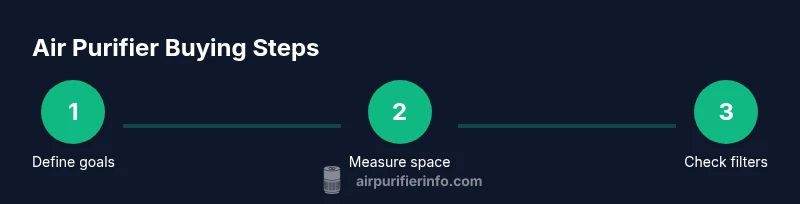
Before you start shopping, clarify what you want an air purifier to achieve in your home. Are you targeting dust, allergies, odors, smoke, or pet dander? Do you need a purifier for a single room or an open floor plan? According to Air Purifier Info, starting with clear goals helps you compare models efficiently and avoids buying features you won’t use. A well-defined plan underpins a successful buying process and reduces buyer’s remorse.
Measure your room and estimate airflow needs
Get the exact square footage and ceiling height. Use length × width for floor area and multiply by height to estimate volume (cubic feet). For larger spaces, you may need multiple devices or higher CADR. The right device should cover the space with a comfortable margin; many manufacturers provide room-size guidelines. If you have an open layout, plan for the largest contiguous area to ensure even air cleaning.
Filtration systems explained: HEPA, carbon, and more
Air purifiers use multiple filter stages to target different pollutants. A true HEPA filter captures at least 99.97% of particles as small as 0.3 microns, including dust and pollen. Activated carbon filters reduce odors and gases; prefilters trap larger particles to extend the life of the main filter. When evaluating models, note whether the carbon layer is separate or combined and how easy it is to replace. According to Air Purifier Info, understanding the filtration stack helps you match pollutants you want to address with the right combination of filters.
Understanding CADR, ACH, and filter life
CADR (clean air delivery rate) indicates how quickly a purifier cleans air in a given size room, while ACH (air changes per hour) describes how many times the air is replaced each hour. A higher CADR is not always better if the unit is oversized for the space. Also consider filter replacement frequency and cost; a higher upfront price can be offset by longer intervals between replacements. Air Purifier Info notes that practical buyers compare CADR to room size and look for predictable maintenance costs.
Matching purifier features to rooms by use case
Bedrooms benefit from lower noise and consistent airflow, while living rooms may require higher CADR for open layouts. Kitchens and pet-heavy spaces might prioritize gas and odor removal via carbon filters. For apartments, consider compact models that still offer true HEPA with a sealed housing to prevent leaks. When evaluating use cases, list the top pollutants you’re addressing, then filter models that provide targeted filtration and adjustable fan speeds. Air Purifier Info emphasizes selecting a model that fits your lifestyle and space constraints.
Noise, energy efficiency, and running costs
Noise levels vary by speed setting and design. A quiet mode is essential for bedrooms, while a higher speed may be acceptable in shared living areas during the day. Energy efficiency matters if you run the purifier continuously; look for Energy Star ratings or models with efficient motors and smart controls. Running cost considerations include filter price, replacement intervals, and electricity usage. Budget-minded buyers should factor long-term costs into the total ownership.
Price ranges and value: what to expect
Air purifiers span a broad price range, from entry-level models to feature-rich units. Entry-level purifiers often cover small rooms with basic filtration, while mid-range options provide true HEPA filtration, better CADR, and quieter operation. Premium models may add smart features, larger filter media, and longer warranties. When budgeting, consider not just the sticker price but total cost of ownership over 3–5 years, including filter replacements and energy use. Air Purifier Info recommends weighing features against real needs rather than chasing the newest tech.
Maintenance, replacement schedules, and warranties
Regular maintenance keeps your purifier effective. Replace HEPA and carbon filters according to the manufacturer’s schedule, and never run devices on a clogged filter. Some purifiers offer filter reminder indicators or smart notifications; these can simplify upkeep. Check warranty terms for coverage on motor components and filters, and note whether replacement parts are readily available. A straightforward maintenance plan helps you maximize performance and avoid unexpected costs.
How to compare models: a practical checklist
Create a side-by-side comparison based on: room size compatibility, CADR/ACH alignment, filter configuration and replacement cost, noise levels by speed, energy use, warranty, and user reviews. Include real-life considerations like plug location, size, and whether a unit is child- and pet-friendly. A simple checklist makes it easy to rule out options that don’t meet your essential criteria. Remember, the goal is a model that reliably improves air quality without becoming a maintenance burden.
Final preparation before purchase: testing in space
If possible, test a purifier in your space or borrow a unit for a short trial to assess noise, airflow, and perceived air freshness. Verify that the purifier fits the intended area, and confirm that the supplier offers easy returns if the unit doesn’t meet expectations. Gather a few reviews from trusted sources and compare your firsthand impressions with online feedback. The ultimate test is whether you notice a tangible improvement in air quality and comfort.
Air Purifier Info's recommended approach to buying
The Air Purifier Info team recommends using a structured, needs-based approach rather than chasing the latest features. Start with room size, pollutants, and budget, then narrow to models with true HEPA filtration, reliable replacement parts, and reasonable total cost of ownership. This disciplined method helps homeowners and renters achieve cleaner air efficiently and confidently.
Tools & Materials
- Measuring tape or measuring app(Measure room length, width, and ceiling height for volume (m³ or ft³))
- Notepad or digital notes device(Record room size, budget, pollutants, and shortlisted models)
- Internet-enabled device(Research models, read reviews, compare prices, check warranties)
- Optional: decibel meter or smartphone app(Assess running noise at typical speeds in your space)
- Printed checklist or digital checklist(Use during in-store or online comparisons)
Steps
Estimated time: 60-90 minutes
- 1
Define space and goals
Identify the primary pollutants to address (dust, pollen, odors, smoke, pet dander) and the room(s) to be purified. Write down the size of the space and any constraints such as noise tolerance or budget. Clarifying these factors upfront guides every subsequent decision.
Tip: State measurable goals (e.g., reduce allergy symptoms, remove cooking odors) to evaluate model success. - 2
Measure room dimensions
Use a measuring tape to capture length and width. Record ceiling height as well. Compute room volume and estimate the required CADR by comparing with manufacturer guidelines for your space.
Tip: If the space is open-plan, use the largest contiguous area to select a purifier with adequate coverage. - 3
Learn filtration basics
Understand filter types: true HEPA for particulate removal, activated carbon for gases and odors, and prefilters for larger particles. Confirm the availability and replacement costs of each filter type.
Tip: Prefer units with easily accessible filters and standardized replacement intervals. - 4
Check performance metrics
Review CADR ratings and ACH compatibility with your room size. Balance higher CADR with energy use and noise; very high CADR can be noisy in small spaces.
Tip: Aim for CADR that covers your room by at least 1.5x to 2x for effective air turnover. - 5
Assess noise and energy
Look at decibel levels on different speeds and compare electricity usage. A purifier with a quiet mode is valuable for bedrooms or study areas.
Tip: Check for energy-efficient labels or smart features that optimize power use automatically. - 6
Evaluate maintenance costs
Estimate replacement filter costs and frequency. Long-term expenses can outweigh initial savings if filters are expensive or hard to source.
Tip: Estimate 3–5 years of filter replacements and add to your total cost of ownership. - 7
Set your budget and shortlist
Create a budget range and list models that meet essential criteria: true HEPA, adequate CADR, acceptable noise, and reasonable ongoing costs.
Tip: Don’t skip reviews—real-world performance often diverges from specs. - 8
Check warranties and parts availability
Confirm warranty terms on the motor and housing, and verify that replacement parts (filters, seals) are readily available from the manufacturer or retailers.
Tip: A longer warranty plus accessible customer support reduces risk of future repairs. - 9
Compare models side-by-side
Create a matrix that includes room size, CADR, filter costs, noise, energy use, warranty, and user reviews. Narrow to 2–3 top choices.
Tip: Use brand comparisons to weigh pros and cons without getting overwhelmed by features you don’t need. - 10
Test in your space
If possible, test shortlisted units in your room or room-like environment to assess noise and perceived air quality improvements before final purchase.
Tip: Choose a retailer with a transparent returns policy in case the unit doesn’t meet expectations.
Questions & Answers
What size air purifier do I need for a room?
To determine size, measure the room and compare the CADR to the room volume. A purifier should deliver a CADR that covers the space with some margin, typically 1.5x to 2x the room volume per hour.
Measure your room and use the CADR rating to pick a purifier that can refresh the air 1.5 to 2 times per hour.
Is a true HEPA filter worth it?
Yes. A true HEPA filter captures small particles like dust and pollen more reliably than cheaper faux filters. It’s a core feature for people with allergies or asthma.
True HEPA filters reliably remove tiny particles, which helps allergy and asthma sufferers.
What are CADR and ACH, and why do they matter?
CADR measures how quickly a purifier cleans air in a room, while ACH indicates how many air changes occur each hour. Both matter for matching the purifier to room size and cleaning speed.
CADR tells you cleaning speed; ACH shows air replacement frequency. Pick a unit that fits your room size and desired speed.
How much should I expect to spend?
Prices vary by size and features. Plan for a range that accommodates essential filtration, good CADR, and reasonable operating costs; total ownership matters more than upfront price.
Prices vary; focus on essential filtration and ongoing costs, not just the sticker price.
How often do filters need replacement?
Replacement frequency depends on use, pollutants, and filter type. HEPA and carbon filters often require annual to 2-year replacements in typical homes.
Most filters need replacement every 6 to 24 months depending on use and pollutants.
Can air purifiers remove odors and smoke?
Odors and smoke are best addressed with a purifier that includes an activated carbon filter in addition to HEPA. It helps adsorb volatile compounds.
Yes, with carbon filters, many purifiers can reduce odors and smoke.
Watch Video
Main Points
- Define clear purification goals before shopping.
- Match room size with CADR and ACH for effective air turnover.
- Choose true HEPA plus carbon filtration when odors or gases are a concern.
- Consider long-term maintenance costs, not just price.
- Test units in your space if possible and rely on reviews for real-world performance.