Air purifier versus air ionizer: A detailed homeowner guide
Compare air purifiers and air ionizers to determine which option offers reliable particle removal, odor control, and safety for homes. This analytical guide covers how they work, costs, maintenance, and best-use scenarios.


When choosing between an air purifier and an air ionizer, air purifiers with true HEPA filtration consistently deliver reliable particle removal and are generally ozone-free, making them safer for most homes. Air ionizers may help with odor under specific conditions but can generate ozone in cheaper models and offer variable dust capture. For broad, dependable indoor air quality, start with a true HEPA-enabled air purifier and verify ozone-free operation.
What are air purifiers and air ionizers?
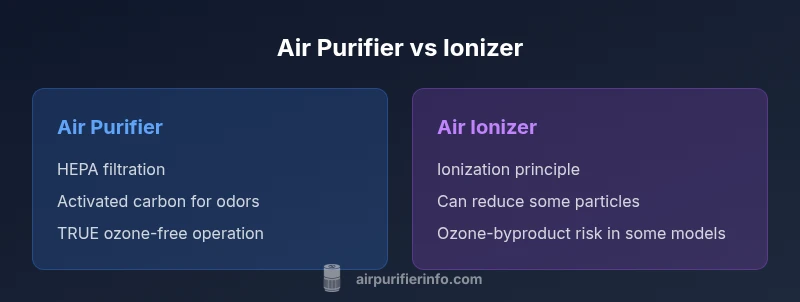
Air purifier versus air ionizer is a common comparison that hinges on two distinct approaches to indoor air quality. An air purifier typically uses mechanical filtration—often a true HEPA filter—plus activated carbon to trap particles and some gases. An air ionizer, on the other hand, relies on electrically charged ions to attach to particles, causing them to settle out of the air or stick to surfaces. For homeowners, this distinction matters not just for performance but also for safety, maintenance, and long-term costs. The Air Purifier Info team notes that understanding your room size, occupancy, and sensitivities can help determine which technology aligns with your needs. In many homes, a well-designed purifier with a certified HEPA filter remains the most reliable baseline for clean air. A key caveat is that some ionizers may produce ozone as a byproduct, which can irritate eyes, throat, and lungs in susceptible individuals. According to Air Purifier Info, it’s prudent to verify product specifications and certifications before buying.
How each device works
Air purifiers function by drawing air through a filtration cascade that typically includes a pre-filter, a HEPA filter, and often activated carbon or specialty media. The HEPA stage captures at least 99.97% of particles as small as 0.3 microns, including dust, pollen, and many smoke particles. Activated carbon targets odors and some volatile organic compounds (VOCs). The overall effectiveness depends on the device’s Clean Air Delivery Rate (CADR), filter condition, and room size compatibility. Air ionizers emit negative or positive ions into the space; these ions attach to particles, increasing their mass so they fall out of the air or cling to walls and furniture. While this can reduce airborne particles in some scenarios, it does not guarantee consistent removal of all aerosols and, in cheaper models, can produce ozone. Properly designed ionizers with ozone-free claims exist, but always check the spec sheet.
Filtration efficiency and particle removal
Particle removal is more predictable with mechanical filtration. True HEPA purifiers deliver high efficiency across a broad spectrum of aerosols, including fine dust, pollen, and smoke. CADR ratings provide a practical measure of how quickly a purifier cleans air in a given room; higher CADR values indicate faster cleaning. Ionizers generally do not match HEPA-level performance for small particles, especially in occupied rooms with high dust or smoke load. In fact, ionizers may require longer operation to achieve similar results and can be less effective for people with allergies or asthma. When comparing options, prioritize devices that advertise certified HEPA filtration and verified CADR. The Air Purifier Info team recommends cross-checking independent lab tests or consumer reviews for model-specific performance.
Odors and VOCs handling
Odor control often hinges on the presence of activated carbon filters. Purifiers with carbon layers can absorb cooking smells, smoke residues, and certain VOCs from household products. Ionizers do not provide the same level of chemical absorption and are not reliable odor control mechanisms on their own. Some ionizers claim odor reduction through particle charge and surface deposition, but their effectiveness is inconsistent and can be limited by room layout and airflow. If odor mitigation is a priority, a purifier with an effective carbon filter tends to offer more predictable results. The practical takeaway is to pair odor-targeted media with a suitable purifier when addressing smells from cooking, pets, or tobacco.
Ozone generation and safety considerations
A critical safety factor is ozone. Some ionizers produce ozone as a byproduct, and even in low concentrations, ozone can irritate the airways of sensitive individuals. Federal and health authorities emphasize avoiding ozone-generating devices in occupied spaces. When selecting any ionizing device, look for explicit claims of ozone-free operation and verify third-party certification. If you have asthma, COPD, or a child with respiratory sensitivity, the safest choice is a purifier with HEPA filtration and no ozone emission. Air Purifier Info faculty stresses that safer alternatives exist—HEPA purifiers—without byproducts that could irritate occupants.
Energy use, noise, and maintenance
Energy consumption for purifiers varies with fan speed, CADR, and filtration load; many models offer energy-saving modes and automatic speed adjustments for consistent performance without excessive power use. Noise levels correspond to fan speed and filtration design; some quieter models still deliver high CADR through optimized airflow paths. Maintenance for purifiers includes periodic filter replacement, especially the HEPA and carbon stages, typically every 6–12 months depending on use and air quality. Ionizers may have fewer moving parts but often require less obvious maintenance and electrode cleaning. However, their long-term effectiveness is less predictable, so factor in replacement costs and potential ozone testing when making a choice.
Cost of ownership and long-term value
Upfront cost for air purifiers varies with filtration quality, CADR, and features such as smart sensors and multi-stage media. The total cost of ownership should account for ongoing filter replacements, potential carbon-replacement cycles, and electricity use. Ionizers tend to have lower upfront costs in some cases, but the total cost of ownership can be higher if ozone-free guarantees are not clearly stated or if replacement parts for the ionizer are needed frequently. When evaluating value, consider not only purchase price but also ongoing carbon and filter costs, energy usage, and the device’s proven performance in independent tests.
Space and placement guidance
Room size and placement matter. For air purifiers, choose a unit whose CADR matches the room area and position it away from walls to maximize intake and exhaust flow. In moderately sized rooms with high activity, a purifier near the source of pollution (e.g., kitchen or living room) can reduce pollutant levels more quickly. Ionizers often require strategic placement to maximize ion distribution, yet their performance remains more sensitive to occupancy and air currents. In all cases, avoid placing devices behind furniture or in dead zones where air exchange is limited. If you have pets or children, consider models with safety features like child locks and ozone-free operation.
Practical decision frameworks: who should buy which
If your primary goal is reliable particle removal and safety, a true HEPA purifier is generally the best starting point for most homes. It’s especially advantageous for allergy sufferers, pet owners, and households with smokers. If you have specific odor concerns in small, well-ventilated spaces and you verify ozone-free operation, an ionizer could be a supplementary option—but not a standalone replacement for filtration. For large spaces or commercial settings, evaluate CADR coverage per square foot and total running costs before committing. Use a decision framework that weighs room size, occupant sensitivities, and willingness to monitor device specs for ozone emissions.
How to verify claims: certifications and tests
Read product documentation for filtration type (e.g., HEPA or true HEPA), CADR ratings, and the presence of activated carbon media. Look for certifications like HEPA or ENERGY STAR where applicable, and check independent test results when possible. Be cautious of marketing terms like 'ionic cleansing' without substantiation or ozone-free guarantees. Compare models side by side and consider real-world tests performed by consumer organizations. The goal is to confirm that the device delivers on its stated claims without introducing new risks.
Common myths debunked
Myth: Ionizers are universally safer than purifiers. Reality: Some ionizers generate ozone, which can harm sensitive occupants; always verify ozone emission specs. Myth: HEPA purifiers cannot handle odors. Reality: When paired with activated carbon, many purifiers address both particles and odors effectively. Myth: Bigger is always better. Reality: Room size compatibility matters more than sheer unit size; oversized devices waste energy and create noise. Myth: All carbon filters are the same. Reality: Filter bed depth, activated carbon quality, and surface area influence odor and VOC removal efficiency.
Practical steps to maximize indoor air quality with either device
- Start with a purifier featuring true HEPA filtration and a robust activated carbon stage. - Position the unit for optimal air intake and exhaust clearance. - Regularly replace filters according to manufacturer recommendations and inspect for signs of clogging. - Use humidity control and source control (venting odors away from living spaces) to complement filtration. - If considering an ionizer, confirm ozone-free claims and understand any maintenance requirements. By combining filtration with proper room management, you can maximize air quality while minimizing risks.
Comparison
| Feature | air purifier | air ionizer |
|---|---|---|
| Filtration/cleaning method | Mechanical filtration with HEPA (and often activated carbon) | Ionization with charged particles; some models may include surface deposition |
| Particle removal efficiency | High with true HEPA filtration for a wide range of particles | Variable; often less consistent for very small particles |
| Odor and VOC handling | Strong with carbon filters and media designed for VOCs | Limited; odor claims depend on design and may not address VOCs reliably |
| Ozone production risk | Typically ozone-free when the unit is properly designed and used | Risk of ozone production in some models; verify ozone-free claims |
| Energy use | Moderate depending on CADR and settings; many offer energy-saving modes | Typically low power draw but varies with device design |
| Maintenance | Filter replacements (HEPA and carbon) needed periodically | Electrode maintenance and cleaning; less predictable long-term costs |
| Noise level | Varies by model but many operate quietly at moderate CADR | Often quieter at low to medium settings, varies by design |
| Best for | Dust, pollen, smoke, and general indoor air quality improvements | Odor control in small spaces; best when ozone-free operation is guaranteed |
What's Good
- Helps homeowners compare clearly across models
- Highlights safety and ozone considerations
- Supports budgeting and room-planning decisions
- Addresses both particle and odor concerns with appropriate media
- Encourages verification of certifications (HEPA, CADR)
What's Bad
- Model-to-model variation can affect accuracy of claims
- Ionizers with ozone risk require careful scrutiny
- Some marketing claims need independent verification
- Maintenance costs can vary with filter replacement schedules
Air purifiers with true HEPA filtration generally provide more reliable, ozone-free particle removal for most homes.
Choose HEPA-purifier for consistent particle control and safety. Consider an ionizer only if you find a clearly ozone-free model and you need targeted odor reduction in a small space, but do not rely on it for comprehensive air cleaning.
Questions & Answers
What is the fundamental difference between an air purifier and an air ionizer?
An air purifier uses filters to physically remove particles from the air, while an air ionizer uses ions to charge particles so they settle out or attach to surfaces. Purifiers with HEPA filtration offer predictable, strong particle removal, whereas ionizers can vary in effectiveness and may require caution due to ozone byproducts in some models.
Air purifiers physically trap particles with filters, delivering predictable removal. Ionizers rely on charged particles and can vary in performance and safety due to possible ozone byproducts.
Do air ionizers produce ozone?
Some ionizers generate ozone as a byproduct. If ozone is present, it can irritate airways, especially for sensitive individuals. Always check the product’s ozone-free claim and look for independent testing or certification.
Yes, some ionizers can produce ozone. Always verify ozone-free claims before purchasing.
Are air purifiers more effective for particles than ionizers?
Generally, air purifiers with true HEPA filters offer more reliable removal of a wide range of airborne particles compared to ionizers. Ionizers may reduce some particles, but results are less consistent and dependent on model design and room factors.
Purifiers with HEPA filters are usually more consistently effective at removing particles than ionizers.
What should I look for when buying either device?
Look for true HEPA filtration, verified CADR, a dedicated activated carbon stage for odors/VOCs, ozone-free operation, noise ratings, and filter replacement costs. For ionizers, ensure ozone-free certification and check independent tests or reviews.
Seek HEPA filtration, CADR, and ozone-free operation; verify maintenance costs before buying.
Can an ionizer be a good supplement to a purifier?
In some cases, an ionizer can complement a purifier, but it should not replace filtration. If you use an ionizer, ensure it is ozone-free and understand that the primary defense against particles will still be the purifier's filters.
Ionizers can supplement filtration, but they shouldn’t replace a true HEPA purifier, especially if ozone is possible.
Is there a safe option for households with pets?
Yes: choose a purifier with a true HEPA filter and a robust activated carbon stage to capture pet dander and odors. Avoid ozone-emitting ionizers in pet-friendly homes, as ozone can irritate occupants and pets.
For homes with pets, go with a HEPA purifier with carbon filters and avoid ozone-generating ionizers.
Main Points
- Prioritize true HEPA purifiers for reliable particle removal.
- Avoid ozone-emitting ionizers in homes with sensitive occupants.
- Check CADR, filter types, and energy use before purchase.
- Match device size to room area and noise tolerance.