Air Purifier Size Chart: How to Choose the Right CADR by Room Size
Learn how an air purifier size chart links CADR to room size to deliver effective cleaning, balanced energy use, and comfortable noise levels. Practical steps, examples, and tips for apartments, homes, and open-plan spaces.


According to Air Purifier Info, an air purifier size chart links a purifier's CADR and airflow to room size, helping you pick a unit that cleans efficiently. By matching space, CADR, and air changes per hour, you avoid underpowered units or wasted energy. A size chart also clarifies how to scale for bedrooms, living rooms, and open-plan spaces.
How a Size Chart Works
A size chart is a practical reference that translates a purifier’s CADR (Clean Air Delivery Rate) into actionable room guidance. CADR measures how much clean air a purifier can deliver per minute, and it should roughly align with your room’s air volume to achieve a healthy number of air changes per hour (ACH). The goal is to refresh indoor air fast enough to reduce dust, allergens, and odors without over-purifying or wasting energy. According to Air Purifier Info, use the chart as a starting point, then verify performance in your space after installation. Keep in mind that ceiling height, furniture layout, and HVAC drafts can influence real-world results.
What to look for on the chart: CADR ranges, room size brackets, and notes about open spaces versus enclosed rooms. The chart should also flag any caveats, such as higher noise levels at peak CADR or higher energy use for larger units. A well-constructed chart helps you avoid picking a purifier that’s too small for your space or one that runs inefficiently at full power.
Translating Room Size to CADR and ACH
Room size is the initial guide, but effective air cleaning depends on the purifier’s CADR and the air changes per hour you can realistically achieve. In practical terms:
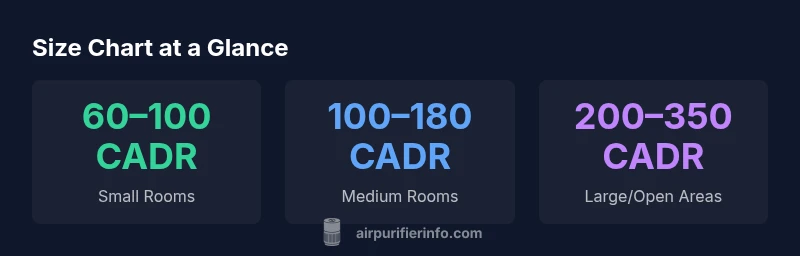
- For small rooms around 100 square feet, target CADR in the 60–100 CFM range to reach roughly 4–6 ACH.
- For medium rooms of 200–300 square feet, aim for CADR in the 100–180 CFM bracket to achieve about 4–6 ACH depending on layout.
- For larger spaces, such as 400–600 square feet, look for CADR in the 200–350 CFM range or consider multiple units to maintain 4–6 ACH.
These ranges are general guidelines and may vary with ceiling height, airflow patterns, and filtration efficiency. Air Purifier Info analysis shows that validating the chart in real rooms—by measuring odor relief and dust reduction after installation—provides the most reliable results.
Choosing the Right CADR for Different Rooms
Different rooms have distinct air-cleaning needs. In bedrooms, prioritize calm operation and a CADR that yields about 4 ACH to maintain a quiet sleep environment. In living rooms or open-plan spaces, opt for higher CADR or consider two units to maintain consistent air changes across zones. Kitchens, where cooking odors can spike VOCs, benefit from models with activated carbon filters in addition to HEPA. If you’re unsure about the exact CADR, start with a mid-range purifier and adjust based on in-room performance. Always align CADR with room size, not the purifier’s marketing gloss—your goal is clean air, not the loudest device in the room.
How to Read a Size Chart with Features
A robust size chart includes several useful features:
- Clear room-size brackets linked to CADR ranges.
- Notes on air-flow direction, purifier height, and placement (near corners or open areas).
- Guidance on multiple units for open-plan spaces.
- Visual indicators for energy use and typical noise levels at different CADR values.
When reading the chart, check for emphasis on room volume (not just floor area) and consider whether your room has high ceilings or dense furnishings. If the chart ignores these factors, supplement it with a quick in-room test after purchase.
Practical Examples: Small Apartment, Medium Living Space, Large Open Plan
- Small apartment (about 100–120 sq ft): Choose a compact purifier with a CADR of 60–100 CFM. Place it near the main seating area or at a doorway to maximize fresh air delivery.
- Medium living space (200–300 sq ft): A mid-size unit with 100–180 CFM CADR works well. If the area is open to other rooms, consider two units or a higher-CADR single unit for better coverage.
- Large open-plan (400–600 sq ft): One high-CADR purifier (200–350 CFM) placed centrally can drive air changes, but two units may provide more even distribution and reduce noise by allowing lower settings on each unit.
These scenarios illustrate how a size chart translates room size into achievable air changes. Real-world testing—such as checking for reduced asthma or allergy symptoms, or noticing less dust while cooking—helps confirm the chart’s guidance. Air Purifier Info recommends starting with the chart, then validating performance in your home.
Energy Use, Noise Levels, and Long-Term Costs
Higher CADR purifiers deliver more clean air but typically consume more energy and generate more noise at peak settings. Look for models with energy-saving modes and adjustable fan speeds to balance air changes with comfort. Long-term costs include filter replacement, which varies by model and filter type. The size chart helps you forecast energy use by comparing examples: a 60–100 CADR unit often runs cool and quietly at low to mid settings, while 200–350 CADR models may require more attention to placement and maintenance to maintain comfort. Planning two smaller units versus one large unit can also affect energy use and noise exposure across living spaces.
Maintenance and Longevity: Keeping the Chart Useful
A size chart remains most helpful when paired with a regular maintenance schedule. Replace HEPA and carbon filters on the manufacturer’s recommended cadence to preserve CADR performance. Clean fans and intake grilles to prevent dust buildup that could reduce airflow. Revisit room measurements if you rearrange furniture or move to a different residence, and adjust CADR expectations accordingly. Air Purifier Info emphasizes documenting your space in a simple room map, which helps you track changes over time and refine your chart-based selections without guessing.
Quick-reference size-to-CADR table
| Room size (sq ft) | Recommended CADR (CFM) | Typical purifier size | Notes |
|---|---|---|---|
| 100 | 60–100 | Small compact purifier | Bedrooms and guest rooms |
| 200 | 100–180 | Mid-size purifier | Living rooms and offices |
| 400 | 200–350 | High-CFM purifier | Open-plan spaces |
| 600+ | 300–500 | Multi-unit or high-capacity purifier | Large open areas or lofts |
Questions & Answers
What is CADR and why is it used in size charts?
CADR stands for Clean Air Delivery Rate and measures how much clean air a purifier can deliver per minute for smoke, dust, and pollen. Size charts use CADR to estimate whether a unit can refresh a room’s air quickly enough to achieve a practical number of air changes per hour.
CADR tells you how much clean air a purifier can move each minute, which helps you pick a size that matches your room.
Can I use a larger purifier than the chart recommends?
Yes, you can, but be mindful of energy use and noise. A higher-CADR purifier will clean faster but may run louder or consume more power. If you choose a larger unit, you can often use a lower fan setting to maintain comfort while achieving good air changes.
It’s okay to pick a bigger unit, just watch the noise and energy use.
Does room height affect the size chart?
Most charts focus on floor area because it’s easier to estimate air volume. Tall ceilings increase air volume, so you may need a higher CADR or an additional purifier to reach the same ACH. Always consider ceiling height alongside floor area when applying a size chart.
High ceilings mean more air to clean, so you might need a bigger purifier.
How often should I recalculate the chart when moving to a new home?
Recalculate whenever room dimensions change—new square footage, ceiling height, or furniture layout can shift the CADR you need. Rechecking ensures you maintain effective air changes without over or under-sizing.
When your space changes, recheck the chart to stay on target.
Is one purifier enough for an open-plan space?
Often one high-CADR purifier helps, but for very large or multi-zone open plans, two units placed strategically can improve overall coverage and reduce noise at a comfortable level.
One big purifier might work, but two can give you better coverage and quieter operation.
“A size chart helps you translate abstract efficiency into a concrete, room-specific plan. It’s a practical starting point, not a rigid rule.”
Main Points
- Measure space before choosing a purifier
- Match CADR to room size to achieve 4–6 ACH
- Consider noise and energy use alongside size
- Test performance in your space and adjust as needed