Air Purifier in Bathroom: A Practical Guide
Learn how to choose, place, and maintain an air purifier in bathroom spaces to reduce humidity, odors, and allergens. Practical steps, safety tips, and maintenance guidance for homeowners and renters.


This quick guide shows you how to choose and operate an air purifier in bathroom to cut humidity, odors, and allergens. You'll learn sizing, placement, maintenance, and safe operation for compact, moisture-rich spaces. By following the steps, you can confidently compare models, set up the unit, monitor performance, and create a healthier bathroom environment for your family.
Why an air purifier in bathroom matters
Bathrooms are moisture-rich environments that can foster mold growth, musty odors, and lingering allergens. An air purifier designed for humid spaces helps reduce airborne mold spores, bathroom odors, and dust mites that trigger allergies. When sized correctly for the room and used consistently, a bathroom purifier can improve comfort during morning routines and post-shower air quality. According to Air Purifier Info, homeowners and renters can make a meaningful difference in indoor air quality by selecting a model that handles humidity and uses a true HEPA or equivalent filtration. This section explores why a purifier matters in the bathroom and what to expect from a well-chosen unit.
Key benefits beyond odor control
In addition to eliminating bathroom smells, an air purifier in bathroom can lower irritants that aggravate allergies and asthma. The right unit helps capture fine particles like dust, pollen, and pet dander that circulate when doors open and showers run. A quality purifier also reduces humidity-related issues by indirectly supporting better moisture balance, especially when paired with exhaust fans or dehumidifiers. For many households, this translates into fewer symptoms, less mirror fogging, and a more comfortable morning routine. The goal is sustainable air quality improvements in a space that tends to be one of the moistest rooms in the home.
How to assess bathroom-specific needs and model fit
A bathroom purifier must balance compact size with effective filtration. Start by measuring the room’s volume (length × width × height) and comparing it to the unit’s CADR (clean air delivery rate) guidance. Look for models labeled as suitable for bathrooms or moisture-prone areas and verify that filters are easy to clean or replace. Consider noise levels during use, since bathrooms are often small and quiet operation is preferred. Air Purifier Info recommends prioritizing models with sealed housings and anti-microbial coatings to resist humidity-related degradation.
Common myths and practical realities
Many people assume a purifier alone will solve all air quality issues in a bathroom. While it helps, it works best when combined with proper ventilation, regular cleaning, and scheduled filter maintenance. Real-world results depend on humidity control, the purifier’s CADR relative to room size, and how consistently the unit runs. Expect gradual improvements in odor perception and a reduction in visible humidity-related smells when paired with an exhaust fan or window ventilation. This section separates myths from actionable steps you can take today.
Tools & Materials
- Bathroom-appropriate air purifier(Choose a compact model rated for bathrooms or moisture-prone spaces; look for sealed housings and mildew-resistant components.)
- Filter replacements or washable filter kit(Have replacements on hand based on manufacturer guidance; washable filters reduce ongoing cost but require regular cleaning.)
- Microfiber or lint-free cleaning cloths(For quick wipe-downs of surfaces around the purifier to maintain airflow.)
- Measuring tape or ruler(Helpful to verify room dimensions for CADR-based sizing estimates.)
- Exhaust fan or dehumidifier (optional but recommended)(Supplementary moisture control improves purifier effectiveness in very humid spaces.)
- Power surge protector (optional)(Adds basic protection in damp environments; ensure cord management to avoid water contact.)
Steps
Estimated time: Total setup time: 15-25 minutes; ongoing maintenance: 5-15 minutes every 1-3 months
- 1
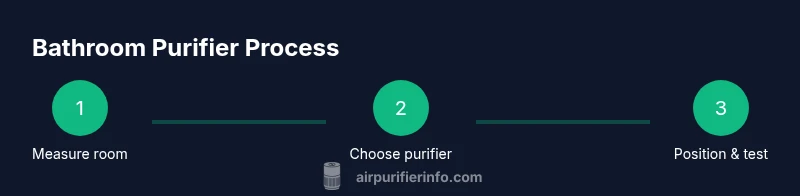
Measure the bathroom and define needs
Measure length, width, and height to calculate room volume. Use this to estimate the CADR you need for effective purification in a moisture-rich space. Consider typical activities (showers, baths) that raise humidity.
Tip: Write down room measurements and note any ventilation presence; this helps in model selection. - 2
Choose a bathroom-rated purifier
Select a model labeled for bathrooms or humid environments. Verify that the unit has a sealed housing and easily replaceable filters to withstand moisture.
Tip: Prefer units with IP ratings or coatings that resist humidity and wear. - 3
Position the purifier for airflow
Place the purifier within 3–6 feet of the shower or vented area but not directly in the water path. Ensure unobstructed air intake and outlet for optimal circulation.
Tip: Keep the unit away from walls that could block airflow and adjust placement after a few days based on odor and humidity cues. - 4
Install and test filtration
Install the proper filter as per the user manual and run the purifier on a medium setting for initial testing. Listen for unusual noises that may indicate misalignment or airflow blockage.
Tip: Mark the filter change date on the unit or a calendar to avoid overdue maintenance. - 5
Integrate with ventilation
If your bathroom has an exhaust fan, run both devices simultaneously for enhanced moisture control. The purifier works best when humidity is managed upstream.
Tip: Coordinate schedules so both devices operate during peak moisture periods. - 6
Establish a maintenance routine
Check and clean filters or replace them on a regular schedule. Use a damp-dry cloth to wipe nearby surfaces, keeping vents clear and free of dust buildup.
Tip: Set reminders to inspect filters monthly and replace according to manufacturer guidance.
Questions & Answers
Can I use a standard living-room air purifier in a bathroom?
A standard purifier can work, but choose one rated for bathrooms or moisture-prone areas to avoid corrosion and ensure humidity safeguards.
A standard purifier can help, but choose a bathroom-rated model to handle humidity and prevent damage.
What CADR rating do I need for a small bathroom?
For small bathrooms, look for a CADR that matches the room size. Higher CADR improves air turnover, but balance with noise and energy use.
For small baths, match CADR to room size for better air turnover without excess noise.
How often should I replace bathroom purifier filters?
Filter replacement frequency depends on usage and the filter type. Check the manufacturer’s recommended interval and inspect monthly.
Follow the maker’s interval and inspect monthly to catch clogs early.
Is it safe to run a purifier while showering?
Yes, as long as the purifier is away from water and has a sealed housing. Do not place it in direct water spray or moisture-prone zones.
Yes, but keep it away from direct spray and ensure it’s sealed.
Should I pair a purifier with an exhaust fan?
Pairing helps humidity management; the purifier complements ventilation by clearing particles that ventilation may miss.
Pair it with your exhaust fan for best results.
What maintenance steps are essential?
Regularly clean intake grills, replace or wash filters as recommended, and keep the area around the purifier free of dust.
Keep filters clean, replace when needed, and clean the area around it.
Watch Video
Main Points
- Choose a bathroom-rated purifier for durable moisture handling
- Size the unit to room volume using CADR guidelines
- Place with clear airflow and near moisture sources
- Maintain filters regularly to sustain performance
- Ventilation enhances purifier effectiveness