Air Purifier for Secondhand Smoke: A Home Guide with Tips
Discover how to choose and use an air purifier for secondhand smoke to cut exposure, reduce odors, and improve indoor air quality for a healthier home.


To reduce exposure to secondhand smoke indoors, choose an air purifier with a true HEPA filter and activated carbon. Place it in the room where smoke is most likely to gather, run it continuously, and follow filter-replacement guidance. This Air Purifier Info guide shows you how to size, place, and operate a purifier for best results.
Smoke and indoor air: why purifiers help
Smoke from cigarettes contains both tiny particles and odor-causing gases. When someone inside your home lights up, these pollutants can linger in furniture and fabrics. If you are searching for an air purifier for second hand smoke, choosing a model with both a true HEPA filter and activated carbon can make a meaningful difference. According to Air Purifier Info, effective smoke reduction starts with a purifier that has a true HEPA filter and activated carbon. The goal is to capture particles as small as PM2.5 and also adsorb odors and volatile organic compounds (VOCs). Place the purifier in the room where smoke is most likely to accumulate and run it continuously for best results. In this guide, you’ll learn how to size, place, and operate a purifier to improve indoor air quality while keeping noise and energy use reasonable.
How purifiers work for smoke particles and odors
Air purifiers target secondhand smoke through a combination of filtration and adsorption. A true HEPA filter captures fine particles from tobacco smoke, while activated carbon or a carbon-impregnated filter adsorbs odors and chemical vapors. Some models include a secondary stage, such as a pre-filter, to trap larger debris and extend the life of the main filters. When selecting a purifier, prioritize ozone-free designs to avoid introducing unintended pollutants. Regular maintenance is essential because clogged filters reduce effectiveness. From the perspective of Air Purifier Info, the most reliable smoke reduction comes from a purifier that pairs HEPA with carbon filtration and is designed for the room size you intend to cover.
Critical features for smoke removal
For smoke control, look for a purifier with a true HEPA filter and activated carbon. Ensure the device is AHAM-verified and rated for smoke-specific CADR, and confirm it is ozone-free. Consider energy efficiency and noise levels, especially for bedrooms and living rooms where constant operation might be necessary. Filter life matters too—longer-lasting filters reduce ongoing costs, but replace them as recommended by the manufacturer to maintain performance. When in doubt, prioritize models that explicitly advertise smoke or odor removal and have a dedicated Smoke CADR rating.
Room size, placement, and airflow patterns
Correct sizing matters: match the purifier’s capacity to the room size to achieve noticeable air-cleaning impact. Measure the room, then compare to the device’s recommended coverage. Place the purifier away from walls and obstructions to allow free airflow; a spot near the center of the room generally provides the best circulation. For bedrooms, a nightstand-friendly model with low noise can be ideal, while living rooms may benefit from a higher-capacity unit. If smoke sources are localized (e.g., a smoker’s chair), position the purifier so it can circulate air around that zone.
Maintenance, costs, and energy use
Expect to budget for replacement filters according to the purifier’s schedule. True HEPA and carbon filters differ in price and replacement cadence; heavier use or high smoke levels will shorten replacement intervals. Compare energy use across models—look for an ENERGY STAR rating or a model with auto or sleep modes that reduce fan speed during low-activity periods. Cleaning and vacuuming surrounding dust can also help maintain overall air quality, but avoid damp environments that could affect the purifier’s electronics. Regular checks ensure you maintain peak performance without surprises.
Real-world setups: practical configurations for smoke control
In a living room with moderate smoke exposure, a mid- to high-capacity purifier placed centrally can reduce the lingering odor on upholstery over time. In a bedroom with a smoker in the household, a compact unit rated for small-to-medium rooms near the bed can help minimize nighttime exposure without disturbing sleep with loud fan noise. For apartments or open-plan spaces, consider one or two purifiers to create “air-clean zones.” Remember, purifiers complement but do not replace ventilation, so combined strategies (opening windows when feasible and avoiding smoky activities indoors) will maximize results.
Tools & Materials
- Air purifier with true HEPA filter(Choose models with a dedicated smoke/PM2.5 CADR rating; ensure it’s appropriate for your room size.)
- Activated carbon or carbon-impregnated filter(Needed for odor and gas reduction; some purifiers include carbon in the main filter.)
- Measuring tape or room calculator(Estimate square footage to select a purifier with adequate coverage.)
- Power outlet and surge protection(Ensure stable power; avoid overloaded outlets and use a clean circuit.)
- Optional spare filters(Having replacements ready can minimize downtime when replacements are needed.)
Steps
Estimated time: 30-60 minutes
- 1
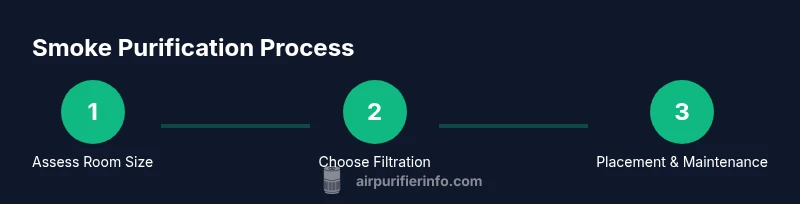
Assess room size and smoke sources
Measure the room’s length and width to calculate square footage, and identify where smoke concentration is highest. This helps you pick a purifier with adequate coverage and plan placement. Accurate sizing reduces the chance of under- or over-filtering.
Tip: Gather a floor plan or sketch quickly to visualize coverage before purchasing. - 2
Check CADR ratings and choose a model
Select a purifier with a dedicated smoke CADR rating and AHAM verification. Prioritize ozone-free units and models that balance filtration stages (HEPA + carbon) for best odor control.
Tip: Avoid devices marketed for ‘ionizing’ purification if you want to stay ozone-free. - 3
Place the purifier for optimal airflow
Position the unit away from walls by at least 1 foot (30 cm) and not behind furniture. Centered placement often yields the strongest room-wide air turnover.
Tip: If room layout forces a corner placement, angle the unit slightly to aid circulation. - 4
Power up and run at an appropriate speed
Turn on the purifier and start at a higher setting during initial use to accelerate cleaning, then reduce speed for continuous operation. In bedrooms, use a low-noise mode if available.
Tip: Run continuously for 24/7 fast-acting air cleaning, then adjust to comfort levels. - 5
Monitor filters and schedule replacements
Follow the manufacturer’s replacement schedule based on usage and air quality. Keep spare filters on hand to minimize downtime.
Tip: Label filters with replacement dates to stay on track. - 6
Reassess impact and adjust as needed
After a few weeks, reassess room air quality by smell and feel, and adjust placement or settings if odor persists. Consider additional purifiers for larger spaces.
Tip: Pair purifier use with better ventilation when possible for faster improvements.
Questions & Answers
Can an air purifier completely eliminate secondhand smoke in a room?
Most purifiers dramatically reduce smoke particles and odors, but complete elimination depends on ventilation, ongoing smoke sources, and room size. Regular use and proper maintenance improve outcomes.
Air purifiers greatly reduce smoke and odors, but they can’t guarantee complete elimination without ventilation and source control.
Should I use ozone generators or ionizers for smoke removal?
Ozone generators can irritate the lungs and are not recommended for homes with occupants, especially children and pets. Stick to HEPA plus activated carbon purifiers and avoid ozone-producing options.
Avoid ozone generators; they can irritate lungs. Use HEPA and carbon purifiers instead.
How do I know if my purifier is sized correctly for a room?
Check the manufacturer’s coverage area and match it to your room’s square footage. Also consider the smoke CADR rating and whether you’ll run it continuously for best results.
Match the purifier to room size and check the smoke CADR rating for best results.
How often should I replace filters in a smoke-heavy environment?
Replacement intervals vary by model and use. Follow the producer’s schedule and inspect filters monthly; in smoke-heavy rooms, plan for more frequent changes.
Follow the manufacturer’s schedule and inspect filters monthly, especially in smoky environments.
Can purifiers replace proper ventilation in a home with smokers?
No. Purifiers reduce pollutants, but proper ventilation and reducing indoor smoking are still essential for healthy air quality.
Purifiers help, but they can’t replace ventilation or stop all smoke sources.
Watch Video
Main Points
- Choose true HEPA + activated carbon for smoke control.
- Size the purifier to your room and place it for best airflow.
- Maintain filters on schedule to sustain performance.
- Purifiers help, but ventilation and source control remain important.