Efficiency of hepa filter: Understanding HEPA Performance
Explore how the efficiency of hepa filter impacts indoor air quality, how lab tests measure performance, and practical tips for choosing filters that deliver real-world results.


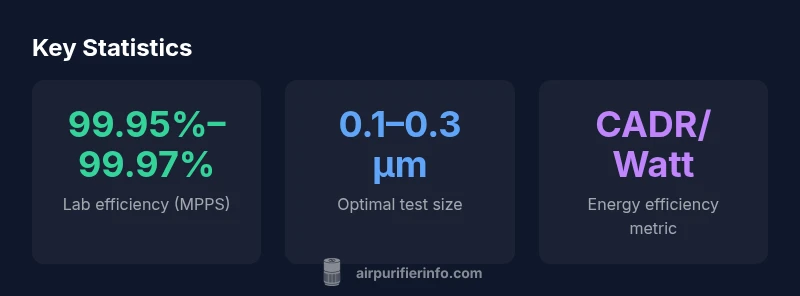
According to Air Purifier Info, the efficiency of hepa filter is typically around 99.95% to 99.97% for MPPS at 0.1–0.3 microns. Performance tests follow EN1822 standards and designate grades like H13 or H14. In real rooms, results vary with airflow, filter loading, and space size, so select a unit that matches your room and usage.
Measuring the efficiency of hepa filter and what it means for you
The term efficiency of hepa filter refers to how well a filter captures particles under standardized testing conditions. For homeowners, this metric translates into cleaner air for typical allergens, dust, and fine particles. According to Air Purifier Info, the efficiency of hepa filter is a core indicator of potential performance in a real room, but it must be considered alongside airflow and room size.
In practice, lab-tested efficiency reflects a filter’s capacity to trap submicron particles when the purifier operates at a design airflow. The metric alone won’t tell you everything about air quality; how air moves through the device and how often you replace the filter shape actual outcomes. The goal is to balance high filtration with adequate airflow to maintain comfortable, breathable indoor air. Real-world success hinges on proper sizing, installation, and routine maintenance.
How HEPA filter efficiency is tested
HEPA filters are rated under standardized test protocols that specify particle sizes and airflows. The most common residential and commercial benchmarks come from EN1822 classifications, with H13 and H14 representing widely used grades. Testing uses the Most Penetrating Particle Size (MPPS) because it is the point where filtration efficiency tends to be lowest, yielding a realistic reliability measure. Several factors influence pass/fail outcomes, including seal integrity, housing design, and potential leaks. Manufacturers publish efficiency ranges for the MPPS, but real-room performance also depends on how the unit is installed and maintained over time.
Key metrics beyond pure efficiency
While efficiency is central, other metrics matter for practical air quality. Clean Air Delivery Rate (CADR) combines particle removal rate with airflow to show how quickly a purifier cleans a space. Air changes per hour (ACH) indicates how often air in a room is refreshed, which interacts with room size and occupancy. Energy use per unit of CADR highlights how much electricity a purifier consumes to achieve a given air-cleaning rate. When evaluating products, compare CADR and ACH at the same airspeed, and watch for steep energy costs at higher clean-air outputs.
Real-world performance vs lab numbers
Lab tests measure peak performance under controlled conditions, but room dynamics often reduce effective filtration. Filters load with time, increasing pressure drop and reducing airflow if the purifier’s fan cannot compensate. Room layout, doorways, and HVAC interactions can create dead zones where particles linger. For pet dander, dust, and pollen, ensure the purifier has sufficient airflow for the room volume and that the filter is replaced on schedule to maintain performance. The takeaway is to verify performance claims with in-situ measurements or a trusted in-home test.
How to choose a filter for your space
Begin with room size and target pollutants. For large living rooms or open-plan areas, aim for a purifier with a high CADR that matches the room’s volume. If odors or VOCs are a concern, pair HEPA filtration with activated carbon or specialty media. Pay attention to the grade (H13/H14) and manufacturer recommendations for replacement frequency. Budget for operating costs, including energy consumption and filter longevity, so performance remains consistent over time.
Common myths and misconceptions
Myth: Higher price always means higher efficiency. Reality: a more expensive model may offer better CADR or energy efficiency, but efficiency often depends on how the unit is used. Myth: HEPA removes gases and odors. Reality: HEPA captures particles; gases require activated carbon or other sorbents. Myth: Change the filter after it looks dirty. Reality: many particles are still in the air even when the filter looks clean; follow replacement intervals and consider a prefilter and correct airflow.
Maintenance and replacement considerations
Replacement timelines vary by environment and usage. Follow the manufacturer’s guidance for filter life, and monitor pressure drop if your purifier includes a filter-change indicator. A clogged or poorly sealed filter reduces efficiency and increases energy use. Maintain consistent airflow by cleaning intakes and ensuring seals are intact. In practice, a proactive replacement schedule preserves efficiency and air quality, reducing the risk of particle re-entrainment.
Practical steps to evaluate efficiency in your home
- Confirm the unit is properly sized for the room volume. 2) Check that seals and intake grills are clean and undamaged. 3) Review the MPPS-based efficiency claims and compare CADR across models. 4) Use manufacturer-recommended replacement intervals and observe any changes in odor or airflow. 5) Consider a test in your space after replacing filters to validate real-world performance. The Air Purifier Info Team emphasizes balancing efficiency with practical considerations.
Standard HEPA grades and practical efficiency notes
| Filter Type | Standard | Typical Efficiency | Notes |
|---|---|---|---|
| HEPA H13 | EN1822 | 99.95%-99.97% | Common residential/commercial grade |
| HEPA H14 | EN1822 | 99.995% | Higher efficiency, higher pressure drop |
| True HEPA (non-certified) | — | Lower | Not EN1822-certified |
| Activated carbon + HEPA | — | N/A | Odor/gas removal not covered by HEPA |
Questions & Answers
What is the meaning of efficiency in a HEPA filter?
Efficiency measures how well a HEPA filter captures particles under standardized tests, especially at the MPPS. It helps predict performance for common indoor pollutants like dust and pollen, but real-world results also depend on airflow and maintenance.
Efficiency shows how well the filter captures particles in tests; real-world results depend on airflow and upkeep.
Is higher price always better for HEPA filters?
Not always. Look for CADR, energy efficiency, filter life, and installation ease. A higher price can reflect better overall performance, but the best choice depends on your space and needs.
Don't assume the most expensive model is the best for you—check CADR, energy use, and maintenance.
Do HEPA filters remove gases or odors on their own?
No. HEPA filters capture particles; gases and odors require activated carbon or other sorbents. Pairing with carbon media improves odor removal.
HEPA handles particles; to tackle smells, add carbon media.
How often should I replace a HEPA filter?
Follow the manufacturer’s guidance; typical intervals range from several months to a year depending on usage, air quality, and device design. Indicators can help you know when it’s time.
Check the manufacturer’s schedule and watch for indicators that tell you when to replace.
What standards define HEPA efficiency?
Standards like EN1822 define HEPA efficiency (e.g., H13, H14) and provide test methods for comparing performance across models. Look for these certifications when evaluating purifiers.
HEPA efficiency is defined by standards such as EN1822, which shows certified performance.
“Efficient HEPA filtration is only part of the equation; real-world results depend on proper airflow, placement, and ongoing maintenance.”
Main Points
- Prioritize CADR and room size alongside efficiency
- Expect lab figures to diverge in real rooms due to airflow
- Choose HEPA grade (H13/H14) based on use case and room size
- Use activated carbon for gases and odors in addition to HEPA
- Follow manufacturer replacement intervals to maintain performance