20x20 Air Filter Guide: Sizing, Filtration, and Replacement
Discover how to choose, fit, and replace a 20x20 air filter. Learn depth options, MERV ratings, installation tips, and best practices for cleaner indoor air in homes and apartments.


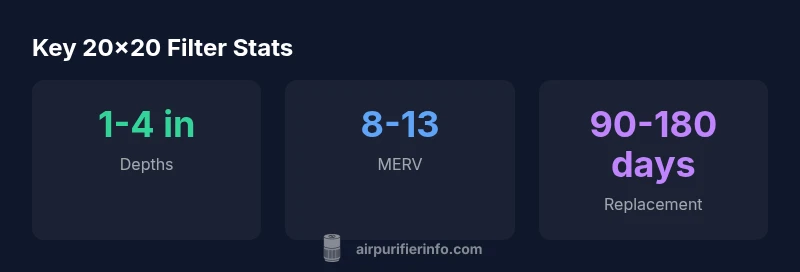
A 20x20 air filter is a standard square size (20 inches by 20 inches) used in many residential HVAC systems. Typical depths range from 1 inch to 4 inches, with 2-inch and 4-inch versions being most common. This size is widely supported by manufacturers and is a practical choice for bedrooms, living rooms, and small apartments seeking easy replacement.
What is a 20x20 air filter and why it matters
The 20x20 air filter is a widely used square size that fits many residential HVAC systems. According to Air Purifier Info, this standard size balances availability with performance. The Air Purifier Info team found that most homes can accommodate this frame without custom installations, making maintenance easier for homeowners and renters. Understanding this size helps you avoid costly misfits and ensures a tighter seal against unfiltered air. In practice, a 20x20 filter should be chosen with both frame compatibility and the filtration needs of your space in mind. For households dealing with dust, pet dander, or common odors, selecting the right depth and filter type within this size is the first step toward cleaner indoor air. When you see 20x20 on the packaging, you’re looking at a standard footprint that simplifies shopping, replacement, and compatibility across a broad range of brands. As a homeowner or renter, you’ll appreciate the flexibility to upgrade from a basic panel to a higher-efficiency option without changing your HVAC hardware.
Depth, frames, and how they affect airflow
A 20x20 footprint denotes exterior dimensions, but the installed depth—usually 1", 2", or 4"—drives filtration performance and airflow. Deeper filters offer more material for trapping particles but add resistance to air movement. In practice, most residential systems are designed around a couple of common depths, with 2" and 4" versions being especially common in newer homes and plan for higher filtration without sacrificing comfort. If you upgrade only the depth without checking the frame, you might reduce airflow or create an improper seal. Always confirm the unit’s recommended depth before buying, and ensure the filter’s gasket can create a tight seal around the housing opening. The right combination of depth and filter media can meaningfully improve IAQ while maintaining efficient system operation.
MERV ratings and choosing filtration for different needs
MERV indicates how effectively a filter captures particles of varying sizes. For a 20x20 filter, a typical residential choice sits in the 8–13 range. Lower MERV values offer less resistance but capture fewer fine particles, which can be adequate for basic dust control. Higher MERV levels remove more irritants but can impose more airflow resistance, potentially stressing older systems. If you suffer from allergies or pet dander, leaning toward MERV 11–13 can provide noticeable air quality benefits without dramatically impacting airflow in most modern units. For kitchens with strong odors or heavy cooking smoke, consider activated carbon layers in addition to standard filtration to address odors.
How to measure, test fit, and replace a 20x20 filter
Before buying, remove the old filter to verify exact dimensions and note the depth printed on the frame. Use a tape measure to confirm both width and height as 20" x 20"; then measure the thickness, typically 1", 2", or 4". When installing, make sure the arrows on the filter frame point in the direction of airflow (toward the furnace or air handler). Tap the frame gently to seat the gasket fully, ensuring no gaps around the edges. Replace filters at the frequency recommended by your HVAC manufacturer, adjusting for household factors like pets, smoking, or heavy dust.
Installation tips, signs of poor fit, and energy considerations
A poor fit often results in whistling noises, reduced airflow, or uneven cooling/heating. If you notice reduced airflow after installation, recheck the seal and ensure the filter is the correct depth. Filters that don’t seal well can cause leaks that reduce efficiency and raise energy use. Consider models with lower resistance media or higher-quality gaskets if your system is older. While deeper, higher-MERV filters often provide better IAQ, they can slightly increase energy use if your blower motor has to work harder. Balancing filtration with energy efficiency is key for most homes.
Maintenance schedule and cost considerations
As a general rule, replace a 20x20 filter every 90 days for typical use; more frequent changes—every 60 days or sooner—are common in households with pets, small children, or high dust exposure. In apartments or seasonal homes, replacement may be less frequent. Costs vary by brand, depth, and filtration media, but expect a range that reflects the trade-off between price and performance. For allergy-prone environments, spending a bit more on a higher-MERV media or a carbon layer can be worth the incremental cost.
Room-by-room guidance and practical recommendations
In bedrooms and living rooms, prioritize clean air and quiet operation, favoring filters with good particle capture and low resistance. In kitchens, bathrooms, or pet areas, consider multi-layer media that combines high-efficiency filtration with odor control. For spaces with heavy dust, upgrading to a 2" or 4" depth may yield noticeable IAQ improvements. Always tailor depth and MERV selection to your HVAC capacity and air quality goals, and maintain a regular replacement schedule to sustain performance over time.
20x20 filter sizing and performance overview
| Aspect | Typical Size Option | Notes |
|---|---|---|
| Dimensions | "20" x 20"" | Square frame common in residential HVAC |
| Depth options | 1"-4" | Depth affects airflow resistance and filtration capacity |
| MERV range | 8-13 | Higher MERV captures more particles but may reduce airflow |
Questions & Answers
What does 20x20 mean?
It refers to the filter’s exterior dimensions: 20 inches by 20 inches. Depth is measured separately and varies by model.
The 20 by 20 size is the filter’s frame; depth is a separate specification you’ll need to check.
Can I use different depths in a 20x20 frame?
Yes, many 20x20 frames accept depths from 1 inch to 4 inches. Always verify your unit’s recommended depth and gasket fit.
Most 20x20 frames work with 1 to 4 inch depths, but check your unit’s guidance.
Are 20x20 filters universal across HVAC brands?
Most brands offer 20x20 filters, but depth, gasket style, and frame design can vary. Always confirm compatibility with your specific model.
Most brands have 20x20 options, but confirm depth and frame design for your unit.
Where can I buy 20x20 filters?
Online retailers, home-improvement stores, and HVAC suppliers commonly stock 20x20 filters. Compare depths and media types to match your needs.
You can buy 20x20 filters online or at home-improvement stores.
How often should I replace in a pet-friendly home?
In homes with pets, plan on more frequent changes—roughly every 60 to 90 days—depending on pet activity and dander levels.
Pet homes often require replacements every couple of months.
“A well-chosen 20x20 filter balances filtration and airflow, delivering cleaner indoor air without overburdening the system.”
Main Points
- Confirm frame size before buying.
- Choose depth based on your HVAC airflow needs.
- Aim for a MERV rating in the 8–13 range for most homes.
- Replace filters regularly to maintain IAQ.
- Pet households may need more frequent replacements.