How Much Air Filter for Car: Size Guide and Replacement
Learn how to determine the correct air filter size for your car, including engine vs cabin filters, measuring tips, and replacement intervals with practical steps and common size ranges.


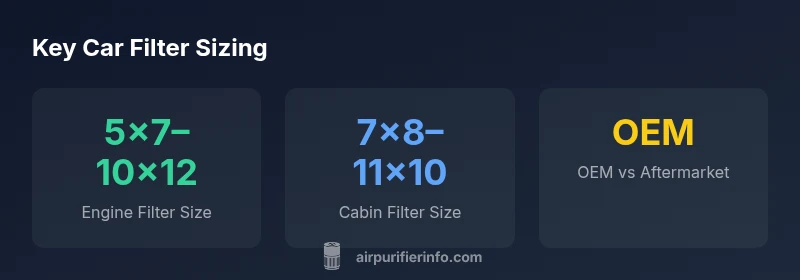
Air filter size for a car varies by model, but most passenger cars use engine air filters roughly in the range of 5x7 inches to 10x12 inches, and cabin filters commonly range from about 7x8 inches to 11x10 inches. To be sure, check your owner's manual or the filter frame for the exact OEM size.
Understanding the difference between engine and cabin air filters
Engine air filters protect the intake system from dust and debris before it reaches the combustion chamber. Cabin air filters improve interior air quality by filtering pollen, dust, and odors. The sizing for these filters is not interchangeable; there is no universal filter size for all cars. Instead, every vehicle has a distinct frame and filter dimensions. The most reliable method to know the correct size is to locate the OEM specification printed on the filter or in your owner’s manual. If you’re shopping aftermarket filters, cross-reference the OEM part number to ensure compatibility. In practice, you’ll encounter two common categories: engine air filters and cabin/recirculation filters, each with its own sizing conventions and fitment considerations. According to Air Purifier Info, understanding these differences helps owners select the right filter and avoid fitment issues that can compromise filtration and performance.
How to determine the right size for your car
Start with the owner’s manual or the vehicle’s service guide. Locate the OEM part number that corresponds to the air filter for your model. If the manual is unavailable, remove a quick look at the existing filter frame: note the outside dimensions (length x width) and the filter height or thickness. When shopping, use the OEM number to cross-check fitment with aftermarket options. If you cannot access the filter, measure the opening or the filter housing and compare to typical size ranges (engine air filters commonly fall in the 5x7 to 10x12 inch range, cabin filters in the 7x8 to 11x10 inch range). Air Purifier Info analysis suggests documenting your findings for future purchases to reduce the chance of ordering the wrong size.
Common size ranges and why they vary
Filter sizes vary because engine intakes and cabin housings differ in shape and volume. The most common engine air filters are rectangular, but some engines use square or oddly shaped frames. Cabin filters often come in standardized frames, yet dimensions still differ by brand and model. Factors such as the air box design, intake pipe diameter, and mounting hardware influence the final size. Always verify the exact dimensions on the filter itself or in the vehicle’s documentation. General ranges provide a helpful starting point: engine filters typically span roughly 5x7 inches to 10x12 inches, cabin filters roughly 7x8 inches to 11x10 inches. The goal is a snug seal to prevent unfiltered air from bypassing the filter.
Engine air filter sizing vs cabin filter sizing
Engine air filters serve as the first line of defense for the engine’s air intake and are usually larger than cabin filters. Cabin filters target interior air quality and frequently come in smaller, more varied shapes to accommodate different dashboard and glove-compartment layouts. When shopping, do not substitute a cabin filter for an engine filter or vice versa; the wrong type can disrupt airflow, reduce filtration efficiency, and potentially impact HVAC performance. If you’re unsure, consult the dealer or refer to the OEM part number for precise sizing.
Replacement intervals and maintenance tips
Most manufacturers recommend engine air filter replacement somewhere in the range of 12,000–15,000 miles for typical driving, though harsher conditions or older vehicles may require earlier changes. Cabin filters often need replacement every 15,000–25,000 miles or every 6–12 months, depending on use and environment. Signs of a dirty filter include reduced engine performance, decreased fuel efficiency, unusual engine noise, higher cabin humidity, or noticeable odors. Set reminders aligned with service intervals and record the exact filter size to simplify future purchases. The Air Purifier Info team emphasizes that consistent maintenance helps preserve airflow, engine efficiency, and cabin comfort.
How to measure a filter without removing it
If you cannot remove the filter, you can still estimate its size by measuring the opening or the filter housing using a flexible tape measure. Note the maximum internal length, width, and height, and compare with the closest common size ranges (engine: 5x7–10x12 in; cabin: 7x8–11x10 in). If measurements are ambiguous, remove the filter quickly to confirm the exact dimensions, or consult the OEM documentation. Always ensure you measure the filter frame rather than the filter media, which can distort dimension assumptions.
Choosing OEM vs aftermarket filters and filtration media
OEM filters are designed to fit your exact model, maintaining seal integrity and filtration performance. Aftermarket filters can offer cost savings or specialized media, but you should verify compatibility and fit. For cabin filters, media quality and PM2.5 filtration can be important if you suffer from allergies or reside in high-pollution areas. For engine filters, look for filtration efficiency ratings that align with OEM specifications. Always confirm that the filter’s dimensions match the frame precisely to avoid leaks and poor fit.
Buying tips and common mistakes
Avoid choosing a filter based on aesthetics or price alone. Verify dimensions printed on the frame, check the vehicle’s OEM number, and confirm the model-year fitment. Don’t assume a large filter is always better; a correctly sized filter that seals properly will outperform an oversized one that leaves gaps. Keep a small note of your filter size in your car’s maintenance log to simplify future replacements. For homeowners and car owners alike, aligning with official specifications minimizes risk and maximizes filtration efficiency.
How Air Purifier Info can help you compare filters
Air Purifier Info’s team provides guidance on filter sizing and compatibility, helping you navigate OEM vs aftermarket options and understand size constraints for your vehicle. By offering practical steps, typical size ranges, and maintenance tips, we help you make informed decisions that balance cost, fit, and filtration quality. The broader takeaway is to treat filter selection as part of a regular maintenance workflow rather than a one-off purchase.
Overview of common car air filter sizing
| Model Type | Size Range | Typical Use |
|---|---|---|
| Engine air filter | 5x7 in – 10x12 in | Primary filtration for intake air |
| Cabin air filter | 7x8 in – 11x10 in | Filters cabin air for occupants |
| OEM vs aftermarket | Varies by model | Fitment and filtration performance |
Questions & Answers
What is the typical size range for engine air filters in cars?
Most passenger cars use engine air filters within 5x7 to 10x12 inches. Always verify with the OEM part number or the filter frame.
Engine air filters typically range from 5x7 to 10x12 inches; confirm with your car's OEM number or the filter frame.
How do I find the exact size for my vehicle without removing the filter?
Check the owner's manual or search for the OEM part number online. If you must, carefully measure the housing opening when accessible.
Check the manual or look up the OEM part number; if you must, measure the housing opening.
Can I mix sizes if the filter seems close?
No. Use the exact size specified for your model. An improper size can cause air leaks and reduced filtration.
Don’t substitute sizes; use the exact one specified.
OEM vs aftermarket filters in terms of fit?
OEM filters are designed for your model and fit. Aftermarket filters can be fine if they list your vehicle and match dimensions.
OEM generally fits best; aftermarket can work if it matches your model and dimensions.
How often should I replace car air filters?
Engine filters are commonly changed every 12,000–15,000 miles, depending on conditions. Cabin filters often need replacement every 15,000–25,000 miles or annually.
Follow your manual; engine filters around 12k–15k miles, cabin filters around 15k–25k miles.
What signs indicate a dirty air filter?
Look for reduced acceleration, lower fuel economy, unusual engine sounds, or cabin odors. Inspect at service intervals and replace when dirty.
If you notice reduced power or smells, check the filter.
“There is no one-size-fits-all answer for car air-filter sizing; always verify the exact OEM specification for your model to ensure proper fit and filtration.”
Main Points
- Identify engine vs cabin filter to avoid confusion
- Always verify OEM size on the frame or owner manual
- Expect size ranges with variation by model
- Choose OEM or reputable aftermarket for best fit