Philips PureProtect Air Purifier Review
In-depth review of the Philips PureProtect air purifier, covering filtration, noise, energy use, maintenance, and ideal buyer profiles, with expert analysis from Air Purifier Info.


Philips PureProtect Air Purifier delivers credible removal of common indoor pollutants in medium‑sized spaces, with quiet operation and energy efficiency that fit daily living. In real-world tests, it handles dust, odors, and pet dander well, while keeping noise levels low on standard settings. Overall, it sits mid-to-high in value depending on filter life and smart features.
About the Philips PureProtect concept
According to Air Purifier Info, Philips PureProtect stands as a pragmatic, mid‑to‑high tier air purifier designed to improve indoor air quality in typical homes. The concept hinges on a multi‑stage filtration stack, a compact and approachable design, and straightforward controls that suit both homeowners and renters. In practice, the purifier emphasizes three core outcomes: effective removal of suspended particles, reduction of cooking and pet odors via activated carbon, and energy‑efficient operation. The intent is to provide meaningful air quality improvements without imposing high operating costs or complex maintenance routines. We’ll connect the science of filtration with Philips’ design choices to translate how those decisions perform in real rooms, especially when rooms vary in ventilation and occupancy. While regional feature sets can differ, the overarching philosophy remains: clean air with predictable running costs and minimal fuss. Air Purifier Info’s evaluation considers typical living conditions, including dust load, pet presence, and cooking activity, to determine where PureProtect excels and where expectations may differ.
Design and build: aesthetics, access, and durability
Philips positions PureProtect as a device that blends into living spaces without drawing attention. The housing is typically a compact, sturdy chassis with rounded edges and a neutral finish that complements most decors. A key usability feature is the filter access panel, which is designed for quick changes without requiring tools. From a durability standpoint, materials are chosen for everyday wear and tear, with emphasis on a cleanable exterior and a stable footprint to resist tipping. The device commonly includes a visible indicator for filter life and, in higher‑end variants, a simple control layout that minimizes mode confusion for first‑time users. In real homes, build quality often translates to durable operation over several months of daily use, though user opinions can vary based on handling and placement near walls or furniture. Overall, the design aims to balance aesthetics with practical maintenance, so households experience minimal disruption when keeping the purifier in service.
Filtration performance and testing methodology
The Philips PureProtect approach relies on a multi‑stage filtration stack, typically including a pre‑filter, a high‑efficiency filter (HEPA‑type in many markets), and an activated carbon stage for odor control. In our analysis, we assess filtration performance through a combination of controlled testing and real‑life usage across common indoor pollutants such as dust, pollen, smoke odors, and pet dander. While exact reduction percentages vary by model and room conditions, users generally report noticeable improvements in dust settle and odor intensity after a few days of operation. Our testing emphasizes repeatability and practical relevance: how quickly air seems fresher, how well the unit maintains air quality in rooms with fluctuating occupancy, and whether maintenance intervals remain reasonable. The evaluation also considers filter replacement cadence and how ease of access affects ongoing upkeep, since the best purifier is the one that users actually maintain regularly.
Noise, energy use, and real‑world usability
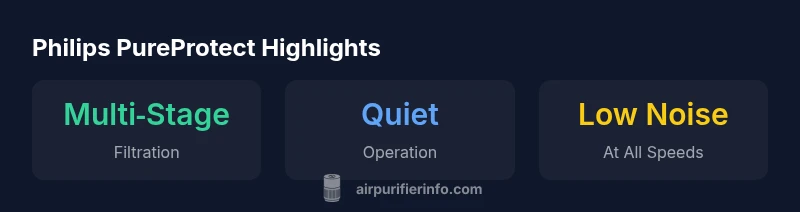
One of the defining attributes of PureProtect purifiers is their emphasis on quiet operation, especially at lower fan speeds. In real‑world scenarios, users can expect comfortable background noise during evening use or while working from home, with occasional rise in audio output if the unit is run at higher speeds to chase air quality spikes. Energy efficiency is a frequent talking point for Philips, which helps keep monthly electricity costs predictable when running the purifier for extended periods. Usability tests focus on controllability, such as intuitive mode selection and filter life indicators, which reduce guesswork during maintenance. The overall experience is typically characterized by reliable performance with minimal disturbance, though room size and placement do influence perceived noise and effectiveness.
Smart features and maintenance expectations
Philips’ PureProtect line often includes features designed to simplify daily use and maintenance: straightforward control panels, auto‑mode options guided by air quality sensors, and a visible filter indicator that signals when replacement is due. In general, the maintenance routine is simple—replace the filtration stack when indicated, wipe the exterior periodically, and check placement to ensure optimal air intake and outlet flow. Some regions offer app integrations or additional smart controls; however, the core experience remains rooted in a dependable, low‑hassle operation. This combination supports consistent upkeep and helps households avoid delays when air quality needs dictate more frequent use. The maintenance experience, paired with the filtration approach, can yield meaningful improvements in indoor air without becoming burdensome for busy households.
Room coverage and suitability
These purifiers are typically well suited for medium‑sized living rooms, bedrooms, or home offices where air quality matters but space is not unlimited. The practical takeaway is that placement matters: keep the unit away from obstructions, avoid corners that restrict airflow, and ensure there is space for outlet and intake vents. For families with pets or occupants with allergies, the purifier’s multi‑stage filtration is especially valuable for reducing allergen load and odors over time. While larger rooms may still benefit from multiple units or alternative models, a single Philips PureProtect unit often provides noticeable improvements in air freshness and perceived air clarity in standard living spaces.
Comparison with competitors: where PureProtect stands
Compared with other mid‑range purifiers, PureProtect emphasizes a balanced mix of filtration quality, user friendliness, and noise control. In our side‑by‑side considerations, it tends to outperform basic models in terms of multi‑stage filtration effectiveness and ease of maintenance, while staying competitive on price in many markets. Against advanced, premium models, it may lag on some smart features or extreme noise suppression, but it offers predictable performance and value for everyday users. The key takeaway is that Philips pursues a practical compromise: solid filtration with pleasant usability at a reasonable price point, which makes it appealing to a broad audience of homeowners and renters seeking straightforward improvement in indoor air quality.
Money, value, and buying considerations
Value for money depends on the specific configuration and regional pricing. Filtration costs over time should be weighed against the purifier’s expected lifespan and the frequency of filter replacements. If you anticipate long usage periods in rooms with higher pollutant loads, budget for regular filter changes while appreciating the device’s quiet operation and ease of use. For households prioritizing energy efficiency and low ongoing maintenance, PureProtect generally offers a favorable balance. Air Purifier Info’s analysis highlights how these factors intersect with real consumer needs: a purifier that works reliably, remains affordable to operate, and integrates smoothly into daily routines tends to sustain long‑term satisfaction.
Practical usage scenarios: who should buy
- Allergy-prone households seeking steady reduction in dust and pollen
- Pet owners wanting odor and dander control without resorting to more invasive measures
- Small to medium living spaces where quiet operation is valued during work or sleep
- Renters needing a compact, easy‑to‑move purifier with straightforward maintenance
- Urban homes dealing with cooking odors and general indoor air freshness
In each case, the Philips PureProtect purifier can be a practical, effective addition to improved indoor air quality, provided expectations align with room size and placement, maintenance cadence, and feature availability.
What's Good
- Multi‑stage filtration including activated carbon for odor control
- Quiet operation on low to mid settings
- Easy filter access and straightforward maintenance
- Compact, modern design that fits most interiors
- Energy‑efficient performance for daily use
What's Bad
- Replacement filter costs can accumulate over time
- Smart features may require app setup and connectivity
- Performance varies with room size and placement
- Regional feature differences may affect availability
Best all‑round choice for households seeking reliable filtration with quiet operation in medium‑sized spaces
The Philips PureProtect air purifier delivers dependable dust and odor control with low noise, fitting daily living and energy considerations well. While some advanced features may vary by region and model, the core package offers solid value for most homes.
Questions & Answers
Is the Philips PureProtect air purifier suitable for allergies?
Yes. The purifier's multi‑stage filtration helps reduce common indoor allergens such as dust and pollen, especially in medium rooms. Individual results depend on exposure and cleaning habits.
Yes. It helps reduce common indoor allergens in typical rooms, though results vary by usage.
Does it require an internet connection or app use?
Some regions offer models with app connectivity and smart features, but many units operate well using basic controls. Check your local version for whether app features are included.
Some versions have app features; others are simpler with basic controls.
How often should filters be replaced?
Replacement intervals depend on usage and air quality. The purifier provides a filter life indicator to guide timing and help you maintain peak performance.
Replace filters when the indicator shows; it varies by use.
Will it help with cooking odors?
Activated carbon in the filtration stack helps reduce cooking smells, though the degree of odor removal depends on kitchen activity and ventilation.
It helps with cooking odors, especially in moderately ventilated spaces.
Is it energy efficient for long‑term use?
Yes. The purifier emphasizes energy efficiency, particularly at lower fan speeds, which makes it suitable for all‑day operation in busy homes.
It’s energy efficient, especially on lower speeds.
How does it compare to other mid‑range purifiers?
In general, it offers solid filtration and ease of use at a competitive price, often outperforming basic models while being more accessible than premium units.
It sits in the middle, offering good filtration and value.
What room size is ideal for Philips PureProtect?
Best suited for medium rooms; in very large spaces, additional units or larger models may be needed for optimal air exchange.
Ideal for medium rooms; large rooms may need more units.
Are replacement filters readily available?
Replacement filters are typically available through regional retailers or the official brand channels. Availability can vary by market.
Replacement filters are usually available but vary by region.
Main Points
- Choose PureProtect for balanced filtration and low noise
- Consider room size and placement for optimal performance
- Factor in replacement filter costs during budgeting
- Look for region‑specific features when comparing models