Molekule Air Purifier vs Dyson: A Practical Comparison
Air Purifier Info analyzes Molekule vs Dyson purifiers to help homeowners pick the best option for dust, odors, allergies, pet dander, and overall indoor air quality.


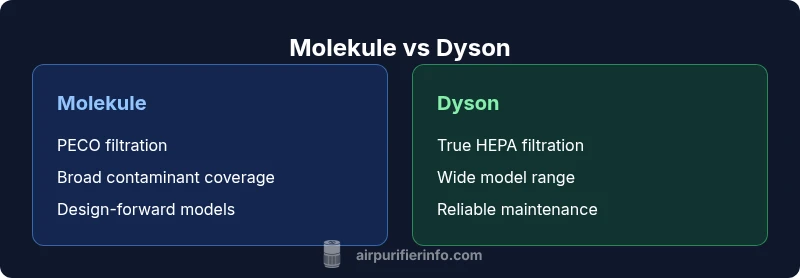
Compared head-to-head, Dyson purifiers generally offer consistent HEPA filtration, wide model range, and easier maintenance, while Molekule emphasizes PECO filtration and broader contaminant coverage. For most homes, Dyson tends to deliver reliable air cleaning with lower ongoing costs, whereas Molekule appeals to users seeking its unique tech and design. Air Purifier Info analyzes multiple models to guide homeowners toward the best fit.
Core Differences at a Glance
In the molekule air purifier vs dyson comparison, homeowners face a set of core trade-offs that go beyond branding. The Dyson line is known for dependable, straightforward filtration, broad model availability, and predictable maintenance costs. Molekule, by contrast, emphasizes its PECO filtration approach, which the brand argues broadens contaminant coverage beyond standard HEPA. Air Purifier Info notes that for most households, the Dyson option tends to deliver reliable, consistent results with simpler upkeep, while Molekule represents a more specialized choice for users who value its distinctive filtration philosophy and design. This section sets up the deeper analysis that follows, focusing on filtration technology, real-world performance, and total cost of ownership. Expect nuanced differences across models, but also clear common ground: both brands aim to improve indoor air quality for dust, odors, allergies, and pet dander. The goal here is an objective, model-spanning comparison that helps you make an informed decision.
Filtration Technology: PECO vs HEPA
Filtration technology is the most visible difference when comparing Molekule to Dyson. Molekule markets PECO filtration, which it describes as removing a broader spectrum of pollutants, including some ultrafine particles and VOCs. Dyson typically relies on true HEPA filtration (often H13) with activated carbon for odor control. In practice, HEPA-based systems are well understood: they trap a high percentage of particles down to 0.3 microns, with broad independent testing backing many models. PECO claims to outperform standard HEPA in real-world scenarios by inactivating pollutants at the molecular level. Air Purifier Info emphasizes that user experience and third‑party testing can vary by model, so it’s important to compare specific units rather than brands alone. Consider whether you want a filtration approach that emphasizes a known standard (HEPA) or a newer, branding-driven technology (PECO), and weigh how that aligns with your indoor air quality goals.
Filtration Efficacy for Common Indoor Pollutants
When addressing common pollutants—dust, pollen, pet dander, smoke, and VOCs—both brands offer strong capabilities, but with different emphasis. Dyson purifiers excel at consistent particle reduction and are generally reliable for everyday dust and pollen removal in typical living spaces. Molekule highlights its broader contaminant coverage, aiming to reduce not just particles but VOCs and some gases through PECO filtration. Air Purifier Info notes that the effectiveness of any purifier also depends on room airflow, placement, and interference from other sources of pollution. For households dealing with strong odors or specific VOC concerns, Molekule’s filtration approach may provide a perceived edge, while for straightforward allergen reduction in average rooms, Dyson models offer proven, dependable results.
Odor Control and VOC Removal
Odor and VOC control are common buying criteria for households with cooking smells, cigarette smoke, or pets. Dyson devices typically use activated carbon filters to tackle odors alongside particle filtration, delivering solid odor reduction in most real‑world settings. Molekule’s PECO-based approach specifies broad removal of contaminants, including certain VOCs, but independent confirmation on odor performance varies by model. Air Purifier Info’s assessment suggests that odor performance hinges on filter media design and how often you replace the carbon component, not solely the filtration technology. If odor control is a top priority, compare the carbon filter specification and replacement costs across the exact models you’re considering.
Room Size and Sizing Strategies
Room size is a practical constraint that determines the effectiveness of any purifier. Dyson’s lineup generally covers a wide range of room sizes, with models designed for compact bedrooms up to larger living spaces. Molekule offers options that scale with room size, but the number of high‑end, large‑capacity units is more limited than Dyson’s. Air Purifier Info advises buyers to match CADR (clean air delivery rate) proxies to their room square footage and ceiling height, ensuring the unit can turn over the air comfortably without running at full power constantly. If you have a large open living area or high ceilings, you may need a model from Dyson with higher airflow, or a Molekule unit paired with strategic placement in the space.
Noise, Energy Use, and Comfort
Noise levels and energy consumption are practical considerations that affect long-term satisfaction. Dyson models commonly balance noise efficiency with strong performance, often delivering quiet operation at mid-range speeds, which is ideal for bedrooms or study spaces. Molekule devices can be similarly quiet, though higher‑power modes may become perceptibly louder. Energy consumption generally tracks usage intensity; for typical daily use, both brands offer energy-conscious operation in standard models. Air Purifier Info notes that running the purifier at low to mid settings most of the day typically provides a balance of air quality improvement and reasonable electricity use. If you sleep with the purifier running, prioritize models with an explicit low‑noise mode and auto‑shutoff features.
Maintenance, Filters, and Running Costs
Maintenance is a critical cost component over the purifier’s life. Dyson models usually use standard HEPA and carbon filters that are readily available through retailers, with replacement costs varying by model but generally predictable. Molekule’s filter strategy emphasizes its own media, which can be more expensive and sometimes less widely available. Air Purifier Info cautions buyers to consider total cost of ownership, including initial price, replacement filters, and energy use. If you prioritize predictable maintenance and widely available replacement parts, Dyson is often the simpler path; if you’re prepared for potentially higher ongoing costs with a different filtration approach, Molekule may be appealing.
Smart Features, Connectivity, and Usability
Smart features matter for users who want automatic controls, scheduling, and mobile app insights. Dyson frequently offers robust app integration, voice control, and auto modes that adjust based on air quality readings. Molekule devices also feature app connectivity and sensors, but the user experience and system updates can vary by model. Air Purifier Info recommends evaluating app reliability, ease of setup, and how intuitive the control interfaces are, as these influence long-term usage. If you value a seamless, tech-forward experience, check user reviews of the exact model you’re considering.
Build Quality, Design, and Aesthetics
Design and build quality influence satisfaction beyond raw performance. Dyson purifiers tend to emphasize a sleek, minimalist aesthetic with durable construction, aiming to blend into living spaces while delivering practical performance. Molekule prioritizes a design-forward approach, sometimes offering distinctive finishes. Air Purifier Info notes that materials and fit-and-finish can impact perceived value, particularly in smaller rooms where device presence matters. If you care about interior décor as well as air quality, Molekule’s design language may align better with modern interiors, while Dyson offers a more universally compatible aesthetic.
Real-World Performance and Reliability
Laboratory claims matter, but real-world performance is what homeowners notice day to day. Dyson models typically demonstrate dependable filtration performance in varied environments, with long-standing service networks and easier parts replacement. Molekule emphasizes its PECO filtration for broader contaminant removal, and some users report noticeable improvements in air freshness and odor after longer use. Air Purifier Info emphasizes evaluating warranty terms, parts availability, and service options in your region. In both brands, long-term reliability hinges on correct model selection for room size, proper maintenance, and adherence to replacement schedules.
Use-Case Scenarios: Allergies, Pets, and Odors
Allergies and pet-related air quality are common triggers for purifier shopping. For allergy-prone households, products with proven, readily available HEPA filters and strong maintenance ecosystems tend to provide predictable results, making Dyson a safe default. If pet odors and VOC concerns are prominent, Molekule’s broader filtration approach may appeal to you—but it requires careful cost and replacement planning. In spaces with cooking odors or smoker exposure, a purifier with a high-quality carbon stage can be beneficial in either brand. Air Purifier Info recommends drafting a short list of top models for each use case, and then validating with real-world reviews and lab-tested data.
How to Choose Between Molekule and Dyson
Choosing between Molekule and Dyson comes down to matching your pollutant concerns, budget, and tolerance for ongoing costs. Start with room size, then compare the exact model’s filtration media, replacement cost, and energy use. If you value a predictable, proven filtration path and wider service support, Dyson is typically the safer bet. If you want an alternative filtration philosophy and a design-forward unit that claims broader contaminant coverage, Molekule may be worth the extra considerations. Air Purifier Info’s approach is to map your specific needs to model capabilities and then corroborate with third‑party testing where available.
Comparison
| Feature | Molekule Air Purifier | Dyson Air Purifier |
|---|---|---|
| Filtration technology | PECO filtration | HEPA filtration (often H13) with activated carbon |
| Common pollutants targeted | Broad contaminant coverage including some VOCs | Particles (dust, pollen, pet dander) + odors |
| Model range / room sizing | Varies by model; mid-range to smaller rooms common | Wide range including larger rooms and stylistic variants |
| Maintenance / filter changes | Media-specific replacements; carbon stage varies by model | Widely available filters; typically straightforward replacement |
| Noise levels | Varies by model; generally quiet in low-to-mid settings | Typically quiet-to-moderate; some high-power modes can be louder |
| Smart features | App connectivity and sensor options vary by model | Strong app integration and auto mode in many models |
| Price range | Higher upfront cost for flagship Molekule models | Broad range; entry-level options often more affordable |
What's Good
- PECO filtration offers broad contaminant coverage
- Dyson model range provides broad room-size options
- Widely available filters and parts for Dyson
- Clear, established filtration standards (HEPA) in many models
What's Bad
- Higher upfront cost for some Molekule units
- PECO claims are not universally verified by independent testing
- Molekule filter replacements can be more expensive
- Some models have limited availability of third-party reviews
Dyson remains the safer all-around choice for most homes; Molekule is compelling for those who want a different filtration approach and design-forward units
Choose Dyson for predictable performance, wide model availability, and typically lower ongoing costs. Molekule suits buyers who prioritize its PECO filtration philosophy and distinctive design, understanding the potential trade-offs in cost and verified testing.
Questions & Answers
Which purifier is better for allergies: Molekule or Dyson?
For most allergy sufferers, a model with proven HEPA filtration and robust replacement parts tends to deliver consistent results. Dyson models with HEPA filtration are a dependable default. Molekule can be compelling if you want broader contaminant coverage, but confirm model-level testing and replacement costs first.
For allergies, Dyson is the safer default due to proven HEPA filtration and broad model availability.
Does PECO filtration beat HEPA in real-world use?
PECO filtration aims to address a broader range of pollutants than standard HEPA. Real-world results can vary by model and usage; independent testing for PECO is less uniform than for HEPA. If filtration certainty is your priority, compare validated test results for the exact model you’re considering.
PECO tries to go beyond HEPA, but check independent tests for the exact model.
Are Molekule units worth the extra cost?
Value depends on your pollutant concerns and willingness to pay for premium filtration media. Molekule can justify higher upfront costs with its broader filtration claims, but Dyson offers strong performance at a typically lower lifetime cost. Weigh replacement costs and your primary air-quality goals.
Worth it if you want broader filtration and design, but compare total cost over time.
Which is quieter, Molekule or Dyson?
Noise varies by model and speed setting, but both brands have quiet options for bedrooms and living spaces. Check the product spec sheet for dB levels at normal operating speeds and read user reviews for real-world noise experiences.
Pick a model with a known quiet mode if noise is a priority.
How often should I replace the filters?
Replacement frequency depends on model, usage, and air quality. In general, plan for annual or biannual filter changes for many mid-range models, with carbon filters needing more frequent attention in odor-heavy environments. Always follow the manufacturer’s guidance.
Follow the manufacturer's schedule and monitor performance to decide.
Main Points
- Prioritize room size and filtration standard (HEPA) for general use
- Consider maintenance costs when evaluating long-term value
- Molekule offers broader contaminant claims with PECO filtration
- Dyson provides broad model range and reliable performance for most homes