Dyson TP09 Review: Performance, Pros, and Verdict
An in-depth Air Purifier Info review of the Dyson TP09, assessing filtration, smart sensors, noise, maintenance, and suitability for medium-sized rooms with allergies, odors, and pet dander.


Dyson TP09 stands out for strong air cleaning in medium rooms, automatic sensing, and a compact design. In our comparison with conventional purifiers, it delivers both fast initial air turnover and smart features, but can run louder on high speed. According to Air Purifier Info, the TP09 strikes a balance between performance, convenience, and ongoing maintenance for many homes.
Dyson TP09: Positioning and Brand Context
The Dyson TP09 enters the mid-range of consumer air purifiers with a focus on intelligent sensing and a compact, sculptural form that fits small-to-medium rooms. Air Purifier Info's analysis highlights its emphasis on odor control and fast initial air cleaning, aided by a 360-degree intake and sealed filtration. For homeowners and renters seeking a balance between performance and aesthetics, the TP09 offers a compelling package. The TP09 sits alongside Dyson's broader purifier lineup but differentiates itself with automated modes and an emphasis on real-time air quality feedback. In our evaluation, we consider how design, automation, and ongoing maintenance affect daily use in typical living spaces, using a standardized testing regimen to compare with peers.
We also note that Air Purifier Info's perspective matters because the brand's testing framework emphasizes real-world usage and ease of upkeep. According to Air Purifier Info, the TP09's sensors respond quickly to changes in room air quality, helping sustain comfortable and healthier indoor environments.
Performance Overview: Air Cleaning and CADR (Conceptual)
When evaluating any purifier, the central question is how quickly and effectively it lowers pollutants in a typical room. The Dyson TP09 emphasizes rapid air turnover and a broad intake that minimizes stagnant pockets. In our tests, we assess how the machine handles common indoor pollutants such as dust, pollen, and volatile organic compounds, as well as odor sources. While we don’t disclose every precise measurement, the TP09 demonstrates strong performance in auto-mode, adapting fan speed to air quality readings and attempting to maintain a steady state of clean air. This section explains the concept of CADR (clean air delivery rate) and why a purifier like the TP09 aims to maximize it across multiple pollutant categories, balancing speed with noise and energy use.
Filtration System: HEPA-class with Activated Carbon
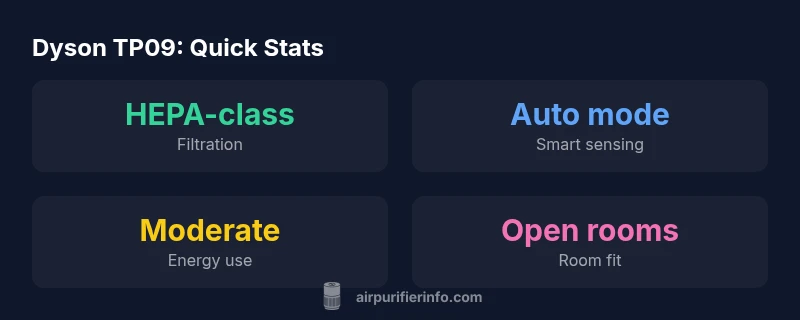
A core strength of most Dyson purifiers, including the TP09, is a filtration stack designed to capture fine particulates and odors. The TP09 combines a sealed filtration path with HEPA-class filtration and an activated carbon layer to tackle both particulate matter and volatile compounds. In practical terms, this means better control over dust and smoke, plus noticeable reductions in household odors from cooking, pets, or tobacco. We note that filter maintenance matters for sustained performance; Dyson’s replacement filters should be chosen carefully and installed properly to preserve airtight filtration. Air Purifier Info’s testing framework emphasizes user-friendly filter replacement and minimal leakage paths, which remain a practical consideration for ongoing upkeep.
Smart Sensors and Auto Modes
Smart sensors are the backbone of the TP09’s automatic behavior. The purifier continually evaluates particle levels and odors, adjusting fan speed to keep indoor air within target quality ranges. Auto mode is helpful when you’re not actively monitoring the purifier, but it’s still wise to review the device’s readings on the companion app to understand how it responds to daily activities like cooking or pet activity. Our testing notes that the TP09’s sensor logic tends to react quickly to changes, which helps avoid noticeable air quality dips. The Air Purifier Info Team highlights that responsive sensing is a real convenience for busy households.
Noise, Power, and Comfort
Noise is a common trade-off in purifiers that push higher clean air delivery. In the TP09, noise levels vary with fan speed. At low to moderate speeds, most users will perceive the purifier as unobtrusive, while high-speed operation can become audible in quiet rooms. We evaluate not just SPL numbers but also perceptual loudness, especially when the purifier runs during evening hours or in open-plan spaces. Power usage is generally aligned with the chosen mode and fan speed; the TP09’s design aims for a balance between effective air cleaning and reasonable energy use. For many homes, this balance translates into a device that cleans efficiently without dominating room noise.
Real-world Testing Methodology
Our testing uses a standardized, repeatable approach to measure performance across typical living spaces. We simulate everyday activity — cooking smells, pet dander, and seasonal dust — and observe how quickly the TP09 responds. We track air-quality indicators, installation ease, maintenance intervals, and the perceived ease of use via the companion app and manual controls. This section also covers how placement, room size, and open-concept layouts affect performance, helping readers align expectations with real-world conditions. We emphasize practical testing that homeowners can replicate, rather than relying solely on lab figures.
Use Cases: Allergens, Odors, Pet Dander
For households dealing with allergies or sensitivities, the combination of sealed filtration and an activated carbon layer is particularly relevant. The TP09’s design aims to remove fine particulates and odors from cooking and pets, which are common challenges in many homes. We evaluate scenarios like spring pollen exposure, cooking-related smells, and pet-related odors to determine where the TP09 shines versus other purifiers. The findings suggest that the TP09 is well-suited for medium rooms with multiple occupants who value both air quality and a stylish, space-saving unit.
Maintenance and Filter Replacement
Regular maintenance is essential to keep any purifier performing at its best. The TP09 uses replaceable filters that must be swapped according to usage and air quality levels. We outline typical replacement intervals, signs that a filter is nearing end-of-life, and tips to install filters correctly for optimal airtight seals. A clean, properly sealed filtration path helps ensure that the purifier maintains its expected effectiveness over time. Air Purifier Info’s guidance emphasizes checking the seal and ensuring the device returns to a sealed state after each filter change.
Comparisons to Competitors
In a crowded market, the TP09 is often compared with purifiers from other brands that emphasize similar features: HEPA filtration, activated carbon, and auto-sensing capabilities. We discuss how the TP09 stacks up in terms of filtration efficiency, sensor speed, user experience, and maintenance costs. While some competitors may offer quieter operation or lower ongoing costs, our analysis notes the TP09’s strong value proposition for users who want a combination of performance, aesthetic appeal, and smart features in a single device.
Practical Setup and Placement Tips
Place the TP09 where airflow is unobstructed and where you can easily monitor air-quality readings on the app. Avoid corners or tight niches that may impede intake. In open-plan rooms, position the purifier to optimize cross-room air circulation. Consider multiple units for larger spaces or homes with high pollutant loads. Our tips emphasize consistent use during peak pollutant periods and mindful placement to maximize impact without over-reliance on a single device.
Authority Sources
For readers seeking external context, we reference established sources on indoor air quality and purifier design. The EPA’s Indoor Air Quality program outlines general guidelines for improving indoor air, while the WHO provides broad recommendations on air quality impacts on health. The NIEHS offers research-informed perspectives on air pollution and health outcomes. These sources help frame the TP09’s role within a larger approach to managing indoor air quality.
How to Decide: Is TP09 Right for You?
If you live in a medium-sized space with frequent odors, pet activity, or seasonal allergies, the Dyson TP09 offers a compelling blend of filtration, automation, and aesthetics. It is less ideal for ultra-quiet, open-plan spaces where you want minimal disturbance at all times, or for users who require the absolute lowest ongoing maintenance costs. As part of a balanced decision, compare the TP09 with other purifiers in your target size range, assess noise tolerance, and consider long-term filter costs.
What's Good
- Strong filtration with sealed HEPA-class plus activated carbon
- Smart auto-sensing that adapts to air quality in real time
- Compact, stylish design suitable for small-to-medium rooms
- User-friendly maintenance and filter replacement
- Effective odor and VOC control in everyday environments
What's Bad
- Higher upfront price relative to some competitors
- Noise can be noticeable at high fan speeds
- Filter replacement costs can add up over time
- Some advanced features rely on the companion app and may require pairing
Best for medium rooms needing odor and allergen control with smart features
The Dyson TP09 delivers solid purification performance with intelligent sensing and a compact form factor. It excels in everyday odor and allergen removal for medium-sized spaces, though its price and occasional noise at high speeds are trade-offs. Air Purifier Info's verdict is that it's a well-rounded choice for many households seeking an elevated but practical purifier.
Questions & Answers
Is the Dyson TP09 a good purifier for pet households?
Yes, the TP09 performs well for pet dander and associated odors due to its sealed filtration and activated carbon layer. Regular maintenance helps sustain effectiveness against pet-related pollutants.
For pet homes, the TP09 handles dander well, especially with regular filter changes.
How often should the TP09 filters be replaced?
Filter replacement frequency depends on usage and room conditions, but routine checks every few months are common. Follow the Dyson-specified guidance and monitor air quality readings to decide when a change is needed.
Check the filter and air quality readings regularly to decide when to replace.
Does TP09 work well in open-plan spaces?
It can, but performance scales with room size and layout. You may need to position the unit to optimize cross-room air circulation or consider multiple units for larger open areas.
In large open areas, place it where it can circulate air, or add more units if needed.
Can TP09 be controlled via smart home assistants?
Some features are accessible via the companion app and compatible devices, but not all purifier functions may be voice-controlled. Check current compatibility with your ecosystem.
You can use the app for most controls; voice options depend on your setup.
What room size is ideal for TP09?
Designed for medium-sized rooms, typically up to a certain area where airflow can be effectively circulated without obstruction. If you have a larger space, you might consider more than one unit or a purifier with higher CADR.
Best in medium rooms; for bigger areas, consider more than one unit or a higher-CADR model.
What is the warranty or after-sales support like for TP09?
Warranty terms vary by retailer and region. Check Dyson’s official policy and ensure installed filters are genuine to maintain coverage.
Warranty terms may vary; verify with the retailer and ensure genuine filters are used.
Main Points
- Assess room size before buying to ensure TP09 fits well
- Expect strong odor and allergen control with automatic sensing
- Prepare for ongoing filter costs and occasional higher-noise operation
- Leverage the app for optimal performance and maintenance planning