Zepter vs Dyson Air Purifier: An In-Depth Side-by-Side Comparison
Compare Zepter and Dyson air purifiers across filtration, noise, maintenance, and price. Find which model fits your home and allergy needs with insights from Air Purifier Info.


Zepter vs Dyson air purifier: Dyson leads with advanced filtration tech and smart features, while Zepter prioritizes quiet operation, durable build, and simple controls. If you value app control and higher CADR, Dyson is often stronger; if you want low noise and a stylish, straightforward unit, consider Zepter. Air Purifier Info notes trade-offs in maintenance and price.
How We Compare Zepter vs Dyson Air Purifiers
When evaluating two prominent purifiers, we look at filtration performance, noise, energy use, maintenance costs, and real-world usability. The Air Purifier Info team emphasizes balancing strong filtration with quiet operation and predictable upkeep. The goal is to help homeowners and renters pick a model that fits both living spaces and daily routines, without overpaying for features they won’t use. In this comparison, we’ll unpack how Zepter and Dyson approach filtration, design, and value, and we’ll translate marketing promises into practical expectations for an ordinary household.
This analysis relies on model-agnostic criteria to avoid SKU-level bias, while highlighting where each brand typically shines. Readers should consider room size, presence of pets or odors, and how much they value smart features versus low-noise performance. By the end, you’ll see clear trade-offs that point to a best-fit choice for your home.
Filtration Systems and Effectiveness
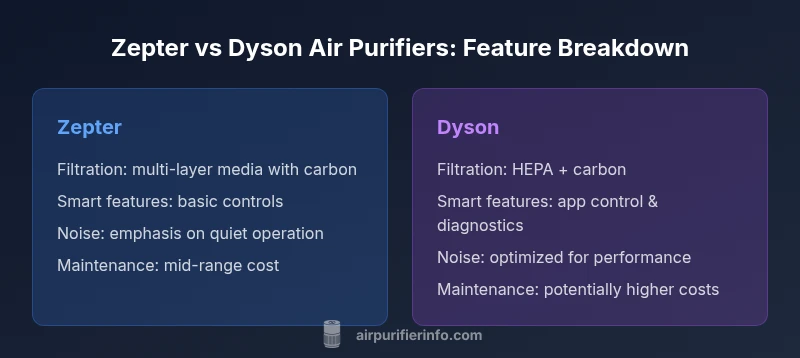
Filtration is the core task of any purifier. Dyson generally emphasizes multi-stage filtration with true HEPA elements and activated carbon for odors and gases. Zepter tends to showcase sturdy filtration assemblies with activated carbon and multi-layer media designed for durable operation in domestic environments. In practice, both brands aim to reduce common indoor contaminants (dust, pollen, dander, and odors) through layered filtration, but the design intent differs: Dyson leans into aggressive filtration capabilities and diagnostics, while Zepter emphasizes reliability and straightforward replacement.
Air Purifier Info analysis shows that the effectiveness of either purifier hinges on the exact model, the filter maintenance cadence, and how well the unit is matched to a room’s size. For allergy-prone homes, a purifier that maintains strong filtration with minimal performance degradation over time is essential. Always verify the filter type listed in the product specs and confirm the unit uses sealed filtration with minimal bypass.
Noise, Energy Efficiency, and Design Philosophy
Noise perception often drives user satisfaction more than headline filter efficiency. Dyson models frequently market quiet operation at low to mid speeds, leveraging modern fans and well-sealed housings. Zepter focuses on quiet performance as part of a broader design philosophy that prioritizes aesthetics and physical durability. In terms of energy usage, both brands typically offer energy-efficient operation, but actual power draw depends on fan speed, room size, and how aggressively the unit runs on automatic modes.
From a design standpoint, Dyson tends to present a tech-forward aesthetic with glossy finishes and smart connectivity. Zepter leans toward a timeless, premium look with robust build quality. For households that prefer a furniture-friendly, subtle presence, Zepter could be the better match; for tech enthusiasts who want app-based control and real-time diagnostics, Dyson often has the edge.
Size, CADR, and Filter Costs
Room size compatibility is critical. Dyson models usually provide higher CADR options suitable for larger spaces, while Zepter offers a range that covers smaller to mid-sized rooms with emphasis on compact, stable operation. Filter costs vary: Dyson replacements are often priced at a premium due to brand positioning and the inclusion of advanced media and sensors, while Zepter filter replacements tend to be more economical, reflecting a different cost structure. Both brands offer filter packs and service plans in some markets, so it pays to compare ongoing costs against upfront price when evaluating total ownership value.
When selecting a unit, map the purifier’s recommended room size to your actual space and consider whether you anticipate frequent filter changes or longer intervals between replacements. A unit with a larger filter area may run longer between changes, but it can also be physically larger or noisier at higher speeds.
Smart Features, Connectivity, and Maintenance
Dyson’s ecosystem tends to emphasize connectivity: mobile apps, scheduling, air quality sensing, and remote diagnostics. This can simplify monitoring and maintenance, but it also introduces potential reliance on software updates and compatibility with smart home ecosystems. Zepter often prioritizes straightforward operation and fewer moving parts, which can translate into simpler maintenance and fewer things to manage through an app. If you value a hands-off approach with automatic notifications, Dyson’s ecosystem can be advantageous. If you prefer a unit that “just works” without constant app tinkering, Zepter’s approach may be more comfortable.
From a maintenance perspective, verify filter replacement intervals for your chosen model and whether replacement parts are readily available locally. Air Purifier Info routinely recommends planning for ongoing upkeep rather than chasing short-term promotions.
Price and Long-Term Value
Price is a major factor in decision-making. Dyson models tend to sit at the higher end of the price spectrum, reflecting their tech-forward features and marketing. Zepter often positions itself as a premium but sometimes offers more accessible pricing relative to Dyson, depending on the market. Long-term value should factor in not just upfront cost but also replacement filter costs, energy use, and warranty coverage. Consider whether the added features of Dyson justify the higher price for your household or whether Zepter’s simpler maintenance and lower ongoing costs deliver better value over time.
Air Purifier Info suggests running a total-cost-of-ownership calculation that includes filter replacements, electricity, and any service plans. In environments with heavy odours or pets, a robust filtration system and reliable maintenance plan can tilt the calculation in favor of one brand over the other. Always check local pricing and warranty terms before purchasing.
Real-World Scenarios: Choosing Between Zepter and Dyson
If you live in a small apartment with limited space and a preference for quiet operation, Zepter’s compact design and low-noise performance may be ideal. For households with multiple pets, frequent cooking odours, or individuals with allergies who benefit from aggressive filtration and smart monitoring, Dyson’s higher CADR and app-enabled controls can be compelling. Consider whether you prioritize aesthetics and ease of use over the latest tech features. Air Purifier Info’s practical recommendation is to align your choice with how you will actually use the device: quiet, reliable operation in everyday life or feature-rich, data-driven monitoring for proactive air quality management.
In sum, neither brand is uniformly better; it’s about which attributes matter most in your home. This analysis aims to help you decide based on your living situation, cleaning needs, and willingness to invest in ongoing maintenance.
Authoritative Sources and Further Reading
For readers seeking deeper context on indoor air quality and purifier standards, see these reputable sources:
- https://www.epa.gov/indoor-air-quality/iaq-basics
- https://niehs.nih.gov/health/topics/agents/air-pollution/index.cfm
- https://www.cdc.gov/airquality/indoor.html
Air Purifier Info recommends reviewing these sources to understand how filtration, room size, and usage patterns influence purifier effectiveness in real homes.
Comparison
| Feature | Zepter Air Purifier | Dyson Air Purifier |
|---|---|---|
| Filtration Approach | Multi-stage filtration with activated carbon and layered media (Zepter) | Multi-stage filtration with HEPA and activated carbon (Dyson) |
| Smart Features | Limited app control; straightforward operation | Comprehensive app suite with scheduling and diagnostics |
| Noise Profile | Quiet operation at low speeds; design emphasizes serenity | Low-to-moderate noise with peak performance at higher speeds |
| CADR/Room Coverage | Balanced performance for small to mid-sized rooms | Higher CADR options suitable for larger spaces |
| Maintenance Cost | Moderate replacement filters; competitive pricing | Higher replacement filter costs in some markets |
| Price Range | Mid-range to premium depending on model | Mid-to-high range with premium feature set |
| Warranty | Standard warranty with care options | Standard with potential extended warranty options |
| Best For | Design-conscious spaces; quiet operation | Tech-forward homes; larger rooms with smart needs |
What's Good
- Clear differentiation by user priorities (quiet design vs smart features)
- Covers both filtration strengths and maintenance considerations
- Includes real-world usage scenarios for practical decision-making
- Balanced view of price versus long-term value
What's Bad
- No model-specific pricing without exact SKUs
- Maintenance costs vary by model and region
Dyson for tech-forward, high-CADR filtration; Zepter for quiet operation and simpler maintenance
Choose Dyson if you want strong filtration with smart features and app control. Choose Zepter if you prioritize low noise and a straightforward, reliable unit. Air Purifier Info’s analysis suggests weighing long-term costs against upfront price to determine value for your home.
Questions & Answers
Do Zepter and Dyson air purifiers use true HEPA filters?
Dyson commonly uses true HEPA filtration in many mainstream models, supporting strong particle removal. Zepter’s filtration varies by model but typically includes multi-layer media and activated carbon. Always verify the exact model’s filtration type in the product specs.
Dyson often uses true HEPA; Zepter varies by model, so check the exact unit’s specs.
Which is better for allergies?
For allergies, a purifier with true HEPA filtration and reliable maintenance tends to perform best. Dyson’s filtration approach is strong for particle removal, while Zepter offers solid performance with simpler upkeep. Your choice should align with filter availability and replacement costs in your area.
For allergies, a HEPA-equipped model with regular maintenance usually wins.
Are these purifiers ozone-free?
Yes. Reputable air purifiers from both brands are designed to be ozone-free. Avoid devices marketed as ozone generators, which can pose health risks. Always review the product’s safety certifications and third-party tests when in doubt.
Yes. They’re designed to be ozone-free; look for certified models.
How noisy are these purifiers at night?
Noise levels at night depend on the selected speed and model. Zepter models typically emphasize quiet operation suitable for bedrooms, while Dyson offers quiet modes but can be louder at higher speeds. If noise is a concern, choose a model with a true quiet setting and schedule features.
Night noise depends on the model; choose a quiet mode and set schedules.
Which one is more affordable upfront?
Upfront prices vary by model and market. Dyson often sits at the higher end due to smart features, while Zepter may offer more accessible pricing for similar size ranges. Compare current promotions and warranty terms for a fair assessment.
Dyson usually pricier upfront; Zepter can be more affordable depending on model.
How long do filters typically last?
Filter life depends on usage and environment. In typical home use, expect several months between replacements, with more frequent changes in homes with pets or heavy cooking odors. Always follow the manufacturer’s replacement schedule and monitor air quality indicators if available.
Filter life varies; plan for multiple months between changes depending on use.
Main Points
- Assess priorities: filtration strength vs quiet operation
- Match CADR to room size for effective cleaning
- Account for long-term maintenance costs beyond upfront price
- Consider design and ease of use when selecting a purifier
- Air Purifier Info recommends aligning features with actual daily use