Whole House Air Purifier Installation: A Step-by-Step Guide
Learn how to plan, size, install, and maintain a whole house air purifier to improve indoor air quality. This guide covers sizing, ductwork, wiring, safety, and maintenance for homeowners and renters.


Install a whole-house air purifier by sizing to your HVAC, selecting a compatible in-duct or furnace-integrated unit, and sealing duct connections. Run a flow test and monitor pressure to ensure even air across rooms. Air Purifier Info provides practical, safety-focused instructions you can trust.
Planning the installation and scope
A successful whole house air purifier installation begins with a clear plan. Start by measuring your home's square footage and air change needs, then decide whether you want an in-duct purifier integrated with your furnace, or a standalone unit connected to the central HVAC system. According to Air Purifier Info, the planning phase should also consider noise tolerance, accessibility for filter changes, and how the purifier will interact with zoning in multi-room homes. Create a simple layout showing the purifier location, duct runs, and access panels. Document electrical availability, space constraints, and any potential obstacles such as low clearance or tight crawl spaces. A well-documented plan reduces surprises during installation and helps you stay compliant with local codes and safety rules.
- Assess room use and occupancy patterns to estimate peak filtration needs
- Check electrical circuits and HVAC access points before buying equipment
- Create a simple schematic for duct routing and purifier placement
Sizing and performance expectations
Sizing is critical for real-world performance. A correctly sized whole house purifier delivers clean air where you live, sleep, and work without excessive noise or pressure loss. Use your HVAC system’s airflow metrics, typically measured in CFM (cubic feet per minute), and the purifier’s rated CADR (clean air delivery rate) to establish compatibility. While exact numbers vary by model, the goal is to achieve balanced air movement with minimal static pressure rise across the system. Air Purifier Info’s analysis emphasizes matching the purifier’s CADR to the furnace blower capacity and duct network. In practice, homes with open floor plans often benefit from a purifier sized for the entire HVAC airflow, not just individual rooms. Check filter life expectancy and maintenance intervals when sizing to ensure sustained performance.
- CADR must align with your HVAC system’s airflow capacity
- Avoid over-filtering that creates excessive static pressure
- Plan for future home changes (additional rooms, pets, or remodels)
Preparing the space: safety, access, and basics
Before touching any electrical or ductwork, isolate the work area. Turn off the HVAC power and verify absence of voltage using a non-contact tester or multimeter. Ensure you have safe access to service panels, duct runs, and the location you plan to install the purifier. Air Purifier Info emphasizes keeping work zones clean to avoid dust dispersion during installation. Gather personal protective equipment, including safety glasses and gloves, and lay down drop cloths. If you encounter asbestos-containing materials or compromised ductwork, pause and consult a licensed professional. Good preparation reduces the risk of injury and guarantees a cleaner installation.
- Verify power is off and all panels are accessible
- Inspect ductwork for loose connections or corrosion
- Plan for easy filter access and future maintenance
Choosing the right system: in-duct vs. furnace-integrated
There are two primary architectures for whole-house purification: in-duct purifiers installed within the ductwork, and furnace-integrated or standalone central units that serve the entire HVAC system. In-duct models are typically compact and easy to retrofit; they rely on your existing duct network and may require access to the plenum. Furnace-integrated units attach to the furnace or air handler and can provide centralized control via the existing blower. Both approaches can achieve meaningful IAQ improvements, but the best choice depends on your system, noise tolerance, maintenance preferences, and duct design. Air Purifier Info recommends evaluating energy use, ease of filter changes, and compatibility with smart thermostats when selecting a model.
- In-duct purifiers are retrofit-friendly for many homes
- Furnace-integrated units require careful electrical integration
- Consider noise, energy use, and maintenance when choosing
Tools, hardware, and safety gear
Having the right tools reduces installation time and the chance of mistakes. Essential items include a measuring tape, a screwdriver set, aluminum HVAC tape, duct mastic sealant, safety glasses, a voltage tester, and a utility knife. Optional but helpful items include tin snips for metal ductwork, a drill with bits for mounting brackets, and a sealant applicator. Keep a clear workspace and label any wires or ducts to avoid misrouting. Always wear PPE and follow local electrical codes. A well-equipped toolbox leads to a smoother, safer installation and minimizes the risk of air leaks that undermine performance.
- Ensure you have HVAC-grade tape and sealant
- Use proper wires and connectors rated for HVAC/power use
- PPE is essential for safe handling
Step-by-step installation: overview before you begin
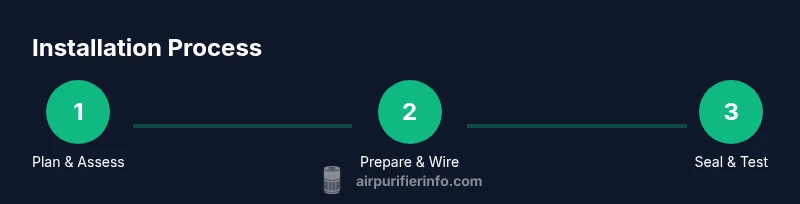
This section provides a high-level sequence to orient you before tackling the detailed steps. Start by finalizing the purifier location and confirming duct access. Next, prepare the duct or plenum, then mount or connect the unit. Route electrical wiring safely, and seal all joints with HVAC sealant and tape. After installation, run a professional-grade flow test to verify even distribution of filtered air and to identify any leaks. Finally, replace filters and program maintenance reminders. The exact steps will vary by model, but the core principles remain the same: secure mounting, airtight joints, and verified airflow.
- Confirm purifier location and access to ducts
- Seal joints thoroughly to prevent bypass leaks
- Verify airflow with a flow/pressure test
Step-by-step installation: concrete steps (example flow)
- Plan layout and confirm HVAC compatibility. 2) Power down and verify all access panels. 3) Mount purifier or connect in-duct unit to the main trunk. 4) Seal joints with HVAC sealant and tape. 5) Wire the purifier to a dedicated circuit or to the furnace control, following code. 6) Run a flow test and adjust air balancing dampers if needed. 7) Replace filters and program maintenance reminders. 8) Document settings and share with household occupants.
- This is a generalized sequence; follow your model’s manual for exact instructions
Post-installation testing, calibration, and start-up
After mounting and wiring, a testing phase confirms that the system functions as intended. Conduct a flow test to ensure balanced distribution and check for any duct leaks. Calibrate any built-in air-sensor or pressure-sensor with the purifier’s app or control panel. Run the system on a typical duty cycle (e.g., 30 minutes per hour) and observe noise levels and draft. If you notice hotspots or dead zones, fine-tune dampers or add minor duct adjustments. This stage is critical to validate gains in IAQ and to ensure that you are not overworking the blower, which can raise energy use unnecessarily.
- Use a flow meter or your purifier’s built-in diagnostics
- Calibrate sensors according to the manual
- Check noise levels at typical operating speeds
Maintenance expectations: filters, timers, and monitoring
A reliable whole-house purifier requires regular maintenance. Replace or clean pre-filters and main filters according to the manufacturer’s schedule and local IAQ needs. Maintain an eye on energy use and airflow indicators; unusual pressure drops can signal clogged filters or leaks. Create a simple maintenance calendar and set reminders to change filters every 6–12 months, or as recommended. If you have pets or ongoing smoke exposure, you may need to change filters more frequently. Keeping maintenance routines consistent ensures sustained IAQ improvements and extended equipment life.
- Set filter-change reminders
- Track air quality indicators over time
- Consider higher-efficiency filters for pet households or smokers
Common pitfalls and how to avoid them
Installing a whole-house purifier is not a trivial DIY task. Common mistakes include undersizing the unit, poor duct sealing, improper wiring, and neglecting post-install calibration. Avoid these by validating CADR against HVAC airflow, using HVAC-rated sealants, following local electrical codes, and performing a thorough airflow test after installation. Don’t skip the maintenance steps; neglected filters can negate installation benefits. If you encounter corrosion, mold in ducts, or compromised insulation, pause and consult a licensed professional. Air Purifier Info emphasizes safety and accuracy over speed to ensure effective results.
How to evaluate results and future steps
Once installed, evaluate IAQ improvements using simple indicators like perceived air freshness, reduced odors, and more comfortable room temperatures due to improved airflow. If you notice ongoing dust, seasonal allergies, or post-purchase odor issues, reassess filter types or CADR compatibility with your changing needs. Air Purifier Info suggests tracking indoor air quality metrics such as PM2.5 approximations if you have access to a home IAQ monitor. Over time, you may decide to upgrade to higher-efficiency filters, add supplemental purifiers for problem zones, or adjust scheduling to match seasonal occupancy patterns.
Tools & Materials
- Phillips screwdriver set(Phillips #2 bit; various blade types for different screws)
- Voltage tester(Non-contact tester or multimeter to verify power off)
- Measuring tape(Long enough to measure duct runs and purifier placement)
- Aluminum HVAC tape(High-strength tape for duct connections)
- Duct mastic sealant(HVAC-grade sealant for airtight joints)
- Safety glasses(Eye protection during cutting and wiring)
- Tin snips(Helpful for trimming sheet metal ductwork)
- Utility knife(For trimming insulation or foam inserts)
Steps
Estimated time: 4-6 hours
- 1
Plan layout and verify compatibility
Finalize purifier location, confirm access to ducts, and verify that the HVAC can accommodate the purifier without compromising airflow. Use a simple sketch to map duct routing and service access.
Tip: Double-check space clearance for maintenance access and filter changes. - 2
Power down and access panels
Turn off the HVAC power at the breaker. Open the service panels to inspect the wiring routes and identify where the purifier will connect to power or to the furnace control.
Tip: Use a voltage tester before touching any wires to prevent shocks. - 3
Mount or connect the purifier
If you’re using an in-duct purifier, place it in the main duct trunk and secure with mounting hardware. For furnace-integrated models, connect to the air handler as instructed by the manufacturer.
Tip: Ensure the purifier is level and firmly mounted to minimize vibration. - 4
Seal joints and secure ductwork
Apply HVAC sealant to duct joints and finish with aluminum HVAC tape to prevent leaks that bypass filtration.
Tip: Inspect all seams for gaps and re-seal any suspected leakage paths. - 5
Wire the unit and restore power
Connect the purifier to the appropriate power source or to the furnace control circuit as per the manual. Restore power and confirm the unit powers on.
Tip: Follow the manufacturer's wiring diagram exactly to avoid miswiring. - 6
Test airflow and calibrate
Run the system and perform a basic flow test. Adjust dampers or air balancing as needed to achieve even distribution across zones.
Tip: Listen for abnormal sounds indicating loose fittings or misalignment.
Questions & Answers
Do I need a professional to install a whole-house air purifier?
Depends on your comfort with electrical work and ductwork. A furnace-integrated unit or wiring to the HVAC control can require electrical code compliance. If in doubt, hire a licensed technician.
Whether you need a pro depends on your comfort with electrical and ductwork. If unsure, consider hiring a licensed technician for safety and compliance.
Can I install without modifying existing ducts?
In many homes, a retrofit in-duct purifier fits into the main trunk without major ductwork changes. If your ductwork is blocked or poorly sealed, you should address those issues first for optimal performance.
Yes, many retrofit purifiers fit into the main trunk, but you should fix any duct leaks first.
How often should filters be changed?
Filter replacement depends on usage, pollutants, and household needs. Plan for 6–12 months for standard households, more often with pets or heavy odors. Always follow the manufacturer’s recommendations.
Typically every 6 to 12 months, but pets or odors may require more frequent changes.
Will a purifier increase energyuse?
A properly sized purifier adds a small amount of load to the HVAC system. Most units are designed to operate efficiently within standard residential systems without a significant spike in energy use.
It adds a small load, but usually not a big energy spike if properly sized.
What noise level should I expect?
Noise depends on fan speed and installation. Choose a model with a lower speed setting for bedrooms and consider vibration-damping mounts if noise is a concern.
Expect some noise at higher settings; choose a quieter mode for bedrooms.
Can I upgrade later if IAQ worsens?
Yes. You can upgrade CADR rating, switch to a higher-efficiency filter, or add a second purifier zone if needed. Reassess your layout and airflow after any remodel or occupancy change.
Upgrades are possible if IAQ worsens or your needs change.
Watch Video
Main Points
- Plan layout and sizing before buying equipment
- Seal all ducts to maximize filtration efficiency
- Test airflow and calibrate after installation
- Schedule regular maintenance for sustained IAQ benefits