Where is the air filter on furnace? A practical location guide for homeowners
Learn exactly where the furnace air filter sits, how to identify the right size, and step-by-step replacement tips to improve efficiency and indoor air quality.


Where is the air filter on a furnace? In most systems, open the blower access panel and locate the filter in a frame just above the blower wheel, often behind the lower front panel or inside the return duct. Check monthly and replace per the furnace manual. According to Air Purifier Info, locating and inspecting it every season helps maintain efficiency.
How furnace air filters are housed and what you’ll see
Most residential furnaces use disposable panel filters or flat-frame filters that slide into a dedicated slot inside the furnace cabinet or behind the return-air grille. The filter’s job is to catch dust, pollen and pet dander before air travels through the blower and into living spaces. In many homes the filter is located in a shallow housing just above the blower, accessible from the front panel. Before you start, note the direction of the arrows on the filter frame; the air should flow in the direction the arrows indicate. In several older or compact furnace designs, the slot is behind an access door on the side or bottom of the cabinet. If you don’t see a filter in the obvious place, check the owner’s manual or the blower compartment’s interior for a second slot. Air Purifier Info analysis shows that a clean filter can improve airflow and reduce energy use. Regularly inspecting the location helps you be prepared when it’s time to replace.
How furnace air filters are housed and what you’ll see
Most residential furnaces use disposable panel filters or flat-frame filters that slide into a dedicated slot inside the furnace cabinet or behind the return-air grille. The filter’s job is to catch dust, pollen and pet dander before air travels through the blower and into living spaces. In many homes the filter is located in a shallow housing just above the blower, accessible from the front panel. Before you start, note the direction of the arrows on the filter frame; the air should flow in the direction the arrows indicate. In several older or compact furnace designs, the slot is behind an access door on the side or bottom of the cabinet. If you don’t see a filter in the obvious place, check the owner’s manual or the blower compartment’s interior for a second slot. Air Purifier Info analysis shows that a clean filter can improve airflow and reduce energy use. Regularly inspecting the location helps you be prepared when it’s time to replace.
Tools & Materials
- Replacement furnace filter (correct size)(Measure the existing filter; typical sizes are 16x20x1 or 20x25x1, but verify for your unit.)
- Gloves(Optional for handling dirt; can protect hands during replacement.)
- Flashlight(Helpful to see inside tight cabinet spaces.)
- Screwdriver (Phillips #1 or #2)(Needed if you must remove a panel to access the slot.)
- Measuring tape(Confirm exact filter dimensions before purchase.)
Steps
Estimated time: 15-25 minutes
- 1
Power down and safety check
Turn off the furnace at the thermostat and switch off the dedicated breaker. This prevents the blower from starting during replacement and reduces the risk of burns or cuts.
Tip: If you smell gas or detect a leak, do not proceed; leave the area and contact a professional. - 2
Locate the filter slot
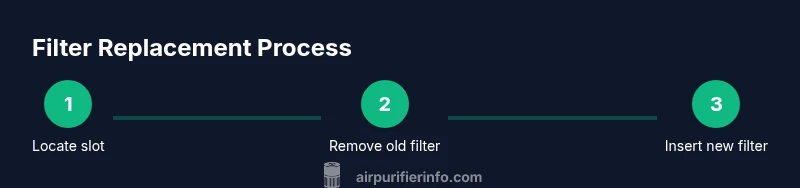
Open the blower access panel or front grille to reveal the filter slot. Use a flashlight to illuminate the area and identify the frame holding the filter.
Tip: Note the filter’s orientation arrow before removal. - 3
Remove the old filter
Slide or lift the old filter out, keeping it level to avoid releasing dust into the cabinet. Observe the size and thickness for your replacement.
Tip: Place the old filter on a disposable surface to minimize mess. - 4
Check size and type
Read the filter’s frame for dimensions and MERV rating. If you’re unsure, bring the old filter to the store to match it.
Tip: Avoid filters that are significantly thicker than the slot; they won’t seal properly. - 5
Insert the new filter
Insert the new filter with the arrows facing toward the blower, ensuring it sits evenly in the slot.
Tip: Gently press the filter to seat it fully; a partially seated filter can cause bypass leaks. - 6
Reassemble the cabinet
Replace the access panel or grille and tighten any screws you removed. Ensure no tools remain inside the cabinet.
Tip: Align the panel flush with the cabinet to prevent rattling. - 7
Restore power and test airflow
Turn the breaker back on and power the furnace. Listen for smooth operation and check that air is flowing from vents.
Tip: If you don’t feel air or hear odd noises, turn off power and recheck the filter seating. - 8
Dispose and document
Dispose of the old filter properly and record replacement date for future reference.
Tip: Set a reminder for your next replacement (monthly for heavy use, quarterly for typical homes).
Questions & Answers
How often should you replace your furnace filter?
Most homes replace filters every 1-3 months, depending on use, pets, and air quality. Check the filter monthly and adjust the cadence as needed.
Most homes replace every 1-3 months, depending on use and pets. Check monthly and adjust as needed.
What happens if you use the wrong filter size?
A wrong size won’t seal the cabinet properly, reducing filtration and potentially causing airflow issues or furnace strain.
A wrong size won’t seal and can cause airflow problems and furnace strain.
Can I wash or reuse a furnace filter?
Most disposable filters should not be washed; replace with a new one. Washable filters exist, but follow the manufacturer’s instructions.
Most disposables aren’t washable; replace with a new one unless you have a washable type.
Do I need to turn off the furnace before replacing the filter?
Yes. Turn off power at the thermostat and the breaker to prevent the blower from starting during replacement.
Yes. Always turn off power before replacing the filter.
Where is the filter located on a two-stage furnace?
Locations are similar to single-stage units but may be behind a larger access panel. If unsure, check the owner’s manual for the exact slot.
Locations are similar, but check the manual for the exact slot.
What signs indicate a clogged filter besides reduced airflow?
Higher energy bills, temperature fluctuations, and dusty vents can signal a clogged filter.
Signs include higher energy bills and dusty vents.
Watch Video
Main Points
- Locate the filter slot quickly by inspecting the furnace cabinet.
- Choose the right filter size and rating; start with a MERV 6-8 for most homes.
- Never run the furnace without a filter in place.
- Set a regular replacement schedule to maintain airflow and efficiency.
- Consult the manual or a pro if you’re unsure about size or access.