What to Consider When Buying an Air Purifier
A comprehensive buyer’s guide for homeowners and renters on choosing an air purifier. Learn how to size by room, compare CADR and filtration, assess noise and energy use, estimate ongoing costs, and verify safety certifications for cleaner indoor air.


You’ll learn how to pick an air purifier that fits your space and needs by sizing for your room, comparing CADR and filtration (HEPA and carbon), evaluating noise and energy use, estimating ongoing filter costs, and checking safety certifications. This structured approach helps homeowners and renters reduce dust, odors, allergies, and pet dander without overbuying. Expect a practical framework, not hype, from Air Purifier Info.
Why choosing the right air purifier matters for indoor air quality
Indoor air quality affects health, comfort, and overall well-being for homeowners and renters. When you search for what to consider when buying air purifier, you should focus on room size, filtration quality, noise, energy use, ongoing filter costs, and safety certifications. A well-matched purifier reduces dust, odors, allergies, and pet dander without wasting money on features you won't use. This article from Air Purifier Info provides a practical framework rather than a shopping list of models. By measuring your space, listing pollutant concerns, and setting a realistic budget, you’ll identify the best fit for your home. Our goal is to empower you to make a confident, evidence-based choice that improves air quality and daily comfort.
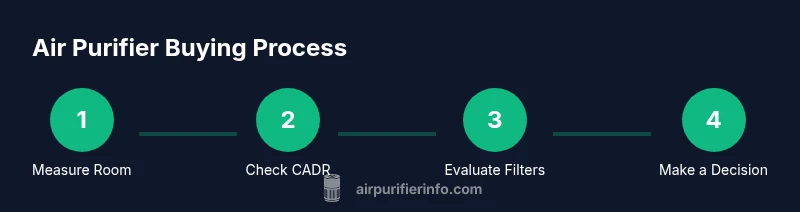
According to Air Purifier Info, the most successful purchases come from a structured decision process, not from marketing claims alone. Start by answering: How big is the room? What are the main pollutants—dust, cooking odors, pet dander, or smoke? How important is quiet operation? What are the long-term costs for filters? Answering these questions before you browse models helps you avoid buyer’s remorse and wasted energy. This quick primer sets the stage for a deeper, step-by-step evaluation that covers sizing, filtration, maintenance, and safety.
In the rest of this guide you’ll find a concise framework, definitions of key terms, a practical checklist, and tested methods to compare models. The goal is to help homeowners and renters make an robust, evidence-based choice that delivers noticeable relief from common indoor air quality challenges.
Core concepts: CADR, ACH, and filtration basics
To understand what to consider when buying air purifier, you first need to decode a few core terms. CADR, or Clean Air Delivery Rate, is a standardized metric that rates how quickly a purifier cleans air for dust, pollen, and smoke. ACH, or air changes per hour, translates CADR into how many times the room’s air is refreshed in an hour. A higher CADR relative to your room size means faster cleaning and more noticeable air quality improvements. Filtration quality matters as much as speed. Look for True HEPA filters that capture at least 99.97% of particles down to 0.3 microns; avoid vague "HEPA-like" labels that don’t meet the standard. A multi-stage stack—pre-filter, True HEPA, and activated carbon—improves performance for both particles and odors. Some models add ionizers or UV-C; weigh the potential benefits against safety concerns and extra maintenance.
Air Purifier Info’s research suggests the best purifier for most homes balances high filtration efficiency with practical room fit and minimal noise. If you have a large living room or open-plan space, plan for a higher CADR unit and a filter stack designed to handle frequent pollutant sources, such as cooking or pet dander. Remember placement matters: position purifiers to optimize airflow and avoid dead zones behind furniture or corners. With the right approach, you can experience cleaner air across your living spaces.
Filtration options explained: HEPA, activated carbon, pre-filters, and more
HEPA filters are the standard for particle capture, removing most dust, pollen, smoke particles, and pet dander from the air. True HEPA is the reliable choice, and it’s worth avoiding vague marketing terms that imply HEPA without meeting the standard. Activated carbon, sometimes in combination with other media, targets odors; it absorbs chemical smells from cooking, cleaning products, and VOCs. Some models use dual-media layers, with a specialized catalytic layer to break down certain pollutants.
In households with strong odors or cooking emissions, look for cartridges that pair HEPA with activated carbon or baking soda-based media. Pre-filters extend the life of the main filter by catching larger debris, and they’re cheaper to replace. High-efficiency filters may require replacement every 6-12 months depending on use; consider cost over the purifier’s lifetime. According to Air Purifier Info analysis, the total cost of ownership often hinges on filter replacement cadence and energy use, not just upfront price. When shopping, verify that filters are readily available from the manufacturer or compatible third-party options, and check whether you can purchase in bundles to save money.
How to size a purifier for your room and compute CADR needs
Begin by measuring your room: length, width, and height. Convert these to volume to understand how many cubic feet of air you need to clean each hour. A good rule of thumb is to match the unit’s CADR with the room’s volume so that the purifier refreshes air at a sensible rate. For example, in a busy kitchen or a pet-filled living room you’ll want a higher CADR to counter frequent pollutant sources; in a bedroom you may prioritize quieter operation with a moderate CADR.
Next, assess the pollutant profile. If the primary concern is dust and pollen, a unit with strong particle filtration is essential. If odors from cooking or a smoker are a problem, you’ll need robust activated carbon. For multi-room layouts or open floor plans, you may need a purifier with a larger CADR or consider multiple units to achieve even air cleaning.
Finally, check the machine’s intake and outlet design. A poorly placed purifier or one that draws air from behind furniture may create dead zones. Place the unit away from walls, open doors, and require roughly a space for circulation; this ensures the air actually passes through the filter rather than skirting around it. The goal is to create a steady, clean air flow across the room.
Noise, energy, placement, and real-world usage
Air purifiers vary in noise depending on the fan speed and filtration stage. In overdrive, some units generate noticeable hum or white noise; in low or sleep mode, they can be quite quiet. If you sleep or work near the purifier, prioritize models with a dedicated quiet mode or very low decibel operation. Energy efficiency matters, especially if you run the unit all day. Look for Energy Star certified models that emphasize lower electricity use and longer filter life; the energy savings can offset higher upfront costs over time.
Placement is not just about convenience; it affects performance. Put purifiers at breathing height in central locations where air movement is most needed, not tucked into tight corners. Avoid placing them behind doors, curtains, or behind large furniture. If you live in a multi-story home, consider a purifier per floor or in spaces where occupants spend the most time, such as living rooms and bedrooms. In practice, a thoughtful setup yields better results with less noise and less energy wasted.
Safety, certifications, and ozone considerations
Some devices generate ozone or use ionization technologies that produce byproducts; these options are not ideal for homes with kids, pets, or asthma. The safest approach is to choose models that explicitly state ozone-free operation and CARB (California Air Resources Board) or equivalent certification. These credentials indicate that the purifier’s emissions stay within safe limits and that claims about clean air are backed by testing. Additionally, check for safety features like automatic shutoff, filter alarms, child-proof controls, and sturdy housing. Certification and safety measures become increasingly important if you’re buying a purifier for a nursery, bedroom, or living room used by multiple family members.
Cost considerations: initial price vs ongoing filter costs
Buyers frequently compare upfront price rather than total cost of ownership. The most economical choice over several years often balances a moderate initial price with affordable replacement filters and reasonably long filter life. Estimate the cost of monthly or yearly filter replacements by comparing price lists and the set of filters required for your chosen unit. Also account for energy use; a purifier with higher CADR but much higher energy consumption may not be the most economical option for long-term use. Finally, check warranty length and coverage to protect against premature failures. A longer warranty can reduce long-term risk and cost.
A practical buyer’s checklist and next steps
To finish your buying journey, assemble a shortlist using these criteria: room size, CADR per pollutant type, true HEPA filtration, activated carbon for odor control, low noise, energy efficiency, filter availability and cost, warranty, and safety certifications. Use the checklist to compare models side-by-side and prioritize factors by your household’s needs. Before finalizing a purchase, plan a quick test in your space by running the purifier for a few days and noting changes in comfort, smell, dust, and overall air quality. Remember to re-evaluate after you’ve lived with the purifier for a week or two, as real-world results can differ from marketing claims.
Tools & Materials
- Measuring tape or laser distance meter(For accurate room dimensions (length, width, height) to compute room volume.)
- Notebook or calculator(To record room measurements, pollutant priorities, and CADR estimates.)
- Room size calculator or online CADR estimator(Optional if you have exact measurements; helps map room volume to CADR.)
- Printer or digital checklist(Optional templates to compare purifier specs side-by-side.)
- Replacement filter price list(Helpful for budgeting ongoing costs over the purifier’s lifetime.)
Steps
Estimated time: Estimated total time: 60-75 minutes
- 1
Measure your space precisely
Use a tape measure or laser device to capture room length, width, and height. Calculate room volume to inform CADR needs. Note any architectural features like alcoves or openings that could affect airflow.
Tip: Double-check measurements at multiple points to avoid rounding errors. - 2
Identify your pollutant priorities
List the main air quality concerns: dust, allergies, odors from cooking or pets, smoke, or VOCs. This will guide your filtration needs and the importance of activated carbon versus particle filtration.
Tip: Prioritize issues that affect daily comfort to avoid chasing unnecessary features. - 3
Assess filtration requirements
Determine whether a true HEPA filter is needed and whether activated carbon is essential for odors. Consider a multi-stage setup (pre-filter + HEPA + carbon) for versatility.
Tip: Prefer units with clearly labeled filter types and replacement intervals. - 4
Evaluate noise and energy implications
Review the unit’s decibel rating on different fan speeds and check energy star certification if available. A purifier should be unobtrusive in daily living or sleep environments.
Tip: Test the purifier in low and high modes to compare noise across typical use cases. - 5
Check replacement costs and availability
Look up the price and availability of filters. Factor in replacement frequency to estimate total ownership costs over several years.
Tip: Choose models with easily sourced, affordable filters and consider bundled replacements. - 6
Review safety certifications
Ensure the purifier is ozone-free and has relevant certifications (e.g., CARB, Energy Star). Check for safety features like auto shutoff and child-safe controls.
Tip: Ozone-free certification is essential for households with children and pets. - 7
Create a short-list and compare models
Use a side-by-side checklist focusing on room fit, CADR, filtration stack, noise, energy use, and price. Exclude models that don’t meet essential criteria.
Tip: Don’t rely solely on marketing claims; verify specs from the manufacturer. - 8
Test fit in your home
Place the chosen purifier in the intended space and observe performance for 24-48 hours. Adjust placement if air seems stagnant or the unit is noisy. If possible, run multiple models in the same room to compare effects.
Tip: Aim for at least a week of real-world testing before committing to a long-term purchase. - 9
Plan for maintenance and re-evaluation
Set a maintenance schedule for filter changes and energy checks. Reassess air quality after a few weeks to ensure your choice still meets needs as conditions change (seasonal pollen, pet activity, cooking habits).
Tip: Document maintenance dates to avoid forgetting replacements.
Questions & Answers
What does CADR stand for and why does it matter?
CADR stands for Clean Air Delivery Rate. It measures how quickly a purifier cleans air for particles like dust, pollen, and smoke. A higher CADR generally means faster cleaning, but you must match it to your room size for real improvement.
CADR is the speed at which a purifier cleans air; pick a unit that fits your room size for effective results.
Should I buy a True HEPA filter for everyday use?
True HEPA filters capture the vast majority of fine particles and are the standard for clean air. Look for devices that clearly label True HEPA and avoid vague claims like HEPA-like filters.
Yes—True HEPA is the gold standard for particle removal in consumer purifiers.
Do air purifiers remove odors and VOCs?
Purifiers with activated carbon filters can reduce odors and many VOCs, but effectiveness varies by compound and concentration. For strong smells, ensure the carbon media is suitably sized and replaceable.
Activated carbon helps with odors; VOC removal depends on the filter media and room conditions.
How often should I replace filters?
Replacement frequency depends on usage, air quality, and filter type. Check the manufacturer’s guidelines and monitor indicators; have replacements ready before the current filters wear out.
Follow the manufacturer’s schedule and replace filters when advised by the indicator.
Are air purifiers safe for pets and kids?
Air purifiers are generally beneficial for reducing pet dander, dust, and odors. Ensure the model is ozone-free and has appropriate safety features for households with children and animals.
Purifiers help with pet dander; avoid ozone-producing models for homes with kids.
Can I run an air purifier in a bedroom?
Yes, many purifiers are suitable for bedrooms. Choose a model with a quiet mode or sleep setting and place it where it won’t disturb sleep.
Yes—pick a quiet model and position it away from the bed for better rest.
Watch Video
Main Points
- Measure room accurately and translate size to CADR needs
- Prioritize true HEPA filtration plus activated carbon when odors are a concern
- Balance noise, energy use, and ownership costs over time
- Check safety certifications and avoid ozone-producing devices
- Test purifiers in your space before finalizing a purchase