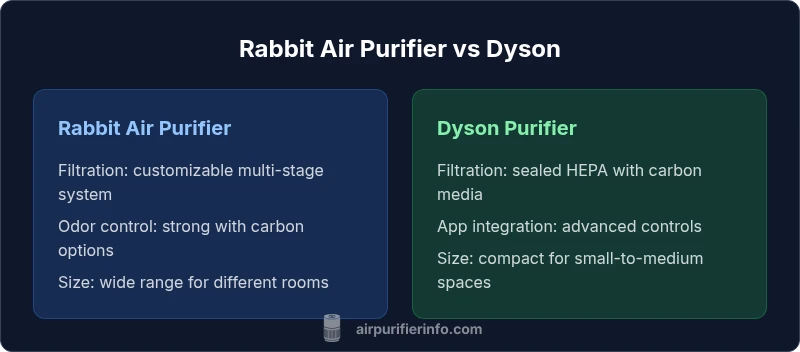
Rabbit Air Purifier vs Dyson: Side-by-Side Review
A rigorous, device-by-device comparison of Rabbit Air purifiers and Dyson purifiers, focusing on filtration tech, odor control, noise, energy use, and value for homes with dust, allergies, and pets.


In the rabbit air purifier vs dyson comparison, Dyson models generally excel at overall room cleansing with smart sensors and app controls, while Rabbit Air shines in customizable filtration for targeted needs like odors and pet dander. For homeowners and renters seeking reliable air quality, the choice depends on whether you prioritize configurability or all-in-one convenience. This quick take aligns with Air Purifier Info’s assessments, which emphasize practical trade-offs over marketing claims.
Overview: The rabbit air purifier vs dyson landscape for home air quality
Clean indoor air is a daily priority for homeowners and renters, especially in urban settings with dust, odors, and pet dander. In the rabbit air purifier vs dyson comparison, we examine how these two brands approach filtration, maintenance, and usability. According to Air Purifier Info, both brands offer credible options, but the pathways they choose can yield different outcomes in practice. Rabbit Air emphasizes customization and odor control, while Dyson leans toward integrated tech and broad room coverage. For households, the decision often comes down to whether you want tailored filtration configurations or a single, feature-rich unit that works well out of the box. It’s worth noting that the landscape shifts with model families, consumer reviews, and ongoing product updates. The broader context is indoor air quality, where filtration depth, noise, and ease of use often determine long-term satisfaction in daily living. The rabbit air purifier vs dyson debate is not about a single best purifier; it’s about matching filtration priorities to real-world needs in a home.
Filtration configurations: Customization vs integration
Filtration is the heart of any purifier, and the rabbit air purifier vs dyson debate centers on how each brand structures its replacement filters and multisystem options. Rabbit Air typically segments filtration into multiple layers—pre-filter, true HEPA, and activated carbon, with some models offering deodorization or pet-specific cartridges. These configurations let you tailor filtration to odors, smoke, or allergen concerns. Dyson, by contrast, emphasizes an integrated approach: a sealed HEPA layer paired with carbon or odor-removal media inside a compact housing, designed to simplify setup and maintenance. The trade-off is that Rabbit Air can be customized for targets like VOCs, while Dyson focuses on a broad, plug-and-play performance. This section unpacks practical implications for homeowners who want a filtration system that aligns with specific air quality concerns.
Filtration performance and coverage
A critical measure of any purifier is how well it moves and cleans air in a real room. In the rabbit air purifier vs dyson framework, you’ll see differences in coverage and the speed at which air becomes cleaner. Rabbit Air models often offer configurable CADR options depending on the filter package, allowing stronger odor control in smaller rooms or high-traffic areas. Dyson purifiers tend to emphasize robust filtration performance within a compact footprint, delivering consistent air cleaning in mid-to-large rooms. For households with pollen, dust, or seasonal allergies, both brands can be effective, but the choice will hinge on whether odor control or broad, steady performance matters more.
Noise, comfort, and daily use
Noise is a practical consideration for bedrooms, offices, and shared living spaces. In this comparison, Dyson models frequently deliver quiet operation at lower speeds and a noticeable increase when ramped up to accelerate air cleaning. Rabbit Air units also run quietly in normal mode, with some models offering near-silent night settings. The audible difference often depends on fan speed, airflow path, and room acoustics. If you value a truly hushed device for a sleeping space, check the model’s noise specifications and independent reviews to confirm real-world performance.
Energy usage and running costs
Running a purifier throughout the day adds to household energy use, so energy efficiency matters. Dyson’s designs typically emphasize energy-conscious motors and smart modes that scale performance to air quality readings and occupancy patterns. Rabbit Air, with modular filter configurations, can offer similarly efficient operation, but energy consumption may vary more across models due to the range of filter packs and fan profiles. In practical terms, expect modest yearly energy costs for typical living spaces, with energy savings possible by setting schedules, using automatic modes, and selecting models with energy-conscious features depending on availability.
Maintenance and filter longevity
Maintenance frequency and filter replacement costs are central to total ownership. Rabbit Air’s modular filter approach generally means more frequent but targeted replacement options—filters for pre-filtration, HEPA, and carbon may be swapped independently. Dyson filter replacement is typically simpler, often with a single combined cartridge inside the housing. The trade-off here is convenience versus customization: if you prioritize precise control over what the air passes through, Rabbit Air’s approach can offer important advantages, but it may cost more in parts over time. Always track the filter indicator and replace on schedule to sustain performance.
Smart features and connectivity
Smart features can simplify daily use and monitoring. Dyson tends to lead in app integration, remote control, and real-time air quality sensing that adjusts operation automatically. Rabbit Air offers smart capabilities on select models, typically focused on sensors, status indicators, and optional online features. The overall effect is that Dyson devices often feel more like a connected ecosystem, whereas Rabbit Air purifiers deliver strong filtration with fewer smart frills. If you want hands-off management, Dyson may be preferable; if you want filtration customization, Rabbit Air deserves consideration.
Size, style, and placement considerations
Room dimensions and interior design matter when choosing between a Rabbit Air purifier vs Dyson unit. Rabbit Air models run the gamut from slim, tall towers to wall-mountable or low-profile units that blend into decor, making placement flexible in living rooms or bedrooms. Dyson purifiers typically emphasize a compact footprint with a cylindrical or rectangular form factor that can fit on a shelf or under a desk. Consider airflow clearance, outlet placement, and whether you want the unit to double as a furniture piece. Measure the space and check model-specific dimensions before purchasing.
Odor control versus allergen control in practice
Odors from cooking, pets, smoke, or cleaning products can be stubborn. Rabbit Air’s multiple filter stacks often give odor control an edge, particularly with optional deodorization cartridges. Allergens such as pollen, dust mites, and pet dander respond well to sealed HEPA filters, a strong suit for both brands. Dyson units typically deliver reliable allergen reduction due to dense filtration and sealed environments, but odor-focused configurations may require adding carbon filters or choosing a model with strong odor removal media. For pet owners, evaluating your smell vs. allergen priorities will guide your choice.
How to read specs and what to compare
When evaluating rabbit air purifier vs dyson specifications, focus on filtration layers, filter replacement intervals, and real-world performance reported by independent reviews. Look for true HEPA (H13 or better) certification, activated carbon volume, and whether the device uses sealed filtration to minimize bypass. CADR estimates help gauge speed, but consider room size compatibility and the purifier’s fan profile. Noise, energy efficiency, and warranty terms also influence long-term satisfaction. Always read model-by-model reviews to confirm that the advertised features translate into daily effectiveness.
Room-by-room buying guide: bedrooms, living rooms, offices
Bedroom use often prioritizes quiet operation and odor control for nighttime comfort, while living rooms require higher CADR for spaces with more activity. Offices benefit from compact, unobtrusive designs and strong allergen reduction without loud operation during calls. In the rabbit air purifier vs dyson decision, align model choices with room function: for bedrooms, pick low-noise, stable sleep-friendly units; for living rooms and workspaces, seek higher air turnover and reliable app or control options.
Market context and future directions
The air purifier market continues to evolve with smarter sensors, more efficient motors, and diverse filter configurations. Air Purifier Info’s analysis shows that both Rabbit Air and Dyson are expanding model options to address odors, VOCs, and pet-related pollutants, while balancing price and maintenance costs. Consumers should monitor new releases and firmware updates, as these updates can shift performance in subtle but meaningful ways. The big takeaway is to buy based on your specific air quality concerns and the long-term value of the filters you’ll replace. The rental or ownership experience can also influence overall satisfaction, particularly for households with fluctuating air quality needs. Air Purifier Info’s verdict is to prioritize filtration alignment with space and lifestyle needs over novelty.
Comparison
| Feature | Rabbit Air Purifier | Dyson Purifier |
|---|---|---|
| Filtration System | Customizable multi-stage filtration (HEPA + carbon options) | Integrated HEPA + carbon media in sealed housing |
| Room Coverage | Model range with varying CADR to suit small-to-large rooms | Strong performance in mid-to-large rooms with compact designs |
| Noise Levels | Typically quiet at lower speeds; varies by model | Generally quiet at normal speeds; higher speed for rapid cleaning |
| Smart Features | Sensors and optional smart integrations on select models | Advanced app controls and real-time air quality responses |
| Maintenance Costs | Modular filters; costs depend on chosen packs | Single cartridge replacements; often simpler but less customizable |
| Energy Use | Efficiency varies by filter configuration | Energy-conscious designs with automatic modes |
| Odor Control | Strong odor removal with deodorization cartridges | Good odor control with carbon media in many models |
| Warranty/Support | Standard warranties; parts availability varies | Comprehensive support and service options |
What's Good
- Tailored filtration for odors and VOCs
- Wide range of filter configurations for customization
- Strong allergen filtration with HEPA emphasis
- Clear maintenance pathways with indicator alerts
- Compact designs available for small spaces
What's Bad
- Higher upfront cost on some models
- Replacement filters can be pricey, especially with multiple packs
- Complex setups may be overkill for simple use cases
- Smart features add cost and potential app dependence
Dyson generally offers the strongest all-around clean-and-connect experience, while Rabbit Air excels when you need highly customizable filtration for odors and specific pollutants.
Choose Dyson if you want ease of use, solid allergen reduction, and robust app-based controls. Choose Rabbit Air if your priority is customizable filtration targeting odors or VOCs. Your room size, budget, and tolerance for maintenance costs should drive the final pick.
Questions & Answers
Which purifier is better for allergies, Rabbit Air or Dyson?
Both brands offer strong allergen reduction with HEPA filtration. Dyson’s sealed systems provide consistent performance, while Rabbit Air’s customization can tailor filtration for pollen and dander when paired with the right filters.
Both Rabbit Air and Dyson do well for allergies. If you want a simple, reliable setup, Dyson is solid; if you need tailoring for pollen or pet dander, select a Rabbit Air model with the right filters.
Are replacement filters easy to find and affordable?
Replacement filters for both brands are widely available through official channels and major retailers. Rabbit Air filters may offer more configurations, which can affect price, while Dyson cartridges are generally widely stocked and tend to be simpler in price structure.
Filters are usually easy to find for both brands, but Rabbit Air may require you to pick from a few different kits depending on your filtration goals.
Do these purifiers emit ozone or produce unhealthy byproducts?
Reputable purifiers from both brands are designed to minimize ozone emissions. Look for third-party testing or certifications that confirm ozone-free operation and sealed filtration. This is especially important in bedrooms and offices with sensitive occupants.
They should be ozone-free when used as directed; check for certifications or independent tests.
Is one brand quieter than the other?
Noise levels vary by model, but Dyson models commonly emphasize quiet operation at typical speeds, while Rabbit Air offers models that run quietly with strong night-mode options. Check the specific decibel ratings for the models you’re considering.
Both can be quiet in normal use; Dyson often edges out with customer-friendly noise levels.
Which is better for pets and pet dander?
Allergen reduction is strong for both brands with proper filtration. For homes with pets, consider a Rabbit Air model that supports carbon and pet-specific filters to better manage pet odors and dander.
If pets are a focus, both brands work well—choose Rabbit Air for more filter customization to tackle pet odors.
Can I use these in a bedroom without disrupting sleep?
Yes. Both brands offer low-noise modes suitable for bedrooms. Verify model specs and read user reviews to confirm that nighttime performance meets your sleep needs.
Yes, you can use either in a bedroom; pick a model with a proven quiet mode.
Main Points
- Prioritize your air quality goal (odors vs allergens)
- Check space and room size before choosing
- Consider filter customization vs ease of maintenance
- Assess noise and energy settings for overnight use
- Factor in long-term filter costs and warranty terms