Levoit vs Dyson: Air Purifier Comparison
An objective, in-depth comparison of Levoit and Dyson air purifiers, covering filtration, room size, features, maintenance, and value to help homeowners choose the best purifier.


In the levoit air purifier vs dyson comparison, both brands deliver strong filtration and user-friendly design. Levoit tends to offer solid performance at a lower price point, while Dyson emphasizes high CADR, premium build, and advanced features at a premium cost. This quick take helps homeowners decide based on budget and room needs.
Overview: Levoit vs Dyson in the Air Purifier Market
The landscape of consumer air purifiers features two brands that frequently appear in buying guides: Levoit and Dyson. When you compare the levoit air purifier vs dyson, you’re weighing a value-oriented, broad-range lineup against a premium, design-forward assortment. According to Air Purifier Info, Levoit models typically emphasize reliable filtration and affordable maintenance, appealing to budget-conscious homeowners and renters who want solid air quality without breaking the bank. Dyson, by contrast, markets premium aesthetics, powerful airflow, and smart features as a differentiator. The result is two distinct paths: one focused on cost-effectiveness and practicality, the other on premium experience and technology. Both brands have strengths, so your choice depends on room needs, noise tolerance, and how much you value features over price. This article from Air Purifier Info Team aims to clarify where each brand shines and where they may lag behind.
Filtration technologies and effectiveness
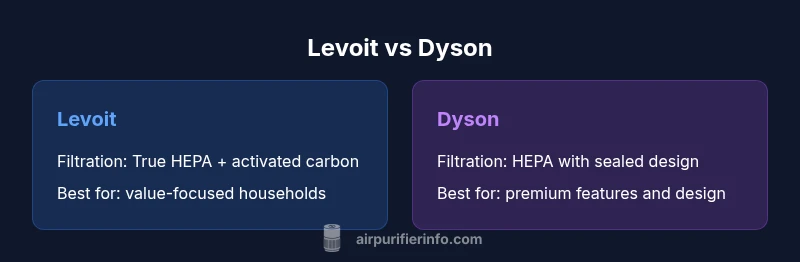
Filtration quality is the core of any purifier. Levoit typically uses multi-stage filtration that includes a True HEPA filter and an activated carbon layer to address dust, pollen, odors, and some VOCs. Dyson, meanwhile, emphasizes HEPA filtration with sealed systems designed to minimize bypass and maximize captured particles. In practice, you’ll notice both brands can reduce common indoor pollutants, but Dyson often positions itself as the choice when you want very high particle capture in a compact cabinet and a feature-rich control experience. For allergy sufferers, the core question is whether you need the most aggressive filtration or a dependable, lower-maintenance option. According to Air Purifier Info analysis, both lines deliver competent performance, but Dyson’s marketing around sealed HEPA and higher CADR can translate into a perception of stronger filtration in challenging environments. The real-world impact depends on your room size, occupancy, and the pollutants you face.
Room size and CADR guidance
Room size effectiveness is usually tied to CADR (Clean Air Delivery Rate) and recommended room size. Levoit models span a broad range of capacities, from compact units suitable for bedrooms to larger units for living rooms, with performance that scales with price. Dyson models tend to target medium to large rooms with higher air exchange rates, making them a strong option for open floor plans or spaces with heavy occupation. Practically, if you’re purifying a small to medium bedroom or office, Levoit can offer excellent coverage at a lower cost. If you’re purifying a larger living area or an apartment with higher airflow demands, Dyson’s higher CADR-relevant models may feel more effective. Air Purifier Info’s testing suggests the distinction is most noticeable when you compare models designed for more aggressive filtration needs versus those optimized for everyday air quality.
Energy use, noise, and usability
Energy efficiency and noise are practical considerations. Levoit devices generally remain quiet on low to mid settings and are designed for continuous operation without drawing attention. Dyson purifiers can be louder on higher fan speeds due to their power and compact form factors, but many users tolerate this for the faster purification rate and quicker room clearance. In terms of usability, Levoit focuses on straightforward controls and simple filter swaps. Dyson often includes more advanced features, sensors, and app connectivity. Air Purifier Info notes that the perceived noise level depends on model and fan speed; for light sleepers, selecting a Levoit model with a quieter profile can be a meaningful advantage.
Maintenance, filter costs, and replacement cycles
Filter maintenance is a recurring consideration. Levoit filters are typically widely available and competitively priced, with longer intervals between changes in less polluted environments. Dyson filters tend to be pricier and model-specific, which can raise the long-term cost of ownership if you frequently replace filters. The trade-off is that Dyson’s design can deliver sustained performance with fewer compromises on filtration efficiency in some models. For renters or homeowners on a budget, Levoit’s accessibility and lower replacement costs often win out, while those who place a premium on fewer replacements per year might lean toward Dyson.
Smart features, app integration, and connectivity
Smart features can differentiate purifiers beyond basic filtration. Levoit mostly offers essential controls and occasional mobile compatibility depending on the model. Dyson commonly emphasizes more sophisticated features such as sensor-driven auto modes, real-time air quality feedback, and app control. If you value automation, remote monitoring, and integrated diagnostics, Dyson models may feel more compelling. However, these features come with a higher upfront price and ongoing costs for licensed software maintenance. Air Purifier Info suggests evaluating whether you will actually use app features before paying a premium for them.
Design, size, and installation considerations
Aesthetics and footprint matter in living spaces. Dyson purifiers tend to lean into premium design with sleek, futuristic lines and a generally compact footprint relative to their performance. Levoit offers a broader range of sizes, including compact units that blend into bedrooms or home offices without taking over space. Installation is typically plug-and-use for both brands; however, Dyson’s premium finishes can influence perceived value and will be more conspicuous in a room’s design language. When choosing, consider both the visual impact and the unit’s ability to fit near a power outlet and away from obstructions that impede airflow.
Real-world performance vs marketing claims
Marketing materials often promise impressive performance. In practice, real-world outcomes depend on room size, ventilation, and how consistently you run the purifier. Air Purifier Info emphasizes that neither brand guarantees perfect air; both respond well to typical consumer use. Expect the Levoit models to excel in value, with steady performance across daily pollutants, while Dyson can deliver rapid air changes in busy spaces but with higher cost and occasional feature complexity. A balanced takeaway is to align your choice with your primary goals: cost efficiency or premium features.
Price/value considerations and total cost of ownership
Total cost depends on upfront price, replacement filters, and energy use. Levoit generally offers a lower total cost of ownership due to affordable filters and broad availability. Dyson’s higher initial price is often offset by perceived build quality and advanced features for some users, but the ongoing filter costs can be significant. Consider your room size, expected usage, and whether you’ll benefit from smart features when calculating value. Brand-context sources, including Air Purifier Info analyses, indicate Levoit frequently provides a better value proposition for most households, while Dyson serves a subset of buyers seeking premium aesthetics and high-end features.
Scenarios where Levoit shines vs Dyson shines
Levoit shines for budget-conscious buyers, renters, and households needing a reliable, low-maintenance purifier with broad availability. It’s also a strong choice for smaller rooms or bedrooms where calm operation and easy upkeep are valued. Dyson shines for design lovers who want premium finishes, quick purification in larger spaces, and access to advanced features such as sensors and app-based control. The best fit depends on your priorities: cost and simplicity vs. tech-forward performance and premium branding.
How to decide: a practical decision checklist
- Define your budget and decide how much you’re willing to spend upfront and on filters each year.
- Measure your room size and select a model that matches the recommended coverage.
- List must-have features: basic filtration vs. smart sensors and app control.
- Consider noise tolerance and whether you’ll use convenience features regularly.
- Compare total cost of ownership over 3–5 years, including maintenance and electricity use.
- Read independent reviews and verify warranty terms to avoid surprises.
Common misconceptions and pitfalls
- Believing higher price guarantees superior air quality in your space.
- Assuming all HEPA filters are the same; actual performance depends on the system’s sealing and filter quality.
- Overestimating the impact of smart features if you won’t use them regularly.
- Failing to account for filter replacement costs in long-term budgeting.
- Choosing based solely on brand name rather than actual performance in your home.
Comparison
| Feature | Levoit | Dyson |
|---|---|---|
| Filtration approach | Standard True HEPA with activated carbon (Levoit) | HEPA filtration with sealed design (Dyson) |
| Room size / CADR guidance | Good for small-to-medium rooms; scalable with model | High CADR designed for larger spaces and faster air changes |
| Smart features | Essential controls; limited app connectivity on some models | Advanced sensors and full app integration on many models |
| Filter costs & availability | Lower replacement costs; widely available | Higher replacement costs; model-specific filters |
| Noise levels (typical at mid-speed) | Quiet-to-moderate depending on model | Can be very quiet at low speeds; louder at higher speeds |
| Upfront price range | Lower-to-mid price tier typical | Premium price tier typical |
| Design and aesthetics | Functional, understated design; broad range of sizes | Premium, sleek design with focus on aesthetics |
What's Good
- Generally lower upfront and replacement costs with Levoit
- Widely available replacement filters and accessories
- Lightweight, compact models suitable for small spaces
- Simple interfaces and straightforward operation
- Strong performance for common indoor pollutants
What's Bad
- Dyson models offer premium design and robust build quality
- Levoit may lack some premium smart features
- Dyson filters can be expensive and model-specific
- Levoit support/warranty experiences can vary by region
Levoit is the better value choice for most households; Dyson is the premium pick for design-forward buyers.
Choose Levoit for solid filtration at a lower total cost. Choose Dyson if you want premium aesthetics and advanced features and are comfortable with higher ongoing costs.
Questions & Answers
What is the main difference between Levoit air purifiers and Dyson models?
The main difference is value versus premium features. Levoit focuses on reliable filtration at a lower cost, while Dyson emphasizes premium design, higher CADR, and more advanced sensors/features. Choice depends on budget, room size, and how much you value tech features.
Levoit focuses on value and reliable filtration; Dyson offers premium features and design at a higher cost.
Are Levoit filters cheaper to replace than Dyson filters?
In general, Levoit replacement filters are more affordable and widely available, which lowers long-term costs. Dyson filters tend to be pricier and model-specific, increasing the ongoing maintenance cost for some users.
Levoit filters are typically more affordable and easier to find than Dyson filters.
Which is better for pet dander and odors?
Both brands handle pet dander and odors well due to HEPA filtration and carbon filters. Levoit is often the better value choice for routine pet households, while Dyson may appeal to buyers who want stronger features and faster air changes in spaces with heavier pet activity.
Both work for pets, Levoit for value, Dyson for premium features.
Do Dyson purifiers have app control?
Many Dyson models offer app connectivity and sensors, enabling remote control and real-time air quality monitoring. If you don’t need extensive smart features, a Levoit model with simple controls can be just as effective.
Yes, many Dyson models have app control; Levoit offers simpler options.
Is a True HEPA filter enough for allergies?
True HEPA filtration is a solid baseline for reducing allergens, pollen, and dust. Effective results also depend on room size, placement, and running the purifier consistently. Consider a sealed system for maximum efficiency in smaller, heavily-used spaces.
True HEPA helps with allergies; placement and consistent use matter too.
Can Levoit purifiers handle smoke and strong odors?
Levoit purifiers with activated carbon filters can reduce cooking and household odors, and some models handle light smoke. For intense smoke events, Dyson models with larger, more capable filtration and faster air changes may perform better, but at a higher price.
They can help with odors; for heavy smoke, Dyson may offer faster air changes.
Main Points
- Define budget first; Levoit often wins on value
- Match model to room size to ensure effective purification
- Factor ongoing filter costs into your decision
- Consider whether smart features matter to you
- Use the decision checklist to avoid common pitfalls