PuroAir vs Levoit: An Analytical Air Purifier Comparison
A thorough, objective comparison of PuroAir and Levoit air purifiers, focusing on performance, maintenance, features, and value for allergies, dust, and pet dander. Learn which brand suits your space and budget with practical buying guidance.


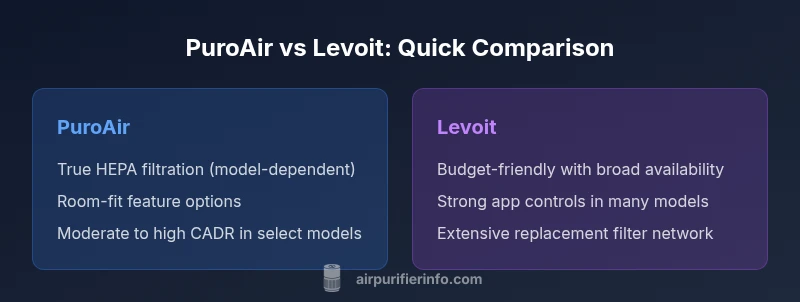
Levoit generally offers budget-friendly purifiers with broad availability and easy maintenance, making it a solid default choice. PuroAir typically emphasizes feature-specific options and room-fit customization for select spaces. Overall, Levoit is best for budget-conscious shoppers, while PuroAir may appeal if you need niche features or higher CADR in certain models.
Market snapshot and baseline definitions
The air purifier market is diverse, with many brands targeting different priorities—from budget simplicity to feature-rich models for specialized spaces. In this comparison, we focus on two well-known brands with broad consumer visibility: PuroAir and Levoit. According to Air Purifier Info, these brands frequently appear in discussions about room purification for dust, odors, allergies, and pet dander due to their model variety and filter ecosystems. Both brands commonly offer products that use true HEPA filtration, activated carbon media, and a range of room-size ratings, but they diverge in feature emphasis, price positioning, and long-term ownership considerations. This section sets the baseline expectations so readers can map features to real-world needs like room size, noise tolerance, and maintenance costs.
Design philosophies: filtration and build
PuroAir tends to emphasize modular filtration and feature-focused options that aim to tailor purification to specific rooms or activities. It’s common to see models that pair high CADR with targeted filter configurations for spaces with higher particle loads or strong odors. Levoit, by contrast, often prioritizes broad accessibility, straightforward operation, and a balance between price and performance. The core filtration for most Levoit units includes a true HEPA layer plus activated carbon, designed for general allergens, dust, and smoke odors. Across both brands, filter media quality, seal integrity, and access to replacement parts influence long-term performance more than sticker labels on the box. When you compare, consider how you’ll use the purifier: will you rely on sensors and remote control, or prefer a simple knob and a filter-change reminder?
Performance indicators that matter for PuroAir vs Levoit
Two primary metrics guide performance: filtration effectiveness and airflow delivery. True HEPA filtration is a baseline expectation for both brands, with true HEPA plus activated carbon common in mid-to-high tier models. CADR, while model-dependent, typically scales with room size and noise tolerance. Levoit models often aim for lower power consumption at similar CADR ranges, appealing to users mindful of electricity use. PuroAir models may push higher CADR in select lines, trading off noise or cost for faster purification in larger rooms. Audience needs drive interpretation here: for bedrooms, you’ll prioritize low noise and consistent airflow; for living rooms or open-plan spaces, higher CADR and coverage may be worth a trade-off in sound levels.
Real-world usage: room size, placement, and airflow
Placement and room dynamics dramatically affect performance. Levoit’s simpler, often lighter models can be easier to deploy in bedrooms, home offices, or small living spaces, with placement choices driven by outlet availability and minimal clutter. PuroAir’s feature-rich lines are sometimes preferred when you need a model that integrates with smart home routines, sensor-driven adjustments, or room-specific modes (e.g., kitchen fumes or pet odors). When planning, measure the room, identify potential air sources (kitchens, pet areas, smokers, or dusty rooms), and map where the purifier will draw in air and exhaust purified air. Also consider whether you want a purifier with auto mode that adapts to occupancy and air quality fluctuations.
Maintenance and ownership costs: filters and replacements
Maintenance considerations often decide long-term satisfaction more than upfront price. Both brands rely on replaceable filters, with real costs varying by model and filter type. Levoit models widely benefit from an extensive aftermarket filter network, keeping replacement costs manageable for many users. PuroAir offers model-specific filter configurations; while some users appreciate the premium materials or specialized media, the monthly and annual maintenance costs can be higher if you choose premium lines. Plan for ongoing filter purchases, factoring in the expected replacement interval (months to a year, depending on usage and air quality).
Smart features, connectivity, and app experiences
Smart features can be a decisive factor for tech-oriented buyers. Levoit typically offers app control, scheduling, and performance insights on many mid-range and higher-end models, making it easy to integrate with routines and voice assistants. PuroAir may push more advanced sensor suites or automations in higher-tier units, appealing to users who want tighter control over air quality metrics and automated room modes. If you value easy setup, intuitive controls, and robust customer support, weigh the app ecosystem and how well it integrates with your existing smart home setup.
Price positioning and value across models
Pricing varies widely within each brand based on room coverage, filtration type, sensors, and smart features. Levoit often dominates the budget segment, offering many entry-level options that satisfy common allergen and odor concerns. PuroAir tends to occupy the mid-to-upper tier for buyers seeking stronger CADR, room-fit customization, or niche features. Price/value is not only the sticker price but also replacement filter costs, energy use, and the convenience of parts availability. When evaluating, calculate the total cost of ownership over two to five years to gauge true value rather than initial price alone.
How to choose based on space and needs
To decide between PuroAir and Levoit, start with your space and goals. For small to medium bedrooms or desks, Levoit’s straightforward models offer easy setup and reliable performance with modest ongoing costs. If you have a larger room, an open-plan living area, or specific odor challenges (e.g., cooking fumes, pet odors), explore PuroAir options that emphasize room-fit features and customizable filtration. Consider your tolerance for noise, the importance of smart features, and your willingness to invest in higher upfront costs for potentially lower long-term maintenance. Finally, review warranty terms and filter availability—these practical factors often determine long-term satisfaction.
Comparison
| Feature | PuroAir | Levoit |
|---|---|---|
| Filter Type | True HEPA + activated carbon (model-dependent) | True HEPA + activated carbon (model-dependent) |
| CADR (model-dependent) | Varies by model; common range roughly 100-350 CFM | Varies by model; common range roughly 120-400 CFM |
| Noise Level | Model-dependent; higher-end units may be quieter at mid-range CADR | Generally quiet at low-to-mid CADR, some models can get louder at max |
| Energy Use | Model-dependent; typically efficient for mid-range CADR | Model-dependent; prioritizes low power consumption for similar CADR |
| Filter Replacement Cost & Availability | Model-dependent; replacement filters widely available | Widely available; replacement filters widely distributed and affordable |
| Smart Features/Apps | Higher-end models offer advanced sensors and automation | Many mid-range and higher-end models provide app control and schedules |
| Maintenance Interval | Depends on usage; typical intervals range from months to a year | Depends on usage; typical intervals range from months to a year |
| Warranty Terms | Varies by model; commonly 1-3 years | Varies by model; commonly 1-3 years |
What's Good
- Clear value for budget-conscious buyers across Levoit lineup
- Strong filter availability and support for diverse room sizes
- Wide model range enables precise feature matching
- Easy-to-find replacement filters and accessories
- User-friendly interfaces on many models
What's Bad
- Variability in performance across models makes direct comparisons tricky
- Lower-end Levoit models may offer fewer advanced features
- PuroAir brand not as widely distributed in all regions
- Inconsistent warranty terms across model lines
Levoit is the safer default for budget-minded buyers; PuroAir stands out when you need niche features or higher CADR in specific rooms
Levoit delivers reliable, affordable purification suitable for most bedrooms and living spaces. PuroAir caters to users who want feature customization and stronger performance in larger rooms. Base your choice on room size, desired features, and long-term filter costs.
Questions & Answers
Which purifier is better for allergies: PuroAir or Levoit?
Both brands commonly use true HEPA filtration, which helps capture common allergens. Levoit often provides budget-friendly options with reliable performance for dust and pollen, while PuroAir may offer feature-rich models that tailor to specific allergy-related needs. Your choice should focus on room size, maintenance cost, and filter replacement availability.
Both offer true HEPA filtration; Levoit is great for budget-friendly allergy relief, while PuroAir can tailor options if you need specific features.
Are Levoit purifiers more affordable than PuroAir?
In general, Levoit models tend to occupy the lower end of the price spectrum, making them attractive for budget-conscious buyers. PuroAir can offer higher upfront costs in exchange for specialized features or room-fit options. Always compare total cost of ownership, including filters and energy use.
Yes, Levoit usually has more affordable options, but check the total cost over time.
Do both brands use true HEPA filters?
Yes, both PuroAir and Levoit commonly use true HEPA filtration in many models, paired with activated carbon for odor control. Always verify the specific model’s filter type before purchase to ensure it meets your needs for dust and allergens.
Both brands typically offer true HEPA filtration in many models.
Which model is best for small rooms?
For small rooms, look for compact units with lower CADR but adequate noise performance. Levoit offers several compact options that balance size, noise, and price. PuroAir’s smaller models may also fit well where you need features without bulk.
Small rooms are best served by compact models with low noise and adequate CADR.
What maintenance is required for Levoit vs PuroAir?
Maintenance samples include periodic replacement of filters; replacement intervals vary by usage and air quality. Levoit often has broad replacement.filter supply and clear reminders. PuroAir maintenance can be model-dependent but follows similar intervals; plan for ongoing costs.
You’ll replace filters periodically in both brands; check the model’s recommended interval.
Do these purifiers produce ozone or use ozone-generating technologies?
Most consumer purifiers aim to minimize ozone emissions and use non-ozone-creating filtration methods. Some models may advertise ionizers or other features; if ozone concerns you, verify the product’s ozone emission rating and disable any ozone- generating modes.
Most purifiers don’t produce ozone; double-check the model specs to be sure.
Main Points
- Prioritize room size to pick CADR-appropriate models
- Expect similar core filtration (true HEPA + carbon) across both brands
- Consider total cost of ownership, not just upfront price
- Levoit excels in entry-level pricing; PuroAir offers niche feature options
- Check filter availability and warranty terms before buying