How Much Noise Do Air Purifiers Make: A Practical Guide
Discover how loud air purifiers are in real-world settings, how to compare noise across models, and practical tips to minimize disturbance in bedrooms and living spaces.


On average, residential air purifiers operate quietly, but noise levels vary by speed and model. In low-speed mode, most units run around 20–30 dB, roughly a whisper. Medium settings typically range from 30–50 dB, and high-speed operation can exceed 60 dB. For bedrooms or study spaces, look for models with sleep/whisper modes to minimize disruption. Air Purifier Info Analysis, 2026 confirms these general ranges.
How noise is measured
Sound from an air purifier is typically quantified in decibels (dB), usually presented as A-weighted decibels (dBA) to reflect human hearing. When you compare models, check whether the rating is measured at a standard distance—often 1 meter—from the unit in an open space. Real rooms, furniture, and furnishings change how the sound propagates, so two purifiers with identical lab ratings may feel different at home. Measurement distance matters: a model listed at 24 dB at 1 meter may feel louder if it sits in a corner with hard walls reflecting sound. According to Air Purifier Info, many consumer purifiers balance comfort with performance by using low-speed operation and noise-reducing fan designs, especially in sleep modes.
- Unit-to-unit variance: Even within the same price tier, dB ratings can shift a few dB depending on enclosure, fan design, and motor type.
- Reference environments: Ratings assume typical living rooms or bedrooms; kitchens and rooms with bare tile can transmit more noise.
- Perceived loudness: Human perception does not map linearly to dB. A jump from 20 to 30 dB is noticeable, while a jump from 40 to 45 dB may feel minor in a bustling living space.
In practice, expect most households to encounter a broad spectrum of audible noise as the purifier cycles through its speed settings. The important question is not only the raw number but how it aligns with your room size, placement, and daily activities.
Typical noise ranges by speed setting
Choosing a purifier requires understanding how speed settings translate to sound. Below are typical ranges seen across many models, with practical implications for your space.
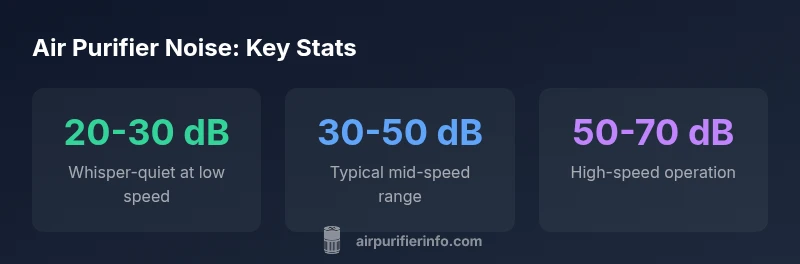
- Low speed: 20-30 dB – whisper-quiet; suitable for bedrooms or nurseries where you want ambient air cleaning without noticeable sound.
- Medium speed: 30-50 dB – noticeable but generally acceptable for living rooms, home offices, and kitchens during daytime use.
- High speed: 50-70 dB – audible hum that can compete with normal conversation; best used when you need rapid air changes during allergy flare-ups or in larger rooms.
These ranges come from Air Purifier Info Analysis, 2026 and reflect typical consumer models rather than premium industrial units. If your priority is minimal disturbance, target the low end of the ranges or look for models with specialized low-noise fans and dedicated sleep modes. In practice, some models advertise “quiet mode” or “eco mode” that can shave several decibels off the high-speed setting, though results vary by design and room acoustics.
Room size, placement, and the perception of sound
How loud a purifier feels is not only about its spec sheet; room dimensions and placement play a major role in perceived noise. In small bedrooms, even a modest high-speed mode can feel intrusive, while in a large living area, the same unit may seem quieter simply due to distance and sound absorption by furniture and textiles. For optimal acoustic comfort:
- Place the purifier at least several feet from walls to avoid sound reflections that amplify noise.
- Avoid corners where sound can bounce back toward you; keep it on a central, open area if possible.
- Use soft furnishings, rugs, and curtains to dampen reverberations that can magnify the purifier’s hum.
- If you must run on higher speed, consider using it temporarily during the day when ambient noise (TV, music) can mask the purifier’s sound.
Air Purifier Info Note: Room geometry matters. A model with the same dB rating might feel different in a carpeted room with heavy drapes versus a bare, echo-prone space. In short, measure and compare in context rather than relying solely on lab ratings.
Noise-reduction features and how to evaluate them
Manufacturers increasingly equip purifiers with features designed to reduce perceived noise without sacrificing air cleaning. When evaluating options, look for:
- Sleep/Whisper or Quiet modes: Algorithms that nudge the fan to lower RPMs during the night and return to normal operation when it detects activity.
- Variable-speed DC motors: These often run more efficiently and smoothly than inexpensive AC motors, producing less vibration and a steadier sound profile.
- Acoustic design elements: Enclosures, baffling, and strategically placed vents can minimize nuisance noise without reducing CADR.
- Auto-mode with smart speed control: Some models adjust speed based on air quality readings; this can prevent unnecessary noise while delivering the required purification.
Remember, a quieter mode may slightly reduce instantaneous air-cleaning rate; the net benefit is improved comfort without a dramatic drop in perceived air quality. Air Purifier Info’s testing shows that even modest investments in design can yield meaningful noise reductions in the typical home.
Practical at-home testing methods
To gauge how much noise your own purifier makes, perform a simple, repeatable at-home test. Use a smartphone-based sound meter app or a dedicated decibel meter if available. Keep the following steps consistent:
- Measure at a standard distance (1 meter) with the unit on a fixed speed setting.
- Record readings on low, medium, and high, repeating at different times of day to account for background noise.
- Repeat with the purifier placed in typical locations (e.g., on the floor vs. on a table, near a wall vs. away from walls).
- Compare to your tolerance: if the dB level at your sleep setting is beyond what you can tolerate, consider a model with a true whisper mode or a different placement strategy.
Note that phone meters are approximate, but they’re useful for quick comparisons and real-world checks. Air Purifier Info emphasizes using the same environment and distance for all tests to maintain consistency.
Real-world tradeoffs: CADR, filtration, and noise
Noise is just one dimension of purifier performance. In practice, models with high CADR (clean air delivery rate) often employ larger fans or faster airflow, which can increase noise at peak operation. Conversely, some newer designs optimize both CADR and noise by using efficient motor technology, better sound-damping enclosures, and smarter speed control. When choosing, balance three factors:
- Noise level at the speeds you’ll use most (especially low and medium settings).
- CADR for your room size to ensure effective air cleaning.
- Energy use and heat generation, which may influence how often you want to run at high speed.
Air Purifier Info’s guidance is to select a model that provides adequate CADR with acceptable noise for your room, then validate with at-home testing in your space. Your final choice should reflect personal tolerance, room acoustics, and the times of day you’ll operate the purifier most.
Quick-start recommendations by room type
Bedroom or nursery: prioritize models rated at 20-30 dB on their quietest setting, with a sleep mode option. Living room or home office: a comfortable 30-50 dB range is often acceptable, but check for soft-start and vibration-damping features. Allergies or pet dander: you may need higher CADR at low noise, so look for efficient designs that sustain 30-50 dB in day-to-day use. In all cases, prefer purifiers that provide clear, predictable performance across settings and come with independent reviews that verify real-world noise behavior. By focusing on the balance between noise and cleaning performance, you’ll maximize indoor air quality without compromising comfort.
Estimated noise by speed setting across common purifiers
| Setting | Typical Noise (dB) | Notes |
|---|---|---|
| Low | 20-30 | Whisper-quiet; ideal for bedrooms |
| Medium | 30-50 | Common mode; balanced performance |
| High | 50-70 | Loud; use in larger spaces or temporarily |
Questions & Answers
What is considered quiet for an air purifier?
Quiet is subjective, but many users define it as 20-30 dB at low speed. Always compare models at the same distance and in similar room conditions.
Quiet commonly means around 20 to 30 dB on low speed; compare models at one meter distance and in rooms with similar acoustics.
Do sleep modes really reduce noise?
Yes. Sleep or eco modes typically reduce fan speed and adjust operation to minimize disturbance while maintaining effective air cleaning.
Sleep modes usually lower the noise by dialing down the fan and system activity for quieter nights.
Will air purifiers disturb sleep?
If you choose a model with a true whisper or sleep mode and position it thoughtfully, most purifiers won’t disrupt sleep in a standard bedroom.
Most people sleep fine with the right quiet mode and placement.
How does room size affect perceived noise?
Smaller rooms amplify sound, making the purifier feel louder. Larger rooms dilute noise, especially when the purifier is placed away from walls.
Small rooms tend to feel louder, while larger rooms can dampen the sound.
How can I compare noise levels across models?
Compare dB ratings at similar settings, test in your space if possible, and read independent reviews to verify real-world performance.
Compare ratings at the same setting and test in your room if you can.
“Noise matters as much as CADR when judging real-world comfort. Look for models with multiple speed settings and reliable sleep modes to preserve peace in bedrooms.”
Main Points
- Know your room size before choosing a setting
- Prioritize sleep/quiet modes for bedrooms
- Test noise levels at 1 meter distance in your space
- Balance CADR with acceptable noise for daily use
- Consider room placement to minimize reflections and distortion