How Much Does an Air Purifier Reduce Dust?
Discover how much dust an air purifier can reduce, with practical guidance on CADR, room size, and filtration. Learn what to expect in bedrooms, living rooms, and open spaces.


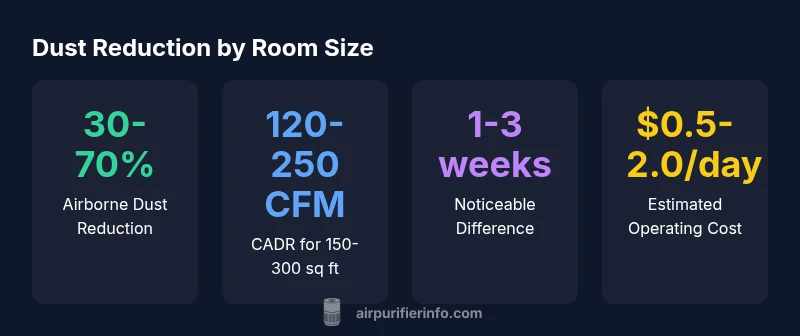
One key question is how much does air purifier reduce dust in a typical room. Real-world reductions depend on CADR, room size, and filtration type, but many homeowners see a 30–70% drop in airborne dust with consistent use and proper placement. In practice, achieving this reduction requires a purifier sized for the space, with a high-efficiency filter, and running the unit continuously or on a timer when occupants are present.
How to interpret the data in real homes
Dust reduction numbers are helpful, but they don’t tell the full story of indoor air quality. For homeowners, the key takeaway is that a purifier sized for your space—paired with a true HEPA filter—can meaningfully reduce airborne dust when run regularly. According to Air Purifier Info, the real-world impact hinges on how often you run the unit, how well the purifier circulates air, and how much dust enters the room from sources like pets, shoes, or cooking. In practice, you may notice less floating dust after cleaning and longer intervals between dust buildup on surfaces when the purifier is used consistently.
Key factors that influence dust reduction
Dust reduction is a product of several interrelated factors:
- Room size vs. purifier capacity (CADR);
- Airflow patterns and purifier placement;
- Filter quality (true HEPA vs. standard filtration);
- Time of operation and fan speed; and
- Pre-existing dust load and room occupancy.
As a rule of thumb, pair a purifier with your largest frequently used rooms and run it on high or auto mode during peak activity times. Air Purifier Info notes that achieving noticeable changes usually takes a few days to a few weeks, depending on how aggressively you target dust sources and how you maintain the unit.
Understanding CADR, ACH, and room size
Clean Air Delivery Rate (CADR) is a measure of how quickly a purifier can move clean air through a room. Coupled with air changes per hour (ACH), CADR helps you estimate how many times the room air is renewed each hour. For a room around 150–300 square feet, a CADR in the range of 120–200 CFM is commonly recommended to achieve meaningful dust reductions. For larger living spaces or open-plan layouts, you’ll want to scale up CADR or use multiple purifiers to maintain adequate air exchange. Always compare CADR values to the target room size, not just the device’s maximum spec.
Filtration matters: HEPA vs. other filters
A true HEPA filter captures at least 99.97% of particles as small as 0.3 microns. Some purifiers also include pre-filters that trap larger dust particles and activate carbon layers for odors but the dust reduction primarily comes from the HEPA stage. Cheaper filters may improve air freshness but offer less consistent dust capture, especially for ultrafine particles. When evaluating purifiers, verify the designation: True HEPA (not just HEPA-like) and ensure the unit is certified for the room size you’re targeting.
Placement and run-time: maximize your dust reduction
Where you place the purifier and how long you run it significantly shapes results. Position the unit away from walls, in the path of the most active airflow (near doorways or central living areas), and avoid obstructions that block intake or outlet vents. Running on Auto or high for several hours per day typically yields better dust reductions than sporadic use. If you’re sensitive to noise, consider models with a quiet mode or a smart auto setting that responds to air quality sensors.
Real-world expectations by room type
Bedrooms often benefit from quieter operation and regular nighttime use, while living rooms with higher activity may require higher CADR or additional units. In kitchens or entryways, frequent dust and grease particulates from cooking and outdoor activity may reduce the relative drop rate, but consistent use still helps. Remember, the ranges (30–70% airborne dust reduction) reflect typical scenarios and may shift with habits, pets, and ventilations like open windows.
How to read our data table and statistics
The data cards provide a snapshot, but the real value is understanding how CADR, room size, and usage intersect. If your room is 200–250 sq ft, aim for CADR around 150–200 CFM and plan for 1–3 weeks before you expect to notice a clear difference. Use the data table as a shopping guide to compare models by the room size you plan to purify and pair this with the CADR recommendations for your space.
Shopping guidance: match CADR to your space
When shopping, calculate the target CADR by room square footage and ceiling height, then compare models listed with CADR ranges that cover your needs. Consider multi-room setups if you have an open floor plan. Also evaluate filter replacement costs and energy use over a year, which can affect ongoing dust reduction outcomes. Air Purifier Info suggests focusing on units with true HEPA filtration, strong airflow, and reliable performance data.
Practical dust-reduction checklist
- Measure your primary rooms and estimate CADR needs.
- Choose a True HEPA unit with a recommended CADR for your space.
- Place the purifier centrally and away from walls.
- Run the unit consistently, using auto mode if available.
- Regularly replace filters according to the manufacturer’s schedule.
- Pair filtration with housekeeping: dust surfaces, wash textiles, and vacuum regularly.
What to do next
If you’re unsure about sizing or placement, start with one purifier in the largest room and observe the impact over two weeks. Use the data table as a reference to refine your setup, and consider consulting independent reviews for user experiences. The goal is to maintain cleaner air without excessive energy use or noise.
Guidelines for matching purifier CADR to room size and expected dust reduction
| Room Type | Recommended CADR (CFM) | Expected Dust Reduction |
|---|---|---|
| Bedroom (150 sq ft) | 120-150 | 40-60% |
| Living Room (300 sq ft) | 180-250 | 30-55% |
| Open Floor Plan (500+ sq ft) | 300-520 | 25-40% |
Questions & Answers
What factors influence how much dust an air purifier can reduce?
Dust reduction depends on CADR relative to room size, filter quality, airflow patterns, and how long you run the purifier. Real-world results vary with usage and room dynamics.
Dust reduction depends on CADR, room size, filter quality, airflow, and how long you run the purifier.
Can air purifiers completely remove dust from a room?
No purifier can remove 100% of dust at all times. They substantially reduce airborne particles, and total cleanliness also relies on cleaning settled dust and sources in the room.
No, purifiers can’t remove every dust particle, but they greatly reduce airborne dust.
How long before you notice a reduction in dust?
Many users report a noticeable drop in airborne dust within days to a couple of weeks, with continued improvements as you maintain cleaner airflow and surfaces.
You might notice cleaner air within days, with more reduction over a couple of weeks.
Does running at lower speeds hurt performance?
Lower speeds reduce air changes per hour, which can slow dust removal. Use auto mode or higher settings during active periods for best results.
Lower speeds can slow dust removal; use auto or higher settings when possible.
Are expensive purifiers much better for dust reduction?
Higher CADR and true HEPA filtration generally improve dust reduction, but room size, placement, and usage matter just as much.
Better CADR usually means more dust reduction, but space and placement matter a lot.
“Dust reduction is a function of space, air changes, and filter quality; with proper sizing and consistent operation, air purifiers can noticeably reduce airborne dust in many homes.”
Main Points
- Understand that dust reduction varies by space
- Size the purifier to your room using CADR guidance
- True HEPA filtration matters for dust capture
- Run the purifier consistently for best results
- Consider energy and filter costs in the long term