Will Air Purifier Help With Dust? A Data-Driven Guide
Explore whether air purifiers reduce indoor dust, how HEPA filters work, how to size a purifier for your space, maintenance tips, and practical setup to maximize dust control in 2026.


Will air purifier help with dust? In most homes, the answer is yes, especially when you use a purifier with a true HEPA filter in a room large enough for its CADR rating. Air purifiers can remove many airborne dust particles, including pollen, pet dander, and fine dust, and work best when you maintain filters and match the unit to room size. Expect gradual dust reduction with regular use.
Dust basics: what dust is and why it matters
Dust is not a single substance; it’s a mix of tiny particles that float in the air and settle on surfaces. In most homes, common components include skin flakes, textile fibers, pollen, dust mites’ debris, pet dander, and minuscule road dirt tracked inside. Indoor dust levels influence how often you need to vacuum and dust, and they matter for people with allergies or asthma. Because dust behaves as a large mix of sizes, some particles stay airborne longer than others, especially smaller particles. An air purifier’s job, in part, is to reduce the concentration of these airborne particles, making the air feel cleaner and less irritating. Will air purifier help with dust? In practice, it depends on whether the purifier is matched to the room, used consistently, and maintained. A well-chosen purifier can noticeably lower the amount of airborne dust over days to weeks.
The science of purifier filtration and dust capture
Most residential purifiers rely on filters that mechanically trap particles as air passes through. The gold standard for dust is a true HEPA filter, which is certified to capture at least 99.97% of particles as small as 0.3 microns. In real rooms, many dust particles are larger than 0.3 microns, so HEPA models remove a large share of the airborne dust. Some units also include activated carbon to tackle odors and VOCs, but carbon alone does not significantly reduce dust. Filtration efficiency interacts with airflow: higher clean air delivery rate (CADR) and proper placement boost outcomes. Finally, any purifier’s effectiveness will degrade if filters are dirty or the unit is routinely run at very low speeds. Regular maintenance and correct sizing are essential to ensure the purifier reliably captures dust as you use it.
How room dynamics affect dust reduction
Dust movement is driven by air currents, doors, and activities like cooking or sweeping. In a small, well-sealed room, a purifier can create an effective micro-environment where airborne dust is captured quickly. In larger or busier spaces, several factors determine results: the purifier’s placement, whether doors are kept closed, and how often the room is ventilated with fresh air. If air in a room stays stagnant or frequently recirculates without being filtered, dust concentrations persist. Practically, you’ll see the best results when you position the device away from obstructions, near the center of activity, and run it at a steady speed for several hours daily. Humidity and temperature can also influence how dust particles behave, but filtration remains the primary tool for airborne removal.
The role of HEPA and other filters in dust control
HEPA filters are the backbone of most dust reduction strategies because they target the most dangerous part of the dust spectrum—the tiny particles that are easily inhaled. Non-HEPA filters (like prefilters) can extend filter life and capture larger debris, but their primary limitation is reduced efficiency for the smallest particles. For odor-focused purifiers that include activated carbon, note that carbon is not a dust killer; it mainly handles smells and VOCs. When shopping, prioritize a true HEPA designation and verify CADR alignment with your room size. For homes with pets or heavy foot traffic, consider models with robust filtration and replaceable parts you can clean without degrading performance.
CADR, room size, and air changes per hour explained
Understanding CADR and room size helps you choose a purifier that meaningfully reduces dust. CADR describes how quickly the purifier can clean air in a given size of room; higher CADR generally means faster dust reduction, assuming the unit is appropriately sized for the space. Air changes per hour (ACH) describe how many times the air within a room is replaced or filtered in an hour. A higher ACH means more frequent dust removal, typically leading to cleaner air over time. In practice, homeowners should aim for a purifier whose CADR roughly matches or exceeds the room’s size, and keep doors closed to maintain a higher ACH. Remember, even the best purifier won’t fix dust if rooms are seldom cleaned or the HVAC system leaks.
Real-world scenarios: apartments, houses, and offices
Apartment living often means smaller rooms and higher dust concentration per square foot; a single purifier with a suitable CADR can make a noticeable difference in the primary living area. In larger houses, multiple units or a larger purifier on the main floor can help, but you’ll likely need to position devices in where dust collects most (near entryways, living rooms, bedrooms). In offices, regular use of purifiers, plus routine cleaning and sealed spaces when possible, yields cleaner air and less surface dust buildup. Across all settings, consistent operation, proper filter maintenance, and mindful placement matter more than the brand name on the box.
Common myths about purifiers and dust
Some people believe purifiers instantly remove all dust. Truth: they reduce airborne dust but do not eliminate settled dust on surfaces. Others think more expensive models always perform better; while price often correlates with feature set and CADR, the right match for your room matters more than sticker price. Another myth is that carbon-only purifiers will solve dust problems; carbon handles smells, not particles. Finally, running a purifier on low speed around the clock may not yield the same results as running at a steady, moderate speed with fresh filters.
How to choose a purifier for dust reduction
Start by measuring the largest room you want to treat and identify a purifier with a CADR suitable for that space. Check for a true HEPA filter, verify that the unit has replaceable filters, and review maintenance schedules. Consider noise, energy use, and ease of cleaning. If you have pets or sensitive occupants, prioritize units with robust filtration, safety features, and accessible filter replacements. Also think about placement: keep at least a few inches from walls, on a stable surface, and away from heat sources. Finally, read user reviews and look for independent testing results.
Practical setup and maintenance to maximize dust reduction
To maximize dust reduction, run the purifier for several hours daily in rooms where dust is most noticeable. Replace filters as recommended by the manufacturer, typically based on usage and dust load. Clean prefilters if your model includes them; wipe the exterior of the unit to remove dust buildup. Pair filtration with regular cleaning: vacuum with a HEPA-equipped vacuum, dust surfaces, and seal cracks where dust enters from outside. If you notice decreased performance over time, reassess room size, placement, and filter condition. With consistent care, you’ll observe the most meaningful dust reductions over days to weeks.
Dust reduction potential in typical rooms
| Aspect | Dust Reduction Potential | Notes |
|---|---|---|
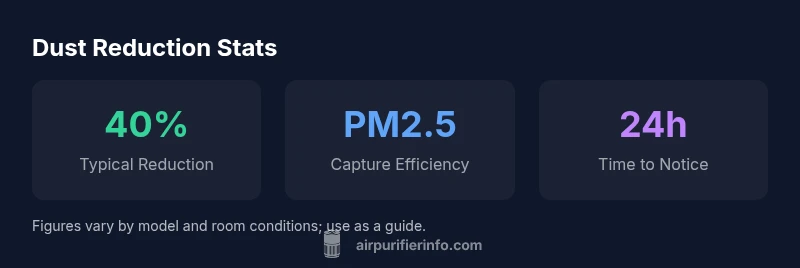
| Airborne dust in living spaces | 10-40% | Depends on CADR and room size |
| Pet dander particles | Moderate | HEPA effective; still requires cleaning |
| Mites and debris | Moderate | Humidity also matters |
Questions & Answers
Do air purifiers help with dust in indoor air?
Yes. Purifiers with true HEPA filters capture most airborne dust particles, including fine dust and dander. Effectiveness increases when sized to the room and maintained with clean filters.
Yes. A HEPA purifier helps with dust, especially when properly sized for the room and kept clean.
What size purifier do I need for my room?
Choose a purifier with a CADR rating that matches your room size. A general guideline is CADR should be appropriate for the room area, and always verify the product specs and your room layout.
Pick a purifier sized for your room and check the CADR rating against the space.
Can a purifier replace regular cleaning?
No. Air purifiers reduce airborne dust but do not replace cleaning of surfaces. Regular vacuuming and dusting remain essential.
No, purifiers don’t replace cleaning; they reduce airborne dust while you still clean surfaces.
How often should I replace the filters?
Follow the manufacturer’s guidelines; typically every 6-12 months for residential use, sooner with high dust loads.
Replace filters as recommended, usually every few months depending on use.
Do HEPA filters catch dust mite debris?
HEPA filters capture many small particles, including dust mite debris and skin flakes, but humidity control also matters for mite reduction.
HEPA captures dust mite particles, but humidity control helps too.
Are there risks with air purifiers?
When used as directed and properly maintained, purifiers are safe. Avoid ozone-generating models and ensure good ventilation where needed.
If used correctly, air purifiers are safe; avoid ozone-producing units.
“Air purifiers with true HEPA filtration substantially reduce airborne dust when paired with proper room size and regular maintenance.”
Main Points
- Choose a purifier with true HEPA and room-appropriate CADR.
- Maintain filters regularly to sustain dust reductions.
- Place purifier where dust levels peak and keep doors closed for best results.
- Combine filtration with regular cleaning to maximize impact.
- Expect gradual improvement over days to weeks.