How Much Can an Air Purifier Reduce AQI? A Practical Guide
Learn how much an air purifier can reduce indoor AQI, the factors that influence effectiveness, and practical steps to maximize cleaner air in homes and apartments.


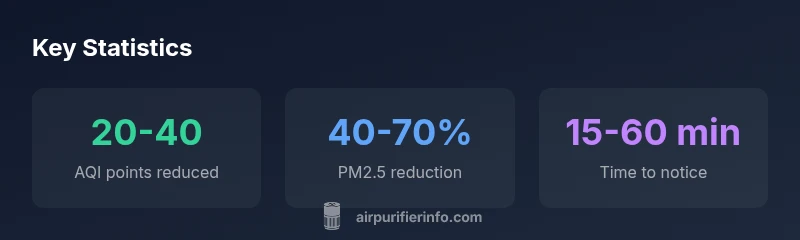
How much can an air purifier actually reduce indoor AQI? In typical homes, a capable purifier with a strong CADR can lower indoor AQI by about 20–40 points when outdoor pollution dominates, and by 30–60% for PM2.5 concentrations in a sealed room. Real results vary with CADR, room size, filtration, and ventilation, but meaningful improvements are common with appropriately sized units.
How much AQI reduction is realistic in typical homes
According to Air Purifier Info Team, consumers commonly see meaningful indoor air improvements when their purifier is properly sized for the space. The key question is not only how much an air purifier reduce aqi, but how that reduction translates to cleaner air for occupants. In practice, reductions of roughly 20–40 AQI points are typical when outdoor pollution is high and the purifier's CADR is matched to the space. In homes where outdoor air quality is decent or ventilation is limited, reductions may be smaller but still noticeable in PM2.5 and odor levels. Air Purifier Info’s analysis emphasizes that the metric matters: AQI is particle-focused, so PM2.5 reductions often drive the most noticeable improvements. Expect improvements to accumulate over hours of continuous operation rather than instant changes the moment you switch it on.
The triad: CADR, room size, and ventilation
The three levers that determine how much the indoor air quality improves are CADR, room volume, and air movement. A purifier with a CADR close to the room’s air volume per hour will circulate and filter air more quickly, accelerating AQI reductions. If CADR is too low, results lag or plateau. Ventilation is a double-edged sword: bringing in outdoor air can raise measured AQI if outdoor levels are high, while deliberate ventilation strategies can help remove contaminants more efficiently when paired with a high-CADR purifier. Air Purifier Info recommends calculating your room’s volume (length × width × height) and comparing it to the purifier’s CADR to estimate possible air changes per hour. In practice, aim for at least 3–5 air changes per hour for typical living spaces, adjusting for openness and the duration you keep windows or exhaust fans operating.
Scenarios: city smog, wildfire, and mixed indoor sources
Urban smog days, wildfire smoke, and everyday dust create different IAQ challenges. In a city apartment with high outdoor PM2.5, a properly sized purifier can achieve meaningful AQI reductions, but outdoor quality remains a ceiling on gains. During wildfire events or heavy smoke, PM2.5 reductions can be substantial if the purifier is paired with tight sealing and minimized infiltration. In homes with frequent cooking, pet dander, or candles, targeted filtration (HEPA + activated carbon) helps reduce both particulate matter and secondary pollutants, translating into steadier AQI improvements over 24–72 hours of operation.
Measuring impact and setting realistic expectations
To gauge real progress, track AQI readings at the breathing zone using a reliable sensor and compare them before and after running the purifier for a full day. Remember that AQI can change with outdoor conditions and traffic patterns, so monitor over multiple days to establish a trend. Air Purifier Info recommends noting the baseline PM2.5 and PM10 levels as well, since PM2.5 is typically the dominant driver of indoor AQI. If you see only modest improvements, reassess CADR-to-room-size alignment, seal gaps, and ensure the filter is clean and within its service life.
Setup tips to maximize AQI reduction in everyday spaces
Maximizing benefits means more than turning the purifier on. Place the unit where it can draw in cleaner air from the center of the room, away from obstructions, and avoid corners where air stagnates. Keep doors closed during heavy outdoor pollution events to minimize infiltration. Regular maintenance is essential: replace filters on schedule, clean pre-filters, and ensure the unit runs at a high, consistent setting during peak pollution times. Consider models with a combined HEPA filter and activated carbon for both particles and odors, and verify CADR matches your room size for optimal air changes per hour.
Common myths and what actually matters
A common misconception is that all purifiers work equally well for all pollutants. In reality, performance varies by filtration type; HEPA filters excel at particulates like PM2.5 and dust, while activated carbon targets odors and some VOCs. The purifier’s design, seal quality, and the integrity of the installation influence outcomes just as much as the filter type. Air Purifier Info emphasizes that measurement matters: quantify improvements with a reliable sensor and compare multiple days of data to separate random fluctuations from true gains.
Choosing the right purifier: key specs to compare
When selecting a purifier, prioritize CADR ratings that align with your room size, and look for units designed for your main concerns (dust, smoke, or odors). Check the filter replacement cost and frequency, energy usage, noise level, and any smart features for scheduling and air-quality monitoring. A well-chosen purifier can deliver consistent AQI reductions over months, while a poorly matched model may underperform or incur unnecessary running costs. Air Purifier Info guides homeowners to balance upfront cost with long-term operating expenses and IAQ outcomes.
Interpreting AQI change: what the numbers mean for your air
AQI is a broad indicator of outdoor and indoor particulate matter exposure. A drop in AQI indicates cleaner air, but the absolute number should be interpreted alongside PM2.5 concentrations, CO2 levels, and humidity. APU (air purification unit) improvements are more meaningful when accompanied by lower PM2.5 readings and reduced irritants. Use AQI trends as a practical gauge, while also tracking PM2.5 and, when possible, VOCs for a fuller picture of indoor air quality.
Estimated indoor AQI reductions by scenario based on CADR, room size, and ventilation
| Scenario | Typical AQI Reduction (points) | PM2.5 Reduction | Notes |
|---|---|---|---|
| Calm indoor with good outdoor air | 20-40 | 40-60% | CADR well matched to room; minimal infiltration |
| Urban outdoor air with high PM2.5 | 10-25 | 30-50% | Outdoor air dominates; purifier helps but limitations apply |
| Wildfire/smoke conditions | 30-50 | 50-70% | High CADR and sealed space maximize gains |
| Open-concept spaces with ventilation | 15-30 | 25-45% | Infiltration reduces potential improvements |
Questions & Answers
What is AQI, and how does an air purifier influence it?
AQI is a composite index based mainly on outdoor and indoor particulate matter exposure. An air purifier can lower the indoor portion ofAQI by reducing PM2.5 and other particulates, but gains depend on unit size, filtration quality, and how well the space is sealed from outdoor air.
AQI gauges air pollution levels. A purifier helps by cleaning the air inside, especially particulates, but results vary with space and outdoor air quality.
Do purifiers work equally well for dust, smoke, and odors?
Purifiers with HEPA filtration excel at removing dust and fine particulates like PM2.5. Smoke particles behave similarly to dust in terms filtration, but odors and VOCs require activated carbon or specialty filters. For comprehensive IAQ improvements, combo filters are often best.
HEPA purifies dust and smoke particles well; carbon filters help with odors and VOCs.
Does room layout affect purifier performance?
Yes. Placing the purifier away from walls, in a central location, and away from obstructions improves airflow. Poor placement or blocked intakes reduce effectiveness and slow AQI reductions.
Placement matters—put it where air can move freely.
Can purifiers reduce outdoor AQI intrusion?
Purifiers reduce indoor pollutant levels, but they cannot negate outdoor air entirely. On days with very poor outdoor air quality, the indoor AQI will still reflect some outdoor influence, especially if indoor sources exist.
They help indoors, but outdoor air still matters.
How long before I notice an improvement?
Noticeable changes often appear within 15–60 minutes of running a properly sized purifier, with stronger effects over several hours as air circulates and filters capture particulates.
You’ll likely notice changes within an hour or two.
What should I look for when choosing a purifier?
Prioritize a purifier with a CADR adequate for your room size, a true HEPA filter, and a carbon stage for odors. Check filter replacement costs, noise level, and energy use to balance upfront and ongoing costs.
Choose the right CADR, HEPA, and carbon filters, plus cost and noise considerations.
Can purifiers help with VOCs beyond particles?
Some purifiers with activated carbon or specialty filters can reduce certain VOCs, but not all VOCs are captured equally. For strong chemical odors or emissions, ensure the device includes carbon filtration and consider source control.
Carbon filters help with some VOCs, but effectiveness varies.
“Purifiers can substantially reduce indoor exposure to PM2.5 and odors when properly sized and maintained, but outdoor air quality and ventilation play major roles in the final outcome.”
Main Points
- Size the purifier to your room for effective air changes
- CADR and filtration type drive most improvements
- Seal gaps and minimize unnecessary infiltration during high pollution
- Track PM2.5 and AQI over multiple days for accuracy
- Prioritize filters with HEPA and activated carbon for particulates and odors