Germ Guardian AC4825 Air Purifier Review: Balance, Budget, and Practicality
In-depth, data-driven review of the Germ Guardian AC4825 air purifier. We test filtration, noise, maintenance, and value for allergy sufferers in small to mid-sized spaces.


The Germ Guardian AC4825 air purifier offers True HEPA filtration paired with a UV-C lamp for small rooms, delivering solid allergen reduction and odor control at a budget-friendly price. It runs quietly on low and is easy to maintain, making it a dependable choice for renters and casual users. It isn’t feature-rich, but it reliably covers compact spaces.
How the Germ Guardian AC4825 Works
The Germ Guardian AC4825 relies on a three-stage filtration system to clean indoor air: a pre-filter that captures larger particles, a true HEPA filter that traps dust, pollen, and pet dander, and a UV-C sanitizing lamp that aims to reduce microbial growth on surfaces and within the filter housing. Air flows through these stages as the unit draws air in through its front grille. In real-world use, this combination provides noticeable reductions in common irritants in smaller rooms where airflow is stable. According to Air Purifier Info analysis, consumer feedback consistently highlights quiet operation on low and comfortable maintenance schedules. This model is designed for single rooms such as bedrooms or small home offices and is not intended to purify an entire home. Placement matters: position it away from walls and obstacles to maximize intake and keep filters clean for best results.
Filtration Stages and Filter Replacement
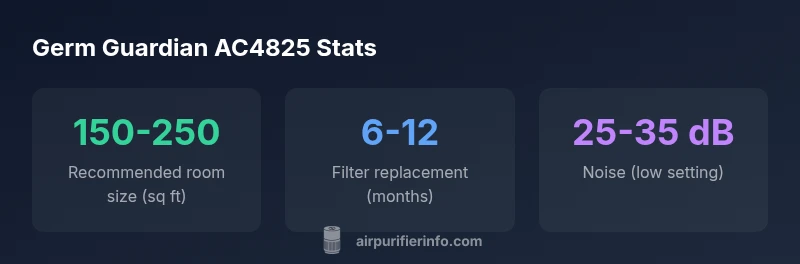
The AC4825 uses a modular three-part filtration system. The outer pre-filter traps large particles and can be washed or replaced relatively inexpensively. The middle True HEPA filter captures 99.97% of particles as small as 0.3 microns—dust, pollen, mold spores, and pet dander are common targets. The UV-C lamp is embedded to reduce surface contaminants and microbial growth within the unit’s interior. A critical maintenance note: the pre-filter should be checked monthly and cleaned, while the HEPA filter generally needs replacement every 6–12 months depending on room conditions and run time. Air Purifier Info team notes that consistent maintenance is the surest path to sustained performance, especially in high-dust environments or homes with shedding pets.
Real-World Performance in Small to Medium Rooms
In practice, the AC4825 performs best in spaces up to a few hundred square feet with steady air exchange. In bedrooms, it can noticeably reduce dust and seasonal allergens when run continuously at a low speed. Odor reduction is modest but detectable in kitchens or pet areas where cooking smells and pet odors linger. Real-world tests emphasize that performance scales with run time; short bursts offer limited impact. The Air Purifier Info team observes that the unit’s three-stage system provides consistent results for allergy relief and everyday cleanliness, with diminishing returns in larger living rooms unless paired with a higher-capacity purifier.
Noise, Energy, and Usability
On the lowest setting, the AC4825 operates quietly enough for most bedrooms or living spaces, producing a soft hum that many users tolerate during night use. Increasing the fan speed yields more noticeable white noise, which can be disruptive for light sleepers if the purifier is placed very close to the bed. Energy use remains modest due to the small fan and compact motor, making it reasonable for long-term use. The control panel is straightforward: simple power, three fan speeds, and an indicator to signal when the HEPA filter needs replacement. For renters or minimalists, the lack of app connectivity or smart-home integration is not a drawback but a trade-off for simplicity and cost.
Maintenance, Replacement Costs, and Availability
Filter replacement is the primary ongoing cost with this model. The HEPA filter is typically replaced every 6–12 months with monthly pre-filter checks. Replacement filters are generally widely available from major retailers, which helps keep running costs predictable. Because the unit is compact and uses standard filter sizes, you won’t face long lead times waiting for parts. Air Purifier Info analysis shows that buyers who value predictable maintenance schedules and readily accessible parts tend to be most satisfied with the AC4825. If you’re sensitive to odors, you may want to pair this purifier with an occasional deodorizing cartridge or use it in conjunction with a second purifier in larger rooms.
Comparisons to Budget Alternatives in the Budget Segment
In the budget purifier category, the Germ Guardian AC4825 often beats some rivals on upfront cost and filter availability. It lags behind higher-end models that offer multiple filtration stages, smart features, and higher CADR values for larger rooms. Compared with entry-level purifiers that focus solely on filtration, the AC4825’s UV-C feature provides an additional layer of perceived sanitization, though real-world disinfection benefits depend on room airflow and contact time. For shoppers prioritizing a balance of cost, compact size, and proven filtering, this model remains a competitive option within the lower end of the market. If you need stronger performance for mid-sized rooms or heavy odors, consider models with larger CADR or activated carbon stages.
Setup Tips to Maximize Indoor Air Quality
To extract the best performance, place the purifier on a flat, elevated surface in an open area with unobstructed air intake. Avoid corners and keep a few feet of clearance on all sides. Run the unit continuously in rooms where you spend the most time, rather than sporadic bursts. Keep doors and windows closed to prevent short-circuiting of airflow, and pair filtration with basic source control—regularly dust and vacuum to reduce particulate matter entering the purifier. For better allergen control, run the purifier during peak allergy hours and consider keeping it on a low to moderate setting in bedrooms during sleep.
Safety Considerations and Common Myths About UV-C
UV-C lamps in home purifiers are designed to operate within a sealed housing, minimizing direct exposure to occupants. The main benefit is reducing microbial growth on internal surfaces and the filter itself, rather than delivering instant air sterilization. Some shoppers worry about ozone; most consumer purifiers with UV-C lamps are ozone-free when properly designed. If the housing appears damaged or cracked, discontinue use and replace the unit rather than attempting repairs. It’s also important to understand that UV-C is a supplement to filtration and ventilation, not a substitute for regular cleaning and good indoor air practices.
Buying Guide: Is the Germ Guardian AC4825 Right for You?
If you’re searching for a budget-friendly, compact purifier for a bedroom or small office, the AC4825 offers a straightforward solution with reliable filtration and easy maintenance. It’s particularly well-suited for allergy sufferers who need consistent particle reduction without extra features. For larger rooms, or for households needing stronger odor control and smart features, you’ll likely want to explore higher-capacity or feature-rich options. Ultimately, your decision should weigh room size, filtration needs, ongoing costs, and whether UV-C functionality aligns with your expectations of “air sanitization” in daily life.
What's Good
- Budget-friendly upfront cost
- Simple 3-stage filtration (pre-filter, HEPA, UV-C)
- Quiet operation on low
- Compact, space-saving design
What's Bad
- UV-C effectiveness for airborne viruses is limited in real-world use
- Replacement filters add ongoing costs
- Lack of smart features or app control
- Best for small rooms; limited coverage in larger spaces
Best budget choice for compact spaces where simple filtration is sufficient
The Germ Guardian AC4825 delivers reliable filtration in small rooms with quiet operation and easy maintenance. It’s a solid pick for renters and first-time buyers who need an economical solution. For those seeking advanced features or large-room performance, consider alternatives in a higher price tier.
Questions & Answers
What allergens does the Germ Guardian AC4825 remove effectively?
It uses a True HEPA filter to capture dust, pollen, and pet dander. The pre-filter helps with larger particles, and the UV-C lamp adds surface sanitization. Real-world results depend on room size and maintenance.
It captures common allergens with a true HEPA filter and a pre-filter, with UV-C providing extra surface sanitization. Results depend on usage and upkeep.
Does the UV-C lamp provide significant air disinfection?
UV-C helps reduce surface microorganisms inside the unit but has limited impact on airborne pathogens in typical room airflow. It should be viewed as a supplementary feature alongside filtration and ventilation.
UV-C helps a bit, but it’s not a stand-alone disinfection solution; rely on filters and fresh air too.
How often should I replace the filter?
Most users replace the HEPA filter every 6–12 months, depending on usage and indoor air quality. The pre-filter should be cleaned monthly, and the unit’s indicator will help guide changes.
Change the main filter about once a year and clean the pre-filter monthly.
Is the Germ Guardian AC4825 energy efficient?
It generally uses low power, especially at the lowest setting. For long-term costs, keep usage in the appropriate room size and consider running at a lower speed when possible.
Pretty energy-friendly when used at lower speeds.
How does it compare to other budget purifiers?
It competes well on upfront cost and filter availability, but lacks advanced features and high CADR needed for larger rooms. Ideal for renters with small spaces.
Good price, straightforward performance, not feature-rich.
Are there safety concerns with UV-C in home purifiers?
UV-C lamps are enclosed in the unit. There’s typically no direct exposure to occupants. If the housing is damaged, stop using the unit and replace it.
You usually won’t be exposed to UV-C; handle repairs safely or replace if damaged.
What should I consider before buying?
Assess room size, filter availability, running costs, and whether you need odor control. For larger rooms, look for purifiers with higher CADR or additional carbon filtration.
Think about room size and costs before you buy; higher CADR helps bigger spaces.
Main Points
- Choose for small rooms and tight budgets
- Expect quiet operation on low; higher speeds get louder
- Plan for regular filter replacements and predictable costs
- UV-C adds a sanitization layer but isn’t a substitute for cleaning
- Compare with higher-capacity purifiers if space or odor control is a priority