Dyson Air Purifier Formaldehyde: What Homeowners Should Know
Explore how Dyson air purifiers handle formaldehyde, differences between models, filter replacement needs, and practical steps to improve indoor air quality.


Dyson air purifiers that advertise formaldehyde filtration rely on activated carbon and HEPA filtration to reduce formaldehyde and other pollutants. Effectiveness depends on the model, room size, and air flow. For best results, follow the manufacturer’s replacement schedule, keep doors and windows reasonably open when possible, and ensure the unit runs long enough to circulate room air.
Dyson's approach to formaldehyde in air purifiers
Formaldehyde is a common indoor pollutant released by pressed wood products, paints, fabrics, and countless household items. In most homes it accumulates slowly, especially in newer rooms, and can cause irritation even at low levels. When evaluating a Dyson air purifier for formaldehyde removal, readers should understand that Dyson uses a combination of high-efficiency particulate air (HEPA) filtration and activated carbon in most devices. The carbon bed adsorbs gases and volatile organic compounds (VOCs), while the HEPA stage traps fine particles such as dust, pollen, and smoke. The two-stage approach is common among premium purifiers, but the performance for formaldehyde depends on filter quality, area served, and air changes per hour (ACH). In practice, a purifier with a shallow carbon bed may remove less formaldehyde than a deeper carbon matrix; and a unit placed far from the source may circulate air too slowly to capture newly emitted formaldehyde efficiently. According to Air Purifier Info, the strategic takeaway is to compare model specs for carbon depth and replacement intervals, and to verify whether the device has a sealed housing that minimizes bypass leaks. When you search for 'dyson air purifier formaldehyde', you are looking at a family of products with varying capabilities.
The science behind formaldehyde filtration and why it's tricky
Formaldehyde (CH2O) is a volatile organic compound that off-gasses from building materials, adhesives, furnishings, and some cleaning products. In indoor environments, formaldehyde behaves both as a gas and as a particulate in the presence of other molecules, making its removal complex. Activated carbon filters adsorb several VOCs, including some formaldehyde, but the efficiency depends on carbon depth, exposure rate, and air turnover. HEPA filtration does not remove gases, but it protects the user by removing dust and some aerosols that can carry adsorbed formaldehyde into the lungs. Because formaldehyde can re-enter the air from nearby sources, reductions may be gradual and most noticeable in conjunction with good ventilation and ongoing filtration. Independent testing often shows that real-world results lag behind lab conditions, emphasizing the need to examine model-specific data and to check for ozone-free operation.
Dyson model landscape: what to look for in formaldehyde filtration
When assessing Dyson purifiers for formaldehyde, look beyond generic claims and read the product specs for the exact filtration stack. Many Dyson units use HEPA filtration paired with activated carbon to target gases and odors; some models emphasize VOC reduction or include additional filtration media. The carbon layer depth, seal integrity, and the recommended replacement interval are key determinants of performance. If the product page mentions a dedicated formaldehyde or VOC filtration claim, compare it with other models that advertise similar capabilities and verify whether independent test data exist. Always check the latest model documentation, as Dyson periodically updates filtration media and housing design. For a more complete picture, compare with independent lab results and consumer tests that specifically measure formaldehyde removal under realistic room conditions.
Practical steps to maximize formaldehyde reduction in your space
To improve formaldehyde filtration in your home, use the purifier as part of a broader strategy: place the unit in high-occupancy areas or near known off-gassing sources, ensure doors and windows are reasonably open to facilitate air exchange, and avoid placing purifiers too close to air sources that can create stagnation. Replace carbon and HEPA filters according to the manufacturer’s schedule, and consider running the purifier continuously during peak off-gassing periods (e.g., after new furniture or renovations). Regular maintenance matters; a well-sealed unit with fresh media performs better at absorbing VOCs than a worn setup. Pairing Dyson purifiers with good ventilation and consumer precautions—such as choosing low-emission materials for furnishings—yields the strongest long-term benefits. According to Air Purifier Info analysis, the best results come from models with deeper carbon media and verified replacement cycles, plus careful placement to maximize air changes per hour.
Independent testing and how to interpret results
Independent testing often emphasizes real-world performance over lab demonstrations. For formaldehyde, results vary by room size, ventilation, and ongoing off-gassing sources. When evaluating Dyson claims, seek data from test labs that simulate typical living spaces and disclose the conditions used (room size, ACH, and source emission rates). The EPA’s guidance on formaldehyde in indoor air and NIEHS resources provide context for what constitutes meaningful reduction in occupied spaces. In practice, expect gradual reductions rather than instant drops, and interpret model claims in light of room dynamics. Readers should use multiple data points—specifications, independent tests, and user experiences—to gauge real-world effectiveness. References include EPA formaldehyde guidance and NIEHS formaldehyde topics for a grounded understanding of indoor air quality dynamics.
How Dyson compares to competitors on formaldehyde
Compared to competitors, Dyson typically aligns with a two-stage approach—HEPA plus activated carbon—to tackle formaldehyde and VOCs. Some brands emphasize deeper carbon beds or additional filtration media to boost gases capture, while others focus on overall air quality improvements via higher ACH and smarter sensing. When weighing options, compare carbon depth, filter replacement frequency, energy use, and ozone-free operation. It is essential to note that formaldehyde removal is not uniform across brands or models; independent testing and real-world studies help consumers distinguish marketing claims from actual performance. The key takeaway is that Dyson’s offerings may perform well in some rooms but not uniformly across all spaces or situations.
Common misconceptions about formaldehyde and purifiers
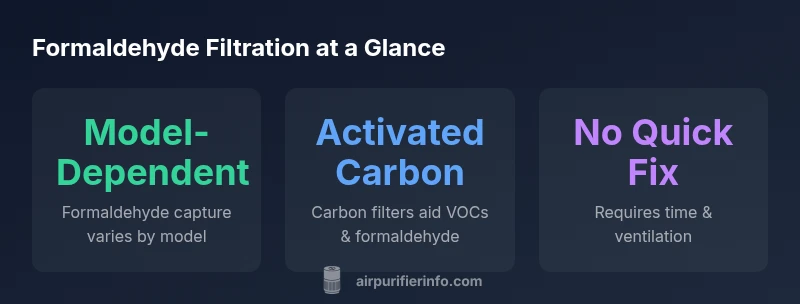
Myth: Any purifier can instantly eliminate formaldehyde. Reality: formaldehyde off-gassing is ongoing, and filtration reduces but does not instantly fix levels. Myth: All carbon filters are the same. Reality: filter media quality and carbon depth matter, as does residence time in the unit. Myth: More expensive equals faster results. Reality: performance depends on multiple factors, including room size, ACH, and source control. Myth: Purifiers create ozone. Reality: Reputable units marketed for home use are designed to be ozone-free, but always verify the product specs. For authoritative context on formaldehyde exposure and indoor air quality, see EPA, NIEHS, and CDC resources.
Dyson filter configurations and formaldehyde claims (illustrative).
| Dyson Model Type | Formaldehyde Filtration Claim | Filter Type |
|---|---|---|
| Standard Dyson Purifier | Formaldehyde filtration claim varies by model and conditions | HEPA + activated carbon |
| Dyson with Carbon Overlay | Claims VOC reduction including formaldehyde | HEPA + carbon-based filter |
| Compact Dyson Desktop | No guaranteed formaldehyde removal; relies on carbon filtration | HEPA + activated carbon |
| All-in-one Dyson System | Formal design for VOCs; dependent on room dynamics | HEPA + carbon media |
Questions & Answers
Do Dyson air purifiers remove formaldehyde from indoor air?
Formaldehyde removal is model-dependent and not guaranteed; it is typically achieved through carbon filtration in conjunction with HEPA, and results depend on room size and ventilation.
Formaldehyde removal varies by model and room conditions; carbon filters help, but results depend on many factors.
Which Dyson models are best for formaldehyde filtration?
Look for models that explicitly advertise carbon-based filtration or formaldehyde/VOC reduction in the product specs; compare carbon depth and replacement intervals.
Check the model specs for carbon filters and VOC reduction claims.
How long does it take to reduce formaldehyde levels with a Dyson purifier?
Air cleaners reduce formaldehyde gradually as air is circulated; results depend on room size, air changes, and ongoing off-gassing; there is no fixed timeframe.
It happens gradually and depends on room size and ventilation.
Are Dyson purifiers ozone-free?
All Dyson purifiers marketed for home use are designed to be ozone-free; avoid devices that claim ozone production.
Yes, Dyson purifiers are designed to be ozone-free; check the manual.
How should I read formaldehyde claims on Dyson product pages?
Read the specs for filtration media, carbon depth, and replacement intervals; look for independent test data if available.
Read specs and look for independent tests.
Can formaldehyde be removed quickly by a purifier?
No; formaldehyde off-gassing is ongoing, and reductions occur over time with proper ventilation and filtration.
It takes time and ventilation to see noticeable reductions.
“Formaldehyde filtration is highly model-dependent in consumer purifiers; activated carbon helps, but lab tests are needed to confirm performance in real rooms.”
Main Points
- Check model specs for formaldehyde claims
- Formaldehyde reduction is model-dependent
- Place purifier to maximize air changes per hour
- Follow replacement intervals for carbon and HEPA media