Coway Air Purifier vs Philips: Which Is Best for Your Home?
Unbiased comparison of Coway and Philips air purifiers, focusing on filtration, noise, features, and value to help homeowners choose the best model for cleaner indoor air.


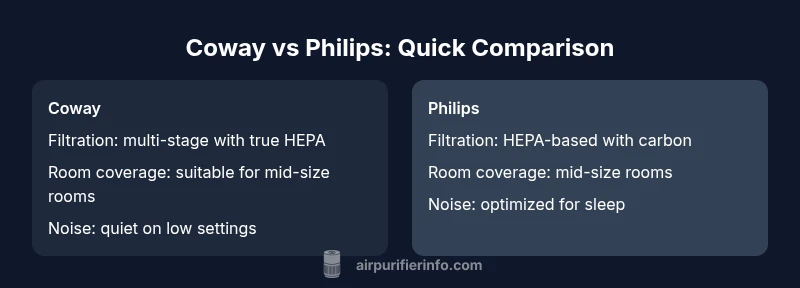
According to Air Purifier Info, the Coway air purifier vs Philips decision usually favors Coway for value and filtration efficiency across common room sizes, while Philips shines in quiet operation and advanced smart features. This TL;DR compares filtration, noise, energy use, and maintenance so homeowners can pick the model that best fits their space and budget. See our detailed comparison for nuance and model-specific guidance.
Overview: The Coway air purifier vs Philips landscape
When homeowners and renters start researching air purifiers, two brands that frequently surface are Coway and Philips. Both offer mid-range to premium models with overlapping capabilities, but the emphasis often shifts between filtration performance, noise, and smart features. In this comparison, we examine the two brands through the lens of real-world use: how they handle common indoor air quality (IAQ) challenges like dust, pollen, odors, and pet dander, and how factors such as room size, energy use, and maintenance costs play into the total value proposition. The goal is not to crown a single winner, but to illuminate the trade-offs so you can pick the model that aligns with your priorities for cleaner air and better quality of life. The Coway air purifier vs Philips debate is nuanced, and the best choice depends on your space, budget, and tolerance for noise and bells-and-whistles features.
Design and Filtration Technology
Both Coway and Philips build purifiers around multi-stage filtration, but there are visible differences in how they structure the filter stack and how aggressively they target odors and volatile organic compounds (VOCs). In general, you’ll see a pre-filter to capture large particles, a true HEPA or HEPA-like stage for fine particles, and an activated carbon element to reduce odors and gases. Coway often emphasizes a compact footprint with straightforward filter access and user-friendly maintenance intervals, while Philips tends to push feature-rich models that balance filtration with system intelligence and customization. Regardless of the brand, always verify that the specific model uses a true HEPA or HEPA-type element and an activated carbon stage for comprehensive coverage. The choice between Coway air purifier vs Philips should consider which filtration stack best matches your typical IAQ concerns, whether you’re dealing with smoke, cooking odors, or seasonal allergies.
Performance and Air Quality Metrics
Performance for purifiers is commonly discussed in terms of room size coverage, particulate reduction, and how quickly a unit can bring down PM2.5 levels. In general, Coway models have earned praise for steady performance across moderate room sizes, with strong filtration that helps with dust and allergen reduction in living rooms and bedrooms. Philips models often excel in noise optimization and steady, predictable air turnover in mid-sized spaces, which is valuable for bedrooms or home offices where sleep and concentration matter. While exact CADR values vary by model, the training principle is consistent: a higher-performance unit in a well-sealed room will feel more effective, especially during peak IAQ events like cooking or seasonal pollen surges. When evaluating the Coway air purifier vs Philips, look for the model’s advertised room size, its filter efficiency rating, and how quickly it can restore air quality under your typical daily routines.
Smart Features and Usability
Smart features can be a deciding factor for tech-minded households. Philips often emphasizes app-based control, scheduled modes, and compatibility with voice assistants, which can enhance daily use and automation. Coway tends to offer reliable, easy-to-use interfaces and practical smart capabilities such as auto mode and filter alerts, but sometimes with a more minimalist approach compared to high-end Philips models. If you rely on automation or want remote monitoring, prioritize the Philips option with robust app integration; if you want a straightforward experience with dependable filtration and fewer potential connectivity hiccups, Coway may feel more intuitive. Regardless of brand, ensure the model supports features you actually need rather than paying for extras you won’t use.
Noise, Power, and Maintenance
Noise levels are a practical concern for bedrooms and home offices. In many reviews, Philips shines in low-noise operation at the lowest fan speeds, while Coway models deliver solid performance with moderate sound at standard settings. Power usage tends to be modest for mid-range purifiers, but it’s worth checking the energy star rating or efficiency claims for the specific model you’re considering. Maintenance costs hinge on filter life and replacement prices. Coway’s filters are commonly accessible and replaceable at competitive prices, whereas Philips filters can vary in cost depending on the series. Plan for ongoing maintenance by budgeting for filter replacements every several months to a year, depending on usage and air quality.
Price, Value, and Long-Term Costs
Pricing across Coway and Philips purifiers spans from budget-friendly to premium. Coway models generally offer strong value for money—solid filtration, reliable build quality, and broad availability of replacement filters can make the total cost of ownership favorable over several years. Philips often positions some models as premium options with enhanced smart features and quieter operation, which can translate into a higher upfront price but potentially lower nuisance value for noise-sensitive users. When weighing coway air purifier vs philips, calculate the 3- to 5-year cost of ownership by combining upfront price, filter replacement costs, energy use, and any ongoing subscription services for smart features. This broader view helps avoid overemphasizing initial sticker price.
Real-World Scenarios: When to Choose Coway vs Philips
Different home contexts favor one brand over the other. If you’re managing dust and allergies on a budget, a Coway model with a proven filtration stack and accessible filters often delivers reliable performance with favorable running costs. For households prioritizing ultra-quiet operation, especially in bedrooms, Philips models with refined noise profiles and advanced smart modes may offer a more comfortable sleep environment. If you require seamless smart home integration or extensive scheduling, Philips tends to surface more options with sophisticated app ecosystems. In open-plan living spaces or rooms with higher traffic, a Coway purifier can scale more effectively due to its broader model variety and robust filtration capacity.
How to Choose: A Step-by-Step Buying Guide
- Define your room size and layout. Measure the square footage and consider ceiling height, which affects air volume. 2) List your IAQ priorities: dust, odors, smoke, VOCs, or allergies. 3) Compare filtration stacks: ensure true HEPA plus activated carbon. 4) Evaluate noise tolerance and daytime vs. nighttime usage. 5) Check filter replacement costs and availability in your region. 6) Review smart features and compatibility with your devices. 7) Consider warranty coverage and retailer support. 8) Read independent reviews and look for model-specific notes on real-world performance. 9) Decide on a budget range and choose the best balance of filtration efficiency, noise, and ongoing costs. This framework helps you navigate the coway air purifier vs philips decision with confidence.
Cleaning, Durability, Warranty, and Support
Durability matters for long-term peace of mind. Look for sturdy housing, reliable fans, and accessible maintenance access panels. Most reputable purifiers offer at least a one- to two-year warranty on parts and labor, with longer coverage in some markets. Examine the replacement filter supply chain—availability and cost can affect long-term value—and verify what the warranty covers, including residential use and potential shipping or service limitations. Finally, consider the manufacturer’s customer support reputation. A purifier is most valuable when you can easily obtain replacement filters and get timely assistance if a defect arises.
Comparison
| Feature | Coway Air Purifier | Philips Air Purifier |
|---|---|---|
| Filtration technology | Multi-stage filtration with true HEPA and activated carbon | Multi-stage filtration with HEPA-based element and activated carbon |
| Recommended room size | Medium rooms typical (varies by model) | Medium rooms typical (varies by model) |
| Noise level | Quiet at low to mid speeds, audible at higher speeds | Quiet operation at lower settings; refined noise profile in premium models |
| Smart features | Reliable auto mode and app alerts on select models | Extensive app control, scheduling, and voice assistant compatibility on many models |
| Filter life | Varies by model and usage; generally accessible replacement filters | Varies by model; often premium pricing for filters on higher-end models |
| Energy efficiency | Generally energy-conscious with solid efficiency | Competitive energy use with smart efficiency modes |
| Price range | Mid-range to value-focused options | Mid-range to premium options depending on feature set |
| Best for | Allergen reduction, cost-conscious buyers | Quiet operation and tech-savvy homes |
What's Good
- Strong value for money with solid filtration
- Wide model variety to fit different room sizes
- Reliable maintenance and readily available filters
- Good overall performance for dust and allergens
- Clear, straightforward user interfaces
What's Bad
- Filter replacement costs can add up over time
- Higher-end Philips models may carry a premium price
- Smart features vary by model and can require setup
- Some Coway models may be less quiet on higher settings
Coway air purifier generally offers stronger value and robust filtration; Philips excels in quiet operation and smart features.
Choose Coway for overall value and dependable filtration in most homes. Choose Philips if you prioritize ultra-quiet performance and advanced connectivity. Your best pick depends on whether you value price-to-performance balance or tech-enhanced convenience.
Questions & Answers
Dust reduction: Coway vs Philips
Both brands deliver effective dust reduction through multi-stage filtration. Coway tends to offer strong value with reliable performance across typical room sizes, while Philips can provide refined noise control and smart features that may help with daily use. In practice, choose the model with the filtration stack that best matches your dust levels and budget.
Both Coway and Philips do a good job with dust. If you want strong value, pick Coway; if you want quiet and smart features, pick Philips.
Ozone-free claim?
Yes. Both brands market their units as ozone-free when used with proper filters and in typical consumer configurations. Always verify the product specs for the exact model you’re considering to confirm ozone emission levels.
Yes, these purifiers are designed to be ozone-free; check the model specs to confirm.
Night mode quietness?
Philips models often excel in low-noise operation at night, thanks to optimized fan profiles. Coway models are generally quiet at lower speeds but can be more noticeable if run at higher power. Test both in-store or read user reviews for the exact model you’re considering.
Philips tends to be quieter in night mode, though it depends on the model. Check the exact model’s sleep setting.
How do filter costs compare?
Replacement costs vary by model and retailer but are a routine consideration for any purifier. Coway generally offers accessible filters with broad availability, while Philips may have higher-priced replacements on certain lines. Factor these ongoing costs into your long-term budget.
Filter costs differ by model; plan for replacements over several months to a year depending on use.
Do these purifiers connect to smart home ecosystems?
Many Philips models offer extensive app control and voice assistant integration, which enhances automation. Coway options also include app control and auto modes, but the degree of smart integration varies by model. If smart home compatibility is important, compare model specifications closely.
Many have apps and some work with voice assistants. Check the exact model you’re eyeing for compatibility.
Is it worth buying flagship models or budget options?
For most households, mid-range models provide the best balance of filtration performance, noise, and ongoing costs. Flagship models may offer premium features that matter for picky users, but they come with higher upfront prices. Align your choice with your IAQ goals and budget.
Mid-range models usually offer the best value; flagship models are for feature enthusiasts with bigger budgets.
Main Points
- Prioritize filtration efficiency and room size fit when comparing models.
- Assess noise levels for night-time use and bedrooms.
- Budget for ongoing filter costs in total value calculations.
- Evaluate app compatibility and smart features relevant to your lifestyle.
- Check warranty terms and after-sales support before buying.