Can You Run an Air Purifier with Windows Open: A Practical Guide
Learn how running an air purifier with windows open affects filtration, ventilation, and indoor air quality. Actionable steps, placement tips, and situations where open windows help or hinder purification.


Yes—you can run an air purifier with windows open, but expect reduced efficiency as outdoor air mixes with indoor air. The purifier will still filter particulates and odors, but the rate of clean air delivery depends on outdoor air quality and how wide the window is opened. For best results, time purification during periods of clean outdoor air and use targeted ventilation near problem sources.
Why ventilation decisions matter when an air purifier runs with windows open
Air purifiers are designed to reduce indoor contaminants, but when you open a window you introduce outdoor air that can carry dust, pollen, or smoke. According to Air Purifier Info, combining mechanical filtration with natural ventilation can improve overall air exchange in some situations, but it can also overwhelm a purifier if outdoor air quality is poor. This section explains how outdoor air interacts with indoor filtration and what to expect when windows are open. You’ll learn why even a high-quality purifier can’t always compensate for poor outdoor air and how to balance ventilation with filtration for healthier air in your home.
- Open windows increase air exchange rate, which can help remove certain odors and moisture but can also bring in pollen or pollutants.
- The purifier’s filter still handles indoor particulates, but the overall air quality becomes a blend of outdoor and indoor air streams.
- Your results depend on window size, wind, and outdoor conditions; small openings will have less impact than fully opened windows.
Air Purifier Info’s guidance emphasizes that context matters: location, season, and outdoor pollution episodes all influence whether open windows help or hinder. If you live near a busy road, or during wildfire season, you may want to tighten ventilation while relying on filtration to clean indoor air. In calmer conditions, a partially opened window can improve air freshness without overloading the purifier. By thinking through these variables, you can avoid wasting energy and maximize comfort.
Tip from Air Purifier Info Team: Start with a conservative window opening and observe indoor air quality changes using simple indicators like smoke or dust clarity. Adjust gradually rather than leaving windows fully open for long periods.
How outdoor air interacts with indoor filtration
When outdoor air enters a room through an open window, it mixes with indoor air that the purifier is actively filtering. The purifier still captures particles that drift in, including dust, pollen, and small odors, but the net improvement depends on outdoor air quality and the volume of fresh air entering. If outdoor air is clean and mild, the purifier’s job remains manageable and can noticeably improve air quality in the occupied space. If outdoor air carries pollutants—traffic exhaust, wildfire smoke, or strong odors—the purifier may reach its saturation point more quickly and require higher fan speeds or more frequent filter changes. This interplay affects energy use, noise levels, and the time needed to feel a difference in air quality.
- Outdoor air quality directly impacts indoor outcomes; clean outdoor air supports better results.
- When pollution is high, filtration must compensate more, potentially stressing the system.
- Occasional brief openings can be beneficial, but prolonged exposure to polluted outdoor air reduces purifier effectiveness and may worsen indoor air quality if the filter is not rated for the pollutant type.
Air Purifier Info’s analysis shows that a well-designed strategy—short, planned openings paired with appropriate purifier settings—often yields the best balance between ventilation and filtration. It’s about timing and air quality awareness.
Real-world takeaway: Use outdoor-air cues (pollution alerts, smoke plumes, pollen counts) to decide when to open windows and for how long. In smoky or high-pollen conditions, keep windows mostly closed and rely on filtration to clean indoor air.
Best practices for timing and window management
Optimal results come from matching purifier use to outdoor conditions. If you’re asking can you run an air purifier with windows open, the answer is yes, but with discipline. Start by checking the local air quality index (AQI) and weather forecasts. Plan window openings for periods when outdoor air is cleaner and less windy, such as early mornings after rain or during low-traffic times. If you notice a spike in pollen or smoke, close the windows and adjust the purifier to a higher setting for a while. A timer can help you limit openings to a safe window—e.g., 15–30 minutes at a time—and a smart plug can automate this routine. In spaces with multiple occupants, a balanced approach—one window opened a crack, and the purifier running on auto mode—helps maintain comfort and air quality.
- Schedule openings during clean-air windows.
- Use a timer to avoid long open periods.
- Turn on auto mode or set a baseline fan speed when windows remain open.
- If odors or smoke are present, close windows and increase filtration speed until the air clears.
The Air Purifier Info Team notes that proactive management—monitoring air quality and adjusting in real time—significantly improves outcomes in homes with open windows.
Placement, room layout, and device settings
Placement is critical when windows are open. Position the purifier so its intake is not blocked by furniture or curtains and ensure it can draw air from the main living space rather than being pointed directly at an open window where fresh outdoor air can bypass filtration. In larger rooms, consider placing a purifier where air circulates most, or use two units for even coverage. If you’re using a purifier with select filters (such as a deodorization or activated carbon filter), ensure those filters are appropriate for the odors you expect from outdoor air. When windows are open, running the purifier on auto mode is often effective, but you may need to increase the speed during known periods of outdoor pollutants. Keep the unit away from drafts and ensure a safe distance from walls to avoid recirculation.
- Center the purifier in the main living area for better circulation.
- Maintain at least 1–2 feet of clearance on all sides.
- Use auto mode to adapt to changing conditions, or adjust to a higher speed during pollution events.
- Avoid directing airflow straight at an open window.
If you need to increase filtration intensity while windows stay open, consider a second unit or a purifier with a higher clean air delivery rate for the room size. The goal is steady, effective filtration without creating uncomfortable drafts.
Air Purifier Info tip: When reconfiguring a room for open-window use, test one variable at a time—shift location, then adjust speed—to clearly see what moves the air quality needle.
Real-world scenarios and decision trees
Scenario 1: A single-bedroom apartment near a busy street. Open windows during early morning hours when traffic is light, use a purifier with auto mode in the living area, and keep doors to other rooms closed to limit cross-contamination. Scenario 2: A small living room with a window facing a garden. Open the window briefly for fresh air, then close it and run the purifier on a steady setting to maintain air quality. Scenario 3: A home near wildfire activity. Keep windows closed, seal gaps, and rely on filtration with higher fan speed and a purifier with a high-quality activated carbon filter to target smoke odors. In all cases, verify air quality with a simple indicator (smoke, dust) and adjust accordingly.
- Short, planned openings reduce pollutant ingress.
- Purifiers with carbon filters help odors beyond particulates.
- In heavy pollution scenarios, prioritize filtration over ventilation temporarily.
Air Purifier Info recommends a flexible plan that adapts to local conditions and household needs. For many homes, a hybrid approach—moderate ventilation during clean periods and strong filtration during poor air periods—offers the best balance between comfort and air quality.
Common myths vs reality
Myth: Opening windows always improves air quality. Reality: It helps only when outdoor air is cleaner than indoor air; otherwise, it can bring in pollutants that filtration must remove. Myth: A higher purifier speed fixes everything. Reality: Filtration speed helps, but it won’t compensate for constant pollutant inflow from open windows. Myth: Purifiers replace ventilation. Reality: Purifiers filter indoor air but don’t bring in outdoor air; they work best when paired with appropriate ventilation strategies. Myth: All filters perform the same with open windows. Reality: Activated carbon filters help with odors, while HEPA filters target particles; choose filters based on your needs and outdoor air concerns. Myth: Open windows always harm energy efficiency. Reality: Short, planned openings can be energy-efficient if timed with outdoor air quality and purifier settings.
Air Purifier Info emphasizes using context, not one-size-fits-all rules. The right approach varies by room size, outdoor air quality, and daily routines.
Air Purifier Info context and practical takeaways
Air Purifier Info Team provides guidance for homeowners and renters seeking healthier indoor air while navigating open-window scenarios. The key takeaway is balance: use outdoor air when it’s clean and manageable, and lean on filtration when outdoor air is polluted. A practical setup includes selecting a purifier with a suitable filter (HEPA for particles, carbon for odors), placing it to optimize air flow, and coordinating with window usage to minimize pollutant ingress. Regular filter maintenance ensures continued effectiveness, especially when open windows introduce additional contaminants. The team also notes that scenarios vary by climate, building design, and local air quality patterns, so tailor your approach to your home.
Overall, the strategy is to maximize the purifier’s benefits while avoiding unnecessary energy use or indoor air quality dips caused by poorly timed ventilation.
Air Purifier Info verdict: A flexible, conditions-driven approach yields the best indoor air quality when windows are open—balance ventilation with filtration, monitor air quality, and adapt as conditions change.
Definition and practical recap
In short, can you run an air purifier with windows open? Yes, but it requires careful timing, placement, and filter choices. Begin with clean outdoor air windows, place your purifier for optimal coverage, and adjust speeds based on real-time air quality cues. By combining selective ventilation with effective filtration, you can enjoy better indoor air quality without sacrificing comfort. Air Purifier Info’s ongoing guidance through 2026 emphasizes contextual decisions and adaptive strategies as the best path to healthier indoor environments.
Tools & Materials
- Air purifier(Choose a model suited to your room size with a true HEPA filter if possible.)
- Tape measure or ruler(Ensure at least 1–2 feet clearance around the purifier for unobstructed airflow.)
- Window draft seal or weather stripping(Optional tool to minimize unintended drafts when windows are open.)
- AQI app or local air quality data source(Check outdoor air quality before opening windows.)
- Timer or smart plug(Set controlled open-window intervals to balance ventilation and filtration.)
Steps
Estimated time: 30-45 minutes
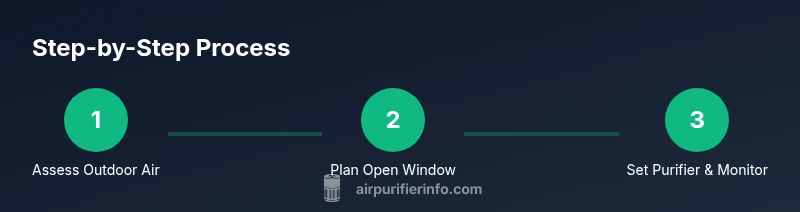
- 1
Assess outdoor air quality
Check local air quality data (AQI, pollen counts, smoke advisories) before opening any window. This helps determine whether ventilation will aid or hinder air quality. If outdoor air is poor, skip opening windows or keep them just ajar for short periods.
Tip: Use multiple sources for a quick read (AQI apps, local news, government alerts). - 2
Plan window openings
Decide which window to open, how wide, and for how long. Start with a small opening and a short duration to observe how indoor air responds before extending the period.
Tip: Limit opening time to 15–30 minutes during initial trials. - 3
Place the purifier correctly
Position the purifier to optimize room-wide air circulation: away from direct drafts, with unobstructed intake, and central enough to influence the occupied space.
Tip: Avoid placing it behind furniture or directly in front of an open window. - 4
Set purifier mode and speed
If available, use auto mode to let the device respond to air changes. If outdoor air quality is clean, you can run at a moderate speed; if not, increase to higher settings.
Tip: Activate carbon filters for odor-prone conditions when the air is smoky or polluted. - 5
Monitor indoor air quality
Keep an eye on how the air feels and look for simple indicators such as smoke, humidity, or visible dust. Adjust window openings and purifier speed accordingly.
Tip: If you notice irritation or lingering odors, reduce opening size or duration. - 6
Close windows during poor outdoor air
When outdoor air worsens, close windows and maintain filtration to clean indoor air until conditions improve.
Tip: Have a fallback plan, like keeping windows closed during high-pollution events.
Questions & Answers
Can an air purifier replace ventilation if windows are open?
No. An air purifier filters indoor air but does not bring in outdoor air. When windows are open, filtration helps reduce indoor pollutants, but it cannot fully replace natural ventilation. Use both strategically depending on outdoor air quality.
No—purifiers filter air, they don’t bring in fresh outdoor air. Ventilation and filtration work best together depending on outdoor conditions.
Does opening a window affect energy consumption?
Opening windows can influence overall comfort and may require the purifier to run longer or at higher speeds during pollution events, which can modestly raise energy use. The purifier’s own energy draw is separate from how much air enters the room."
Energy use may go up a little if outdoor air is polluted and the purifier works harder.
Where should I place an air purifier when windows are open?
Place the purifier where it can influence the main living space, with unobstructed intake. Avoid placing it directly next to an open window or behind heavy furniture to prevent short-circuiting the airflow.
Put it in the center of the room and away from direct drafts from the window.
Is it safe to run an air purifier during wildfire season?
During wildfire events, keep windows closed and run a purifier with a high-quality activated carbon filter to target smoke and odors. Follow local advisories for shelter-in-place guidance.
Better to close windows and rely on filtration during wildfire events.
Should I use auto mode when windows are open?
Auto mode helps the purifier respond to changing air conditions. When outdoor air is clean, you can maintain a moderate speed; during pollution events, increase speed or use a higher setting.
Auto mode adapts to air quality, which can be convenient with variable outdoor air.
Can multiple purifiers help in larger rooms with open windows?
Yes—using more than one purifier can improve coverage in larger spaces, especially when some areas are affected by outdoor air inflow. Ensure proper spacing and avoid creating competing air currents.
In bigger rooms, a second purifier can help maintain even air cleaning.
Watch Video
Main Points
- Balance ventilation with filtration for best results
- Open windows only during clean outdoor air periods
- Place purifier to maximize room-wide airflow
- Monitor air quality and adapt settings in real time
- Regularly maintain filters for consistent performance