Can You Put an Air Purifier Up High? Placement Tips
Learn whether you can put an air purifier up high and how height affects airflow and effectiveness. This guide covers room-by-room placement, safety, maintenance, and practical setups to optimize indoor air quality.


Yes, you can place many air purifiers up high, but effectiveness depends on intake design and room layout. Ideally position the unit away from walls and furniture, at least 3–4 feet off the floor, and ensure the air intake and exhaust have unobstructed paths for optimal circulation. Factors like room occupancy, ventilation, and CADR also influence whether elevated placement is best. In many layouts, mid-height on a stable stand offers reliable performance without risk of tipping.
Why height matters for air purifiers
If you’re wondering can you put an air purifier up high, the short answer is: it depends on the model and the room. Height influences how air moves through the intake, how quickly particles are captured, and how evenly clean air is distributed. Most purifiers pull air in from their front or top and emit cleaned air from vents that may face outward. Elevating the unit can reduce floor-level dust and pet hair near carpets, but it can also shrink the effective intake path if the device expects ground-level airflow. For homeowners and renters, the best approach is to balance placement for strong airflow with safety and accessibility. In practice, you want clear space around the unit, avoid direct contact with walls or furniture, and keep cords managed. If you measure roughly where people breathe most (sitting height in the living room or bedroom) and test airflow after placement, you can verify whether the height is helping or hindering air exchange. This guide walks you through practical height guidelines, model considerations, and room-by-room tips to optimize air quality.
How to evaluate purifier design for high placement
Not all purifiers perform the same when elevated. Look for models with intake openings on multiple sides or a front/top intake that remains efficient when tilted slightly up. Check the user manual for minimum clearance requirements around the intake and exhaust vents, and prefer a unit with a balanced airflow pattern that distributes clean air broadly rather than shooting it in a narrow stream. If you plan to place the purifier on a shelf or high stand, ensure the design supports elevated placement and that cords won’t snag or pull the unit. A model with a stable base and a low profile can minimize wobble and maximize airflow even when higher than typical desk height. Finally, consider the unit’s noise profile; higher placement can magnify or attenuate audible fan sounds depending on where the cabinet or shelf sits relative to seating areas.
Room-specific placement guidelines
Living room: Place the purifier where it can draw air from the primary seating area without being blocked by furniture. Avoid corners, as still air can reduce overall circulation. Bedroom: If possible, position at mid-height in a location where air travels across the bed area, not directly toward the sleeping person. Kitchen and dining areas generate humidity and odors; avoid placing purifiers directly next to stoves or vents to prevent rapid filter loading. General tips: keep the unit away from walls by a few inches, avoid stacking items around it, and allow for unobstructed intake and exhaust paths. If you must place high, ensure the surface is stable and easy to access for filter changes.
Safety and stability considerations
Elevated placement introduces tipping risks if the surface is unstable or top-heavy. Use a sturdy shelf, table, or wall-mounted stand that can bear the purifier’s weight. Secure cords to prevent tripping, and avoid high placements near edges where a knock could tip the unit. For households with children or pets, consider a fixed mounting option or a closed cabinet with proper venting rather than an open shelf. If you ever feel air movement is restricted or the unit is hard to reach, reposition to a more accessible height while maintaining airflow.
Practical high-placement setups: living room, bedroom, kitchen
Living room setups often work well with a mid-to-high shelf that clears seating areas. In bedrooms, aim for a height that aligns with breathing zone comfort while keeping the unit out of direct reach of bedtime pets. In kitchens, consider a placement that avoids direct exposure to steam and grease yet still draws in signatures of cooking odors. The key is to test airflow after placement: observe how quickly room air feels fresher and whether the purifier’s intake remains clear. If airflow seems weak, try lowering the unit slightly or moving it away from walls to open airflow paths.
Maintenance and accessibility when placed high
High placement can complicate filter access. Choose models with accessible front panels or bottom compartments for easy filter changes. Keep a small step stool nearby and maintain a regular filter replacement schedule according to the manufacturer’s recommendations. Wipe down the exterior surfaces to prevent dust buildup from higher shelves. Regular maintenance ensures sustained performance even when the unit sits several feet off the floor.
Testing and validating airflow after relocation
After repositioning, validate performance with a simple check: feel the airflow at multiple seating positions and observe dust settling in the room. If you have an affordable air quality monitor, track changes in PM2.5 levels over a 24–48 hour period to quantify improvement. Compare readings with the purifier off and then on to estimate the incremental benefit of height changes. Small improvements in air quality can be meaningful for allergy or asthma-prone households, especially when combined with other filtration strategies.
Tools & Materials
- Stable elevated surface (shelf, table, or stand)(Ensure surface supports the purifier’s weight and height while maintaining airflow clearance.)
- Step stool or small ladder(Use for safe access to elevated placement; never stand on unstable surfaces.)
- Power extension cord or nearby outlet(Keep cords tidy and avoid overloading outlets; route away from high-traffic areas.)
- Cable management ties(Optional for clean routing and to prevent accidental tugging.)
- Measuring tape or ruler(Helpful for estimating a consistent height across rooms.)
Steps
Estimated time: 20-30 minutes
- 1
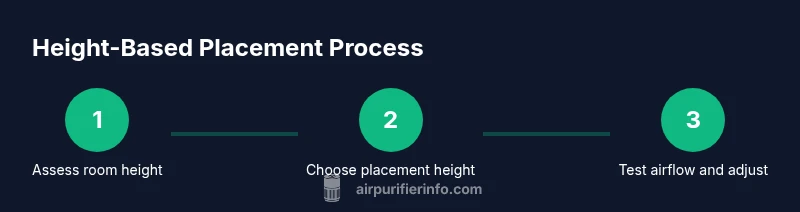
Assess room height and target height
Measure floor-to-sitting-height in the primary living or sleeping area and decide a practical height that keeps air moving without blocking views or pathways. This helps determine whether mid-height or high placement is appropriate for your purifier model.
Tip: Use a tape measure and mark a temporary height on a wall with painter’s tape to visualize airflow before moving the unit. - 2
Gather tools and move the purifier
Collect a step stool, extension cord, and the chosen elevated surface. Clear the path to the placement area to avoid tripping while lifting the purifier.
Tip: Have a helper hold the unit during the initial lift if it’s heavier than expected. - 3
Clear the area around the surface
Remove nearby objects that could obstruct intake or exhaust vents or that could be knocked over. Ensure there’s several inches of clearance on all sides.
Tip: Check that furniture or decor does not block the unit’s grill or airflow path. - 4
Position the purifier on the elevated surface
Set the purifier on a stable, level surface. Confirm it cannot tip and that cords won’t strain the plug when the unit operates at full power.
Tip: Place the purifier so intake is not facing directly into a wall or cabinet. - 5
Orient intake and exhaust correctly
Adjust the unit so the intake has access to room air and the exhaust disperses air away from walls and seating areas. Avoid pointing exhaust directly at curtains or textiles.
Tip: If the unit has moving parts, minimize vertical angling that could reduce efficiency. - 6
Route and secure the power cable
Plug into a nearby outlet and secure the cord with ties or clips to prevent snagging. Do not run cords across walkways.
Tip: Use a power strip with overcurrent protection if a single outlet is insufficient. - 7
Test operation and stability
Turn on the purifier and listen for unusual vibrations or wobbling. Confirm there is unobstructed airflow in multiple directions from the unit.
Tip: Press the unit gently to check stability; if it wobbles, re-seat on a more stable surface. - 8
Verify airflow and adjust height if needed
Observe air movement in the room after several minutes. If airflow seems weak, lower the unit slightly or shift it away from walls to improve intake.
Tip: Keep a small log of room air readings after each adjustment to track improvements.
Questions & Answers
Is it better to place the air purifier on the floor or on a shelf?
Both options can work depending on the purifier design and room layout. A shelf or high stand can improve air mixing in larger rooms, while floor placement often yields easier filter access and stable airflow. Always ensure adequate clearance around intake and exhaust.
Both floor and shelf placements can work, depending on the model. Choose the height that preserves airflow and accessibility while keeping the unit stable.
Can placing it high affect CADR or cleaning rate?
Placement height can influence how quickly air is drawn into the unit and how well clean air spreads. If the intake is optimized for higher placement, CADR remains strong; otherwise, performance may drop slightly. Test airflow to confirm.
Height can affect how fast the purifier cleans the room, so test after repositioning to ensure it still performs well.
Are there safety concerns with using a tall purifier?
Yes, stability is key. Use a sturdy surface, secure cords, and avoid high placements where the unit could tip. If in doubt, lower the unit to a safer height.
Tipping is a real risk—use stable surfaces and secure cords to keep everyone safe.
Should I mount the purifier to a wall or cabinet?
Wall mounting is an option for some compact purifiers with mounting kits. Check the manufacturer’s guidelines for weight limits and vent clearance before proceeding.
Wall mounting is possible for some models, but follow the maker’s instructions to ensure safety.
Does height help with pet dander or allergies?
Elevated placement can help if it clears ground clutter that traps pet dander. However, focus on models with true HEPA filtration and proper CADR suited to the room size.
Height can help a bit, but the right filter and room size matter most for allergies.
What should I do if airflow seems weak after moving it up high?
First, check for obstructions and confirm adequate clearance. If still weak, lower the unit slightly or reposition away from walls, then re-test after a few minutes.
If airflow drops, adjust the height a bit and verify nothing is blocking the intake.
Watch Video
Main Points
- Place purifier at a height that balances airflow and accessibility
- Ensure stable, sturdy placement with clear intake paths
- Maintain safe cord management to prevent trips
- Test airflow after repositioning and adjust if needed
- Schedule regular filter changes based on manufacturer guidance