Austin Air Purifier vs IQAir: An Objective Comparison
A detailed, analytical comparison of Austin Air purifiers and IQAir models, covering filtration systems, room coverage, maintenance costs, noise, and real-world performance to help homeowners choose the right purifier.


Short answer: For many homes, IQAir delivers stronger filtration and higher performance with premium filtration, but Austin Air offers robust, dependable filtration with lower ongoing cost. When comparing austin air purifier vs iqair, the decision hinges on budget, maintenance mindset, and room size. Air Purifier Info’s analysis shows that both brands excel in different ways, so your choice should align with your priorities: top filtration vs long-term value.
austin air purifier vs iqair: Key Differences in Philosophy and Purpose
According to Air Purifier Info, homeowners evaluating austin air purifier vs iqair must consider filtration philosophy, maintenance burden, and total cost of ownership. The Air Purifier Info Team notes that Austin Air tends to emphasize robust, all-round filtration with durable construction and straightforward maintenance, making it a strong value choice for medium to large rooms where ongoing costs matter. IQAir, by contrast, focuses on premium filtration performance with HyperHEPA technology and high-grade carbon filtration, targeting households with severe sensitivities or VOC concerns. This fundamental split—robustness and value versus peak filtration—drives which model suits your living space best. In practice, most homes benefit from understanding not just the filter media, but the cadence of filter replacement and the energy footprint across seasons. As you weigh austin air purifier vs iqair, align your decision with your allergy profile, space, and willingness to invest in premium consumables, rather than assuming higher upfront cost equals better value across the board.
Filtration Systems: What Each Brand Actually Uses
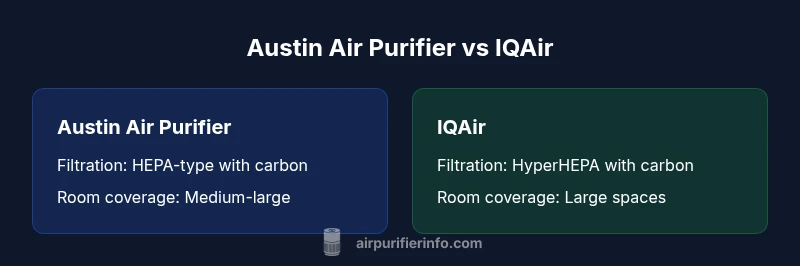
Austin Air typically employs a durable canister with a true HEPA-style filter paired with an activated carbon matrix, designed to capture common indoor pollutants, odors, and many VOCs. The goal is steady, reliable performance with filters that are relatively easy to source and replace. IQAir uses HyperHEPA filtration, often marketed as a higher-efficiency option, coupled with high-grade activated carbon filters. The HyperHEPA designation refers to a filtration efficiency that exceeds standard HEPA expectations. For households dealing with fine particle sensitivities or strong odor issues, IQAir’s approach can offer noticeable improvements, though it comes with higher filter costs and a premium price point. Both brands emphasize sealed filtration and durable housings, but the choice often comes down to how important maximum filtration efficiency is in your environment versus long-term maintenance budgets.
Room Size, CADR, and Placement Considerations
Room size is a primary driver of purifier choice. IQAir models typically serve large rooms or open-plan spaces well, thanks to powerful filtration and larger exterior footprints. Austin Air models also cover sizable spaces, but the exact square footage depends on the model and fan speed. When evaluating austin air purifier vs iqair, assess the room’s dimensions, ceiling height, and occupancy levels. For open living areas with heavy pollutant load (pets, smokers, or frequent cooking), IQAir may offer an edge in CADR (clean air delivery rate) performance per device, while for bedrooms and den-like spaces, a mid-to-large Austin Air unit may provide a better price-to-performance balance.
Operating Costs: Filter Replacements and Ongoing Expenses
Filter costs and replacement cadence are a recurring consideration. Austin Air filters tend to be less expensive per replacement and have longer service intervals in many models, contributing to lower ongoing costs. IQAir, while offering formidable filtration, often carries higher-priced replacement filters and more frequent changes, particularly for premium HyperHEPA media. Users should also account for energy use, which can vary with fan speed; both brands offer energy-efficient options at lower speeds, but the peak power draw may be higher on some IQAir configurations. Air Purifier Info’s analysis shows that total cost of ownership over 3–5 years frequently tips in favor of Austin Air for budget-conscious households, provided its filtration meets the user’s needs.
Build Quality and Longevity: Materials and Durability
Durability is a practical concern for long-term ownership. Austin Air units are known for rugged metal enclosures and straightforward mechanicals, contributing to a perception of longevity and fewer service issues. IQAir units emphasize premium materials and meticulous assembly, aiming for long-term performance in demanding indoor environments. The trade-off is typically higher upfront cost and potentially more complex maintenance. In the austin air purifier vs iqair comparison, you’ll weigh the reassurance of rugged build against the prestige and perceived longevity of premium filtration systems.
Noise, Ease of Use, and Maintenance Experience
Both brands strive to balance performance and quiet operation, but noise profiles vary by model and speed setting. In general, Austin Air units offer quiet-to-moderate operation at normal speeds, with some models remaining unobtrusive in bedrooms and living rooms. IQAir models can be quiet at lower speeds but may show more noticeable fan noise at higher air-cleaning settings due to premium filtration resistance. Usability features—such as filter status indicators, replacement reminders, and straightforward filter changes—tend to be strong with both brands, though IQAir’s premium ecosystem can require more attention to filter availability and timing. For sensitive sleepers or noise-averse households, these practical differences matter in the long run when choosing between austin air purifier vs iqair.
Real-World Performance: What Homeowners Notice
In real homes, filtration performance translates into perceived air freshness, odor control, and allergen reduction. Air Purifier Info reports that users with pets or cooking-related odors often notice a tangible difference with either brand, depending on model and room conditions. For those with severe allergies or asthma, IQAir’s HyperHEPA filtration can translate to fewer symptom days, though this benefit is contingent on consistent filter changes and proper placement. The Air Purifier Info Team emphasizes evaluating your actual indoor pollutant profile—dust, dander, VOCs, smoke—before committing. The practical choice between austin air purifier vs iqair hinges on whether your priority is consistent daily performance and lower upkeep or peak filtration in challenging environments.
Decision Framework: Which Is Right for You?
To decide between austin air purifier vs iqair, map your needs to four factors: pollutant profile (dust, odors, VOCs, smoke), room size, tolerance for ongoing costs, and tolerance for maintenance tasks. If you want strong all-around filtration with reasonable upkeep, Austin Air is a sensible default. If you require maximum filtration efficiency for sensitive occupants or high pollutant loads and are willing to invest in premium filters, IQAir is the premium choice. In many homes, a two-model approach—one for common living areas and one for bedrooms—can deliver balanced coverage without compromising comfort or budget. Air Purifier Info’s verdict favors tailoring the system to your space, rather than chasing the highest possible specification in every room.
Authority sources and practical considerations
When researching austin air purifier vs iqair, consult independent reviews, test data, and local installation considerations. Always verify model-specific features, warranty terms, and filter replacement schedules. Real-world performance depends strongly on room layout, air change rate, and occupant activity. As you finalize a purchase, consider starting with a mid-range Austin Air unit for general coverage and evaluating upgrade options if your needs evolve.
Authority sources
- https://www.epa.gov/iaq-a-guide
- https://www.osha.gov/SLTC/indoorairquality/
- https://www.niehs.nih.gov/health/topics/agents/air-pollution/index.cfm
Comparison
| Feature | Austin Air Purifier | IQAir |
|---|---|---|
| Filtration philosophy | HEPA-type filter with activated carbon; durable, value-focused | HyperHEPA filter with activated carbon; premium filtration |
| Best for | All-round filtration with strong value for most homes | Highest filtration performance for sensitive environments |
| Typical room coverage | Medium-large rooms (model-dependent) | Large rooms and open-plan spaces (model-dependent) |
| Filter replacement cost | Moderate price; longer replacement cycles (model-dependent) | Higher upfront and ongoing filter costs |
| Noise at high speed | Low to moderate; many models designed for quiet operation | Moderate to high depending on model and speed |
| Energy use | Low to moderate; energy-efficient options available | Moderate to higher depending on speed and model |
| Warranty | Typically strong warranty across core models | Warranty varies by model; premium lines often have strong terms |
What's Good
- Clear trade-off insights between filtration quality and cost
- Helps buyers match budget to long-term maintenance
- Useful for households with allergies, pets, or odors
- Model range supports different room sizes
What's Bad
- May overwhelm casual buyers with technical terms
- Not a substitute for real-world testing in your space
- Prices and availability can vary by region
- Brand bias may obscure model-specific nuances
IQAir is the better choice for maximum filtration when sensitivity is high; Austin Air offers strong performance with better value for most homes.
If peak filtration matters due to allergies or asthma, IQAir is recommended. If long-term ownership costs and robust, reliable filtration matter more, choose Austin Air.
Questions & Answers
What is the main difference between Austin Air and IQAir?
The main difference lies in filtration philosophy: IQAir emphasizes premium HyperHEPA filtration for maximum pollutant capture, often at a higher cost, while Austin Air offers solid, long-lasting filtration with a simpler maintenance model and lower ongoing costs.
IQAir prioritizes premium filtration; Austin Air focuses on long-lasting, value-friendly performance.
Which purifier is better for allergies?
For severe allergies, IQAir may provide superior particle filtration due to HyperHEPA media. For many allergy-prone households, a well-sized Austin Air unit also helps reduce dust and dander effectively with lower ongoing costs.
IQAir tends to be better for severe allergies, but Austin Air can still help a lot.
Are replacement filters worth the cost for IQAir?
Replacement filters for IQAir are premium-priced, reflecting the advanced media. Assess your budget for long-term upkeep and consider whether the incremental filtration gains align with your needs and room conditions.
Premium filters cost more, but some homes value the higher filtration IQAir offers.
Which is quieter at normal operation?
Noise varies by model and speed. Generally, both brands offer quiet operation at low to moderate speeds; IQAir can be louder at higher speeds due to filtration resistance, while Austin Air tends to stay quieter in mid-range settings.
Quiet at normal use for both, but check model specs for high-speed noise.
Do both remove VOCs effectively?
Both brands use activated carbon filters intended to reduce VOCs, with IQAir often pairing carbon with premium filtration for higher VOC capture. Effectiveness depends on room air exchange and filter maintenance.
Yes, both can reduce VOCs, with IQAir offering premium media.
What should I consider beyond filtration when choosing?
Consider room size, energy use, filter replacement cadence and costs, warranty terms, and whether you prefer a simpler maintenance routine or are willing to manage premium filters for peak performance.
Think about room size, energy, and maintenance costs too.
Main Points
- Prioritize filtration quality if allergy sensitivity is high
- Consider total cost of ownership, not just upfront price
- Model range matters for room size
- Tailor the choice to your space and budget