Aroeve vs Levoit Air Purifier: An Objective Comparison
A thorough, objective comparison of Aroeve vs Levoit air purifiers, focusing on filtration, CADR, noise, energy use, and value to help homeowners choose the right model.


According to Air Purifier Info, when comparing Aroeve vs Levoit air purifiers, you should weigh room size, filtration performance, energy use, and maintenance costs. The Air Purifier Info team found that both brands offer solid all-round options, but model-level differences matter for odor control and noise. This quick snapshot helps you decide which path to explore further.
Market Context: Why compare Aroeve and Levoit
Choosing an air purifier is a practical step for homeowners and renters facing dust, pet dander, and odors. When you compare Aroeve vs Levoit air purifiers, you’re weighing room size compatibility, filtration performance, maintenance costs, and user experience. The Air Purifier Info team found that model lines within each brand vary considerably, so a strong showing in one model may not transfer to every option in the lineup. The practical method is to anchor your decision to your space: measure the room, assess dominant air concerns (dust, odors, allergies), and then look for models that match those needs rather than relying on brand reputation alone. The sections that follow unpack core differences, offer practical tests you can perform at home, and illustrate how the two brands tend to perform under common daily conditions.
Core specs you should compare
When you compare Aroeve vs Levoit air purifiers, the core specs usually matter most: room size or coverage, filtration type, CADR (clean air delivery rate), energy use, and noise level. Look for models that specify a clear CADR for smoke/dust, and confirm the filtration stack includes a true HEPA stage plus activated carbon for odors. Check replacement filter availability and price, as those costs affect total ownership. Finally, verify warranty terms and service options. An objective approach focuses on model-level data rather than brand fame, ensuring you choose a purifier that actually fits your space and air quality goals.
Filtration and CADR: what's typical
Filtration performance is the heartbeat of any purifier. Across Aroeve and Levoit lines, performance varies by model, but most mid-range options rely on a true HEPA equivalent filter plus an activated carbon layer to tackle odors and VOCs. CADR, the metric that translates filtration into real-world air cleaning speed, tends to scale with purifier size and filter quality. When you’re comparing Aroeve vs Levoit air purifiers, examine the claimed CADR values for smoke, dust, and pollen separately, and verify whether those numbers reflect real-use conditions in a typical room. Remember that higher CADR is useful for larger rooms, but it may come at the expense of higher energy use or noise.
Energy use and noise: what to expect
Operational energy use and noise are critical for daily comfort. Most models from both brands offer energy-efficient modes, but the wattage and decibel levels can vary by model and fan speed. If you work from home or sleep near the purifier, prioritize lower wattage on eco modes and noise ratings under typical speeds. Air Purifier Info recommends checking the dB ranges listed in product specs and, if possible, testing the purifier in your space. A slightly more expensive model with a quiet mode may deliver better long-term comfort and energy savings than a louder, cheaper option.
Filter lifespan and replacement costs
Replacement filter cadence depends on usage, room air quality, and whether you run the purifier on high or auto. Typical life for HEPA-style filters ranges from 6–12 months with average use, but this varies. Activated carbon filters may require more frequent changes in homes with heavy odors or cooking byproducts. When you compare Aroeve vs Levoit air purifiers, estimate annual filter costs and factor in the time to order replacements. The total cost of ownership often hinges on how readily available and affordable filters are in your area.
Size, coverage, and room-fit
Room size is a primary factor. Purifiers designed for small rooms won’t efficiently clean larger spaces, even if they seem attractive on price. Compare each model’s recommended room size and CADR-to-room-size ratio. For compact apartments or deskside setups, Aroeve options with space-saving designs can be advantageous. For larger living rooms, Levoit models with higher CADR ratings may deliver steadier air quality without constant adjustments. In all cases, ensure the purifier’s dimensions place it away from walls and furniture to avoid airflow obstructions.
Smart features and app integration
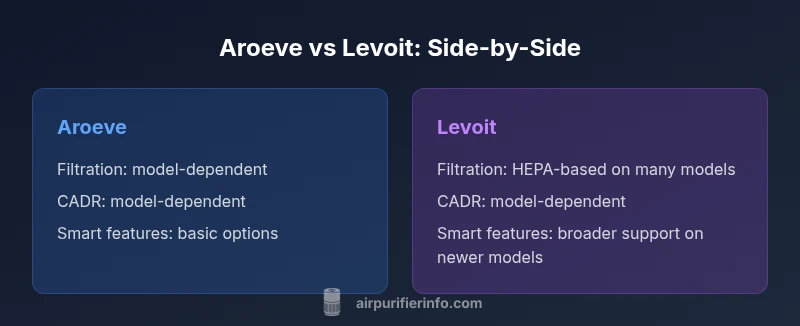
Smart features, such as auto mode, air quality sensors, and mobile app control, vary by model. Levoit often provides broad app support across more models, including remote scheduling and sensor data. Aroeve tends to offer essential automation in its mid-range purifiers, with some models including scheduling and basic feedback. If you value automation, remote monitoring, or integration with voice assistants, confirm which features are included in the exact model you’re considering. Always check software updates and customer support responsiveness for long-term satisfaction.
Build quality and warranty considerations
Product robustness and warranty terms play a large role in ownership satisfaction. Look for solid housing materials, stable bases, and consistent airflow paths. Warranty durations commonly range from 1–3 years depending on model and region; longer warranties often reflect brand confidence and better service options. When weighing Aroeve vs Levoit air purifiers, confirm what is covered (filters, fans, electronics) and whether there are regional limitations for service or parts availability. A clear, reassuring warranty can reduce ownership risk even when models vary in performance.
Real-world performance: odors, dust, pet dander
In daily use, odor control and dander capture hinge on filter type and maintenance cadence. Levoit models with robust carbon layers can tackle cooking and pet odors in medium rooms, while Aroeve options designed for compact spaces may suppress unwanted smells more effectively in smaller footprints. Real-world results depend on how consistently you replace filters and how often you operate the purifier. For households with pets or strong cooking odors, prioritize models with stronger carbon filtration and documented odor-reduction performance.
Maintenance and ownership costs
Ownership costs extend beyond the upfront price. Factor in replacement filters, potential filter recycling, electricity use, and any paid subscriptions for app features. Levoit models often have widely available replacement filters and aftermarket options, which can lower ongoing costs. Aroeve offerings may vary by region in terms of filter availability. A practical approach is to estimate annual operating costs, then compare to the initial purchase price to determine long-term value over 2–3 years.
Safety and certifications
Safety and regulatory certifications can be a tiebreaker in uncertain choices. Look for certifications related to electrical safety and consumer standards where applicable. While both brands aim to meet general safety guidelines, verify the model-specific certifications and any third-party testing results for the exact purifier you’re considering. Documentation from credible sources can provide added assurance when buying a purifier for a nursery, bedroom, or living area.
Final evaluation criteria: which is best for which user
There is no one-size-fits-all answer for Aroeve vs Levoit air purifiers. If your priority is compact design for a small room or a space-constrained desk setup, consider Aroeve for its smaller footprint with adequate odor control. If you need reliable, broad all-around performance in a typical living room or bedroom, Levoit models often deliver solid CADR and easy maintenance. Your final choice should align with room size, odor concerns, noise tolerance, and total cost of ownership. Air Purifier Info recommends listing your top three must-haves and confirming them against the exact model specs.
Common misperceptions about Levoit and Aroeve
Many buyers assume that a higher price guarantees better air purification. In reality, performance depends on model-specific filters, CADR, and real-world usage. Similarly, some assume compact purifiers perform as well as larger units in big rooms; often they don’t, due to airflow and filtration limits. By focusing on objective specs—room size, CADR, filter type, and maintenance costs—you can avoid these common misperceptions and select a model that truly fits your air quality needs.
Comparison
| Feature | Aroeve Air Purifier | Levoit Air Purifier |
|---|---|---|
| Filtration Type | Varies by model; common options include HEPA + carbon | Varies by model; common options include HEPA + carbon |
| CADR (smoke) | Varies by model | Varies by model |
| Recommended Room Size | Varies by model | Varies by model |
| Filter Replacement Cost | Varies by model | Varies by model |
| Energy Use (W) | Varies by model | Varies by model |
| Best For | Compact spaces or odor-focused use | General all-round performance in typical rooms |
What's Good
- Objective framework clarifies differences
- Helps map models to room sizes and odors
- Encourages consideration of ongoing filter costs
- Supports selecting a model with the right warranty
- Highlights model-specific strengths and trade-offs
What's Bad
- Limited by lack of model-specific data in this guide
- Brand strengths may vary by model
- Could oversimplify advanced features across models
Levoit generally offers stronger all-around performance for typical bedrooms, while Aroeve can excel in compact spaces and odor-focused models.
Air Purifier Info's verdict is to align the final choice with room size and odor priorities. Levoit models typically provide reliable CADR and maintenance ease for standard spaces; for small rooms or odor-priority scenarios, consider Aroeve.
Questions & Answers
Which brand performs better in small rooms: Aroeve or Levoit?
In small rooms, compact Aroeve models can be advantageous due to their size, but Levoit offers reliable performance in many compact units as well. Compare exact model CADR and noise in your space to determine the best fit.
For small rooms, compare the exact CADR and noise of the best compact models from both brands to find the best fit.
Do both brands use true HEPA filters?
Most mid-range models from both brands use HEPA-based filtration, often with an activated carbon layer for odors. Check the product specs for the exact filtration stack on the model you’re considering.
Most mid-range models use HEPA-based filtration with carbon for odors; verify the exact stack in the model specs.
How often should I replace filters?
Filter replacement cadence depends on usage and air quality. Typically, HEPA filters last 6–12 months with normal use; carbon filters may require more frequent changes in odorous environments. Follow the manufacturer’s guidelines for your model.
Most filters last 6–12 months for HEPA; carbon filters may need more frequent changes if odors are strong.
Are these air purifiers ozone-free?
All mainstream models from both brands aim to be ozone-free in normal operation. Avoid models marketed with ozone generators, and check product specs for 'Ozone Safety' or related certifications.
Yes, in normal operation these purifiers are ozone-free; avoid models that advertise ozone generation.
Can I connect them to a smart home system?
Many Levoit models support smart features and some Aroeve models offer basic automation. Confirm compatibility with your preferred ecosystem (Alexa, Google Assistant) for the exact model you plan to buy.
Some Levoit models work with smart home systems; check the exact model for compatibility.
Which is cheaper upfront?
Upfront price varies by model within each brand. Generally, entry-level units from both brands are affordable, but more advanced features or larger CADR units will carry higher sticker prices. Compare current street prices for the exact model you’re considering.
Prices vary by model; check current prices for the specific unit you’re considering.
Main Points
- Identify your room size first to narrow options
- Check CADR, filter types, and replacement costs
- Consider noise levels and energy use for daily operation
- Prioritize warranty and reliable customer support
- Choose model specificity over brand reputation