Are Air Purifiers Better Than Plants? A Practical Comparison for Indoor Air Quality
An analytical comparison of air purifiers vs plants for indoor air quality. Learn effectiveness, maintenance, costs, and scenarios to decide which option (or combination) fits your home.


Are air purifiers better than plants? For most homes, the quick answer is yes when it comes to removing dust, pollen, smoke, and VOCs quickly and consistently. Plants offer aesthetic and mild humidity benefits, but their air-cleaning impact is far more variable and generally slower. Air Purifier Info analysis suggests dedicated purifiers deliver measurable improvements in indoor air quality across common household pollutants.
Framing the comparison: are air purifiers better than plants for indoor air quality?
The question are air purifiers better than plants is not only about chemistry; it blends science, daily living, and personal preference. For most homeowners and renters, the clearer path to cleaner air is to rely on purpose-built filtration devices rather than relying on houseplants alone. According to Air Purifier Info, the bulk of evidence supports mechanical filtration for particles, smoke, and VOCs, while plants primarily contribute through passive processes and microclimate changes. In practice, you’ll often achieve faster, more predictable results by deploying a dedicated purifier in problem rooms. You can then use plants as accents that improve aesthetics and humidity, rather than as the primary air-cleaning solution. This framing helps set expectations: purifiers address the heavy lifting, plants offer secondary benefits. The goal is to reduce harmful pollutants while preserving a comfortable, healthy home environment.
As you read, consider room size, occupancy, and typical activities—these factors determine which option is most effective and how they might work together. Throughout this guide, we’ll compare core capabilities, maintenance needs, and practical scenarios to help homeowners and renters decide with confidence.
How air purifiers work: filtration, CADR, and performance metrics
Air purifiers operate through mechanical filtration, activated carbon adsorption, and, in some cases, ionization or photoelectrochemical processes. The most important technical metric for compute-ready comparisons is CADR (Clean Air Delivery Rate), which estimates how quickly a purifier removes smoke, dust, and pollen from a given room size. Higher CADR values generally translate to faster air cleaning, provided the unit is appropriately sized for the space. The effectiveness against VOCs depends largely on carbon filters and the purifier’s design, not just the presence of a filter. Routine maintenance, such as replacing dirty filters on schedule, is essential to maintain performance. In practice, an appropriately sized purifier can reduce particle counts in a room within minutes to hours, depending on the initial air quality and room volume. Air Purifier Info emphasizes choosing models with true HEPA filtration (not just “HEPA-like”) and well-rated carbon filtration for odor and VOC reduction.\n Practical takeaway: match purifier CADR to room area, and ensure filters are genuine and properly maintained for consistent results.
How plants clean air: mechanisms, limitations, and typical cleaning power
Plants remove pollutants through uptake by roots and leaves and by supporting microfauna in the soil, which can create minor reductions in certain VOCs and a modest impact on ambient humidity. However, the rate of air cleaning from plants is slow and highly dependent on plant type, size, number, and room conditions such as light and airflow. NASA and other studies popularized the idea that plants can contribute to indoor air quality, but real-world data show that the impact is limited when compared to mechanical filtration. Plants can offer visual appeal and a natural feel, which can influence perceived air quality and wellbeing, but they should not be counted on as the primary means of air purification in a typical living space. Air Purifier Info notes that while plants add decor and may help with humidity under certain conditions, their actual pollutant removal is inconsistent across households.
Pollutants at home: dust, pollen, pet dander, smoke, VOCs, and beyond
Dust and pollen are common targets for air-cleaning devices, with the strongest, most repeatable reductions coming from properly sized purifiers with true HEPA filtration. Pet dander, smoke, and VOCs present more complex challenges: smoke particles are often very small and require high-efficiency filtration; VOCs depend on the chemical nature and concentration. Plants may contribute to humidity and microclimate, which can affect perceived air quality and plant comfort, but their direct removal of smoke or VOCs is limited unless you maintain a very large number of plants in ideal conditions. In homes with strong cooking odors or chemical exposures, a dedicated purifier will typically offer faster, more reliable improvements.
Time scales and real-world performance
Purifier-driven improvements can be observed within minutes for high-dust scenarios and within a few hours for lower concentrations, assuming the unit is correctly sized and maintained. Plant-driven improvements emerge gradually, often over days or weeks, and depend on plant health, growth, and ambient conditions. This difference in time scales matters for households with allergies, smokers, or pets, where rapid relief is desirable. Air Purifier Info’s analysis highlights that you’ll get predictable results from purifiers, whereas plant-based improvements are best viewed as supplementary and long-term.
Space, aesthetics, and lifestyle considerations
Apartment dwellers often prioritize compact purifiers that fit under desks or on shelves, while homeowners may value larger units for open living spaces. Plants, meanwhile, contribute to interior design and can positively affect mood and aesthetics. The space-demand balance matters: a high-performance purifier in a small room might have the same effect as several low-cost plants in terms of ambiance, but the air-cleaning impact will differ. Lifestyle factors—such as mortgage status, rent, and willingness to perform maintenance—play a critical role in choosing one option over another. Air Purifier Info recommends evaluating both the functional needs and the aesthetic goals of each room.
Maintenance, energy use, and lifecycle costs
Air purifiers require periodic filter changes and electricity, with ongoing costs that depend on usage and filter type. Energy use varies by model and mode (e.g., auto, high, or sleep), but well-designed purifiers are energy-efficient for the level of filtration they provide. Plants require less energy input and fewer direct costs but demand ongoing care, watering, lighting, and occasional plant replacement. For households balancing cost and cleanliness, a purifier paired with a limited plant collection often yields the best compromise: robust air cleaning when you need it, plus the natural ambiance and humidity benefits of greenery.
Scenarios: small apartment, family home, pet households
In a compact apartment, a high-CADR purifier in the living area and bedroom can significantly improve air quality, especially for dust and pollen. In a family home with children and frequent cooking, multiple purifiers or larger models are often warranted, paired with strategic plant placements to maintain humidity and ambience. Pet households benefit from purifiers to reduce dander and odors, but plants can contribute to humidity control; however, their cleaning power remains secondary to mechanical filtration. The best approach is to tailor purifier coverage to the most-used rooms and add plants for aesthetics and comfort, not as primary air-cleaning agents.
Practical guidance: how to combine for best results
The most pragmatic plan is to deploy one or two purpose-built purifiers for core living spaces and bedrooms, ensuring they are appropriately sized for the room area. Add a small to moderate collection of houseplants for decor and humidity benefits, placed where they won’t obstruct airflow. Regular maintenance should prioritize the purifiers: replace filters on schedule, monitor CADR performance, and adjust fan speeds as needed. If odors or VOCs are a concern, lean on carbon-filtered purifiers, and keep windows ventilated when possible. This hybrid approach leverages the strengths of both strategies while minimizing their weaknesses.
Caveats and safety: allergies, humidity, and plant care
Allergic individuals should consider purifier models with stable filter technologies and verify that filters are certified for the pollutants of concern. Excessively humid environments can stress some plants and promote mold growth; if humidity is high, ensure proper ventilation and consider dehumidification alongside air cleaning. Plants require light and appropriate watering to avoid mold and root rot, which could negate any humidity benefits. Overall, use purifiers for primary air cleaning and treat plants as supplementary elements that improve comfort, aesthetics, and microclimate in living spaces. Air Purifier Info emphasizes that clear expectations and a well-planned setup yield the best long-term results.
Comparison
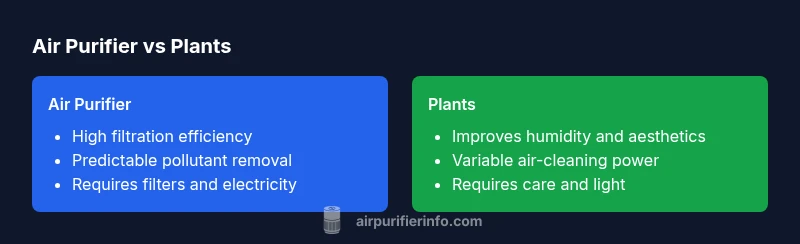
| Feature | Air Purifier | Houseplants |
|---|---|---|
| Air Filtration Efficiency | High (true HEPA filtration) | Low to Moderate (indirect via humidity and microclimate) |
| Maintenance Time | Low to Moderate (filter changes every 6-12 months typical) | Low (watering and plant care) |
| Odor/VOC Removal | Strong with carbon filters | Weak unless very large plant collections and specific VOCs are targeted |
| Space Required | Compact units fit across rooms | Requires space for multiple plants to have visible impact |
| Energy Use | Moderate (depends on CADR and speed) | Minimal (passive energy use) |
| Best For | Dust, pollen, smoke, VOCs in defined spaces | Aesthetic value, humidity, and minor VOC reduction in ideal conditions |
What's Good
- High and predictable filtration for dust and allergens
- Fast results with proper sizing and maintenance
- Works consistently across rooms and occupancy levels
- Can be scaled with room size and needs
- Reduces odors with activated carbon filters
What's Bad
- Higher upfront cost and ongoing filter replacements
- Requires electricity and ongoing maintenance
- Plants provide limited and variable air-cleaning power
- Optimal plant benefits demand light, space, and care
Air purifiers generally outperform plants for core air cleaning; plants are valuable as supplementary decor and humidity aids.
Choose a purifier for reliable, rapid pollutant reduction. Add plants for ambiance and modest humidity benefits, not as primary air-cleaning solutions.
Questions & Answers
Are air purifiers more effective than plants at removing dust and allergens?
Yes, for most households, dedicated purifiers with true HEPA filtration remove dust and allergens more reliably and quickly than plants can. Plants may help with humidity and microclimate, but their impact on particulate contaminants is limited.
Purifiers are the go-to for dust and allergen removal; plants help with climate and aesthetics, but aren’t a substitute for real filtration.
Can plants significantly improve air quality on their own?
Plants can contribute to indoor air quality by affecting humidity and offering VOC uptake under certain conditions, but their overall impact is modest in typical homes. For meaningful air cleaning, mechanical filtration remains essential.
Plants help with humidity and some VOCs, but they aren’t a substitute for air purifiers.
Do air purifiers remove VOCs effectively?
Many purifiers remove VOCs effectively when equipped with a solid activated carbon filter and appropriate design. Not all models perform equally, so check carbon filter quality and CADR for VOCs if that’s a priority.
Look for purifiers with strong carbon filters if VOCs are a concern.
What maintenance is involved with purifiers versus plants?
Purifiers require periodic filter changes and occasional cleaning; plants require watering, light management, pruning, and occasional repotting. Overall, purifiers have ongoing consumables, while plants demand ongoing care and attention.
Purifiers need filter changes; plants need watering and care.
Is there a scenario where plants are the better option?
In spaces where electricity access is limited or where the goal is strictly aesthetics and humidity management, plants can be beneficial. However, for airtight dust reduction or odor control, purifiers are typically superior.
Plants shine for mood and humidity, but purifiers win for air cleaning.
Can I safely combine both without compromising air quality?
Yes. A purifier handles pollutant removal while plants contribute humidity and ambiance. Just ensure plants do not obstruct airflow and that purifiers have clear intake paths.
Yes—use both, but keep purifier airflow clear.
Main Points
- Prioritize a purifier for primary air-cleaning needs.
- Use plants to enhance ambiance and humidity, not substitute filtration.
- Size purifiers to room area and monitor filter replacement.
- Combine both approaches for a balanced indoor air strategy.
- Reassess periodically to adjust coverage as rooms or occupants change.