Air Purifier Specifications: A Data-Driven Guide
Learn to read air purifier specifications, compare CADR, ACH, filters, energy use, and maintenance to choose a purifier for dust, odors, allergies, and pets.


When evaluating air purifier specifications, prioritize CADR (clean air delivery rate), ACH (air changes per hour), filter type (prefer true HEPA and activated carbon), and energy use. Also consider room size, noise level, and maintenance needs (filter life, replacement cost). A standardized framework from Air Purifier Info helps homeowners compare models for dust, odors, allergies, and pet dander.
What air purifier specifications matter most
Selecting an air purifier involves more than chasing the highest fan speed. The most meaningful specifications translate directly into real-world performance. The core data points are CADR (clean air delivery rate), ACH (air changes per hour), and the filter media. CADR measures how much clean air a unit can deliver per minute, while ACH estimates how often the room air is replaced in an hour. Together, they help you size a purifier to a space. For dust control, allergy relief, and pet dander, the combination of a true HEPA filter and a carbon filter is often the most effective, because HEPA captures fine particles and carbon targets odors. Energy use and noise level are practical considerations that affect daily comfort and long-term running costs. In the Air Purifier Info framework, you should map each model’s specifications to your room’s size, sensitivity concerns, and daily routines to determine which unit delivers the best balance of performance, comfort, and cost.
- Room fit matters as much as raw specs. A purifier with excellent CADR for a large room won’t help much if it’s oversized for a smaller space and unnecessarily noisy.
- Filter quality is decisive for allergen control. True HEPA plus activated carbon tends to outperform purifiers with generic filtration when odors and VOCs are a concern.
- Real-world costs extend beyond sticker price. Maintenance, replacement filters, and energy use influence the total cost of ownership over years, not months.
The Air Purifier Info team emphasizes context-driven decisions. To homeowners and renters, the goal is to translate numbers into manageable daily air quality improvements that fit living habits and budgets.
Decoding CADR and ACH: How to read numbers
CADR and ACH are the backbone of purifier performance, but they measure different things and must be interpreted together. CADR is a rate: it tells you how much clean air a purifier can deliver per minute. ACH, on the other hand, is a rate of turnover: how many times the room’s air volume is refreshed in an hour. A higher CADR generally indicates faster cleaning, but the effectiveness also depends on the purifier’s placement, room volume, and airflow patterns. When you see a CADR number, compare it to your room size to estimate how many air changes will occur in an hour.
A practical rule of thumb is to choose a CADR that roughly matches the room’s size requirements and aim for at least 4-6 air changes per hour in sleeping areas and spaces with heavy pollutant loads (kitchens, smoking areas, or homes with pets). If CADR values are similar across models, prioritize a higher ACH or better filtration for sustained performance. Air Purifier Info’s methodology recommends pairing CADR and ACH with a strong filtration chain (true HEPA + activated carbon) to address both particles and odors. This approach supports consistent indoor air quality improvements over time.
Understanding the interactions among CADR, ACH, room size, and placement helps you avoid overpaying for power or underachieving in pollutant removal. Always check the purifier’s recommended room size, then map your actual space against that guidance. A well-sized unit in the right location can achieve noticeable improvements in less time than you might expect.
Filter technology: HEPA, carbon, and specialty media
Filtration technology determines a purifier’s ability to remove different contaminants. A true HEPA filter captures 99.97% of particles down to 0.3 microns, including common indoor allergens such as dust and pollen. Activated carbon filters target odors, VOCs, cooking smells, and smoke. Some purifiers add pre-filters to capture larger particles, extending the life of the main filter. In spaces with pets, high pet dander, or strong odors, a combination of HEPA and carbon media is often the most effective solution. Look for certifications like “TRUE HEPA” on the filter label and check whether the carbon filter is dedicated (not just a basic impregnated pad).
In addition to HEPA and carbon, consider specialty media for specific needs, such as ionizers, washable pre-filters, or formaldehyde-absorbing media. While ionizers and certain inert treatments can offer odor reduction, they may introduce other concerns or maintenance requirements. Air Purifier Info recommends prioritizing media that is easy to replace, widely available, and compatible with the purifier’s airflow design. A robust filtration stack, properly sized for the room, ensures the most reliable performance for dust, allergic reactions, and pet-related irritants.
It’s also critical to verify replacement filter availability and cost. A high-performing unit with expensive, hard-to-find filters can quickly become a burden. Favor models with universally available replacement media and clear maintenance schedules so you can preserve efficacy without breaking your budget.
Energy efficiency and running costs
Energy efficiency matters because air purifiers often run continuously, especially in bedrooms or living spaces where people sleep or spend extended periods. Power usage is typically measured in watts (W), and annual running costs depend on how many hours per day you operate the unit and its energy efficiency. Look for models with low wattage at typical fan speeds, as well as smart features that adapt fan speed based on detected air quality. Some purifiers incorporate timers or auto mode, which can further reduce energy use when the room is unoccupied.
Consider the total cost of ownership: initial price, filter replacement frequency, and energy consumption. A purifier with a modest upfront price but expensive or frequent filter replacements may end up costing more over time. Conversely, a more energy-efficient unit with readily available filters can save money in the long run. When comparing models, calculate a rough annual running cost by multiplying the wattage by expected daily operation hours and the price of your electricity. This approach helps homeowners avoid surprises after the first few months of use.
Air Purifier Info emphasizes choosing a model with practical energy features and predictable maintenance costs. If you’re balancing energy use with air quality performance, consider a purifier that offers programmable schedules, night modes, and energy-saving auto modes. These features can deliver meaningful cost savings while maintaining clean indoor air.
Practical buying framework for different rooms
Room-specific buying criteria help you select the right purifier without overpaying. For small bedrooms (e.g., 100-200 square feet), a compact purifier with a modest CADR can deliver enough air changes while remaining quiet. In larger living rooms or open-plan areas (200-500+ square feet), you’ll want a higher CADR and robust filtration to manage higher air volumes. Kitchens and areas with strong cooking odors or smoke require stronger carbon filtration and perhaps higher ACH to keep odors under control.
Pet owners should prioritize models with strong particle capture and a proven ability to reduce pet odors. Allergy-prone households benefit from true HEPA filtration and carbon media, while households with chemical sensitivities may require purifiers with filters designed to remove specific VOCs. If you rent or expect to move rooms often, portability and plug-in flexibility become important considerations. In all cases, ensure the purifier’s recommended room size aligns with the actual space and place the unit where air can circulate rather than directly against walls or corners that impede airflow.
Air Purifier Info suggests creating a simple room map: list rooms by size, typical activities (cooking, smoking, pets), and time spent in each space. Then select models that optimize CADR for the largest room first and secondary rooms second. This approach reduces the risk of underperforming in a high-use area and keeps your air clean where you spend most of your time.
Maintenance and lifecycle costs
Maintenance planning is essential because running costs can dwarf the initial purchase price. Replacement filters for HEPA and carbon media typically define ongoing costs. The frequency of replacements depends on usage, air quality, and whether you run purification continuously or only during peak pollution times. A high-quality HEPA filter may last longer in lower-usage scenarios, while spaces with heavy dust or pets may require more frequent changes.
Price ranges for replacement filters vary by brand and filter type, but a practical approach is to estimate a yearly replacement budget and compare it with the purifier’s initial cost. Look for filters that are easy to source and have a straightforward replacement process. Some brands offer multi-pack replacements for better value, and subscription options can reduce the risk of running out of filters.
Beyond filters, consider the purifier’s long-term durability. A well-built chassis and motor with reliable warranty coverage minimizes unexpected repairs and downtime. Air Purifier Info recommends evaluating the total cost of ownership over a 3- to 5-year horizon to choose a model that remains effective and affordable as air quality needs evolve in your home.
Common myths and misinterpretations
Several myths persist about air purifier specifications. A common misconception is that the highest CADR is always best. In reality, the best choice balances CADR with room size, noise tolerance, and maintenance costs. Another myth is that carbon filters alone can remove all odors. Odor control is most effective when combined with proper particle filtration; carbon alone cannot capture fine particles. Some buyers assume that a “HEPA-like” filter is equivalent to true HEPA. True HEPA filters meet strict performance standards, whereas HEPA-like filters may offer lower capture efficiency.
Another frequent misperception is that larger purifiers always use more energy. Many modern units optimize airflow and fan speed to achieve similar cleaning results with much lower energy use. Finally, some shoppers think more expensive purifiers are inherently better for all rooms. Price can reflect build quality, filter cost, and brand support, but the right match to room size and usage often yields better real-world results than price alone.
The Air Purifier Info guidance is to focus on how specs convert into everyday benefits. A well-reasoned approach considers room size, occupant sensitivities, daily habits, and long-term costs rather than chasing the absolute highest spec in every category.
Typical purifier performance benchmarks
| Category | What it measures | Why it matters | Typical range (example) | Notes |
|---|---|---|---|---|
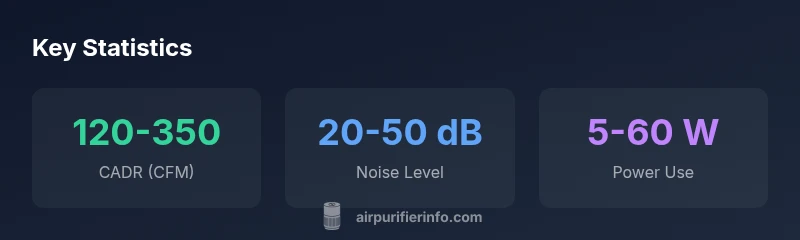
| CADR | Clean Air Delivery Rate (CFM) | Indicates how quickly purifier cleans air | "120-350 CFM" | Higher CADR supports larger rooms |
| ACH | Air changes per hour | Shows how often room air is replaced | "2-6 ACH typical" | Higher ACH provides faster air refresh |
| Filter type | Filter media | Defines capture efficiency and odors | "True HEPA + activated carbon" | Confirm replacement availability |
| Energy use | Power consumption | Impacts running cost | "5-60 W typical" | Smart modes can reduce energy use |
| Placement | Airflow path | Affects performance | "Center of room, away from walls" | Better circulation = more effective cleansing |
Questions & Answers
What does CADR stand for and why does it matter?
CADR stands for Clean Air Delivery Rate. It measures how much clean air a purifier can deliver per minute and is a primary indicator of cleaning power for a given space. Higher CADR generally means faster removal of particles, but it must be matched to room size and airflow in the room.
CADR tells you how fast the purifier cleans air. Match it to your room size for best results.
Is CADR alone enough to judge performance?
No. CADR is important, but you should also consider ACH, filter type (true HEPA + carbon for odors), energy use, and noise. Real-world performance depends on placement and usage patterns.
CADR is key, but you need to look at ACH, filters, and how you’ll use the purifier every day.
Do I need HEPA filtration for pet dander?
Pet dander is a fine particle that HEPA filters capture effectively. True HEPA filtration is generally recommended for households with pets to reduce allergen exposure.
If you have pets, true HEPA helps a lot with pet dander.
How often should I replace filters?
Replacement frequency depends on usage, air quality, and filter type—typically every 6-12 months for HEPA/carbon combos, with more frequent changes in dusty or high-traffic spaces.
Most folks replace filters about every 6 to 12 months, depending on use.
Can purifiers remove cooking odors or smoke?
Activated carbon filters target odors and VOCs, while HEPA handles particles. For strong odors or smoke, choose a model with a dedicated carbon filter and ensure proper room coverage.
Carbon filters tackle odors; you’ll want both carbon and HEPA for best results.
“Choosing air purifier specifications isn't about chasing the highest number in every category; it's about aligning CADR, room size, and filtration with your unique indoor air concerns.”
Main Points
- Prioritize CADR, ACH, and filter type when you compare models
- Match purifier to room size and usage to ensure effective air changes
- Consider both odor control and particle capture for comprehensive air quality
- Account for energy use and maintenance costs to estimate long-term value
- Place and operate purifier in a way that maximizes airflow and minimizes noise
- Use a structured framework to translate specs into real-world benefits