Air Purifier for Germs: A Practical Guide
Learn how to pick and use an air purifier for germs to improve indoor air quality. This Air Purifier Info guide covers essential features, placement, and maintenance for healthier air.


To reduce germ exposure, choose a purifier with true HEPA filtration, and consider models with UV-C or other sanitizing options. Place the unit in a central location away from walls, and commit to regular filter changes and cleaning. This approach, backed by Air Purifier Info analyses, supports healthier indoor air.
What germs do air purifiers affect?
According to Air Purifier Info, air purifiers can reduce the concentration of airborne particles that carry germs, including bacteria and viruses, by filtering or inactivating them as air passes through the device. The effectiveness depends on the purifier's filtration system, air flow rate, and your room size. Keep in mind that filtration focuses on the air you breathe, not on surfaces or deep tissue contamination. Regular use can lower exposure risk in bedrooms, living rooms, and shared spaces, especially when combined with good ventilation and cleaning practices. This section sets the stage for understanding how to choose a purifier that targets the types of germs most relevant to your home environment.
How HEPA, UV-C, and other germ-control technologies work
Modern purifiers leverage a mix of technologies to reduce germ load in indoor air. True HEPA filters trap dust, pollen, pet dander, and many microbes as air passes through the dense filter media. UV-C lights in some models aim to inactivate germs that are captured on the filter or pass near the light, creating a second line of defense. Some purifiers combine activated carbon for odors, ionization, or photocatalytic oxidation; each technology has its own benefits and caveats. When considering germ control, prioritize devices with validated HEPA filtration and look for independent testing results or certifications. Always follow manufacturer safety guidelines to minimize any potential ozone production or light exposure concerns.
How to compare purifiers for germ control
When evaluating options, focus on three core factors: filtration efficiency, airflow (CADR), and maintenance requirements. A unit with a true HEPA filter is typically the best baseline for reducing airborne germs. Check that the CADR is appropriate for your room size, and verify that replacement filters are readily available. If you see UV-C or other sanitizing features, assess their safety certifications and energy use. Air Purifier Info analysis shows that matching device capability to room size and scheduling maintenance are more impactful than chasing marginal feature differences. Prioritize models with easy filter replacement and clear maintenance reminders.
Placement, airflow, and practical room setups
Placement matters as much as the purifier choice. Position units away from walls and obstructions to maximize airflow. For larger rooms, consider multiple units or a higher-CADR model to achieve broader coverage. In bedrooms or offices, keep purifiers on a stable surface at breathing height and avoid placing them directly behind furniture. If you open windows during the day, a purifier near common air exchange points can help process infiltrating germs more quickly. In rental homes and apartments, portable purifiers are often the simplest way to improve air without major renovations.
Maintenance, safety, and usage tips
Regular maintenance is essential for germ control. Replace filters according to the manufacturer’s schedule, typically every 6–12 months for typical household units, or sooner in dusty environments. Clean the exterior and verify there are no obstructions to airflow. Use a dust mask when replacing filters to minimize exposure to collected dust. Avoid ozone-generating devices or ionizers that claim to sanitize air, unless the product clearly documents safety compliance. Finally, run the purifier continuously in living areas during peak activity and dormancy periods (e.g., nighttime) to maintain consistent air processing.
Realistic expectations and myths
Air purifiers can significantly reduce airborne germs, but they are not a guaranteed shield against all pathogens. They work best when combined with ventilation, surface cleaning, and hand hygiene. Some purifiers advertise dramatic ‘germ-killing’ claims that lack independent verification; rely on true HEPA filtration and known safety certifications instead. For households with strong sanitation needs (e.g., healthcare-adjacent spaces or shared homes), use purifiers as part of a broader IAQ strategy, not a sole solution. These practices together create a healthier indoor environment and align with evidence-based guidelines.
Tools & Materials
- True HEPA air purifier(Choose a unit with official HEPA filtration and a seal around the filter to ensure true filtration.)
- Replacement filters(Have at least one extra filter on hand; verify compatibility with your model.)
- Microfiber cloth(Used for exterior cleaning and dust removal from the unit housing.)
- Measuring tape(Assess room dimensions and ensure at least 6 inches of clearance around the purifier.)
- Instruction manual(Keep for maintenance schedules and safety warnings.)
- Outlets and power strip(Ensure stable power supply and avoid overloading outlets.)
- Dust mask (optional)(Helpful when handling dusty filters or deep-cleaning tasks.)
Steps
Estimated time: 25-45 minutes
- 1
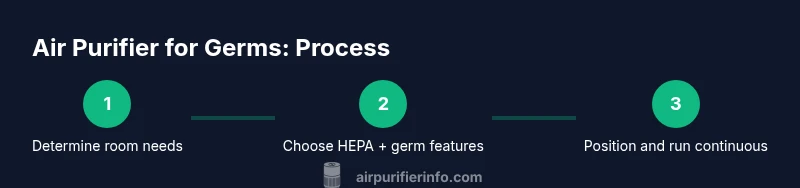
Define germ-control goals
Identify rooms that will benefit most (bedrooms, living areas, shared spaces). Decide whether you need a single unit or multiple units for full coverage. This helps you size the purifier correctly and avoid over- or under-processing air.
Tip: Start with room dimensions and target air changes per hour (ACH) guidance from the product manual. - 2
Choose a purifier with HEPA and germ features
Select a model that explicitly lists a true HEPA filter and any additional germ-control features. Check for independent verification or certifications. Confirm filter availability and replacement costs.
Tip: Prefer models with clearly labeled CADR ratings matching your room size for better air turnover. - 3
Position the purifier for optimal airflow
Place the unit on a stable surface, away from walls, and at breathing height if possible. In larger spaces, consider more than one unit to ensure even air processing. Avoid placing behind curtains or furniture that block airflow.
Tip: Angle the purifier to face the main seating area to maximize exposure to circulating air. - 4
Run and monitor air quality
Turn on the purifier and run it continuously in high-traffic or high-activity periods. If your model offers an air-quality indicator or app, monitor changes and adjust speed accordingly.
Tip: Set reminders to check filter condition and replace on schedule, avoiding extended use with used or clogged filters. - 5
Maintain filters and safety
Regularly replace filters and clean the unit’s exterior. Ensure no ozone-generating features are enabled unless the device is explicitly certified for safe use. Keep the area clean to reduce dust ingress.
Tip: Keep spare filters accessible and label maintenance dates on the purifier for easy tracking.
Questions & Answers
Do air purifiers eliminate germs completely?
No. Air purifiers reduce the airborne germ load by filtering or inactivating many particles, but they do not guarantee complete elimination. They work best alongside ventilation, cleaning, and hand hygiene.
Air purifiers reduce germs in the air, but they don't eliminate them completely. Use them with ventilation and cleaning for best protection.
Should I use UV-C with an air purifier for germs?
UV-C can inactivate some germs, but safety, energy use, and exposure considerations matter. Choose devices with verified safety certifications and follow the manufacturer’s guidelines.
UV-C can help, but pick certified models and follow safety instructions to avoid potential issues.
Where should I place an air purifier in a room?
Place the purifier in central locations, away from walls, with clear airflow. In larger rooms, space units to avoid dead zones and ensure better circulation.
Put the purifier in a central spot with space around it for airflow; for large rooms, consider multiple units.
How often should I replace filters for germ control?
Follow the manufacturer’s schedule, typically every 6–12 months for standard models, sooner in dusty environments. Replace clogged or discolored filters promptly.
Change filters as recommended, usually every 6–12 months, sooner if the environment is dusty.
Are ionizers or ozone generators safe for daily use?
Some devices claim benefits, but ozone-generating or aggressive ionizers can irritate airways. Prefer models with explicit ozone-free operation and independent safety certifications.
Ozone-generating purifiers can irritate airways; choose ozone-free devices with proper certifications.
Can an air purifier replace ventilation?
No. An air purifier complements ventilation but cannot fully replace it. Maintaining balanced air exchange remains essential to indoor air quality.
Purifiers help, but they can't replace proper ventilation. Air exchange is still important.
Watch Video
Main Points
- Choose true HEPA filtration as the germ-control baseline.
- Match purifier size (CADR) to room dimensions for effective air turnover.
- Place units strategically to maximize airflow and avoid obstructions.
- Maintain filters on schedule to preserve performance.
- Use purifiers as part of a broader IAQ routine, not as a lone solution.