Air Purifier for Apartment: Your Complete How-To Guide
Learn how to pick, place, and maintain an air purifier for apartment to improve dust, odors, allergies, and pet dander. A step-by-step guide for renters and homeowners to maximize indoor air quality with expert tips from Air Purifier Info.


To improve indoor air quality in an apartment, choose a compact, energy-efficient air purifier with true HEPA filtration and a CADR suitable for your room size. Prefer models with low noise, easy filter access, and clear maintenance indicators. For renters, pick plug-and-play units that don’t require installation.
Why an air purifier matters in an apartment
An air purifier for apartment can make a meaningful difference in a small living space by targeting common indoor pollutants. In cities or high-traffic buildings, tiny particles from outdoor air, cooking smells, and pet dander accumulate quickly. According to Air Purifier Info, selecting the right purifier begins with room size, pollutant concerns, and your daily routines. The Air Purifier Info team finds that renters especially benefit from compact, true HEPA models and straightforward maintenance indicators that fit in a shared living space. In addition to filtration, consider odor control and energy efficiency to keep your home comfortable without breaking the bank.
How to size the purifier for your room
Sizing starts with measuring the space where you’ll place the purifier. For most apartments, start by calculating the room size in square feet and the ceiling height to estimate air volume. Look for CADR (Clean Air Delivery Rate) ratings that align with that space; reputable models will list smoke, dust, and pollen CADR figures. A practical approach is to choose a purifier whose CADR covers at least the main living area, ensuring air changes per hour without creating excessive noise. In open-layout apartments, placing the unit near the central area often provides broad coverage for adjacent rooms, especially if air tends to circulate along hallways.
Key features to look for in an apartment purifier
When shopping for an air purifier for apartment, prioritize true HEPA filtration to capture particles as small as 0.3 microns. A carbon or activated charcoal filter helps remove cooking odors and VOCs, which are common in compact spaces. Consider CADR ratings for smoke, dust, and pollen to ensure effective performance in day-to-day conditions. Energy efficiency matters in long-term use, so check for Energy Star labels. Noise levels are crucial for bedrooms and living rooms; look for models with a quiet mode or night setting, and ensure filters are easy to replace with clearly marked indicators.
Placement and daily use in small spaces
Strategic placement is key for maximum effectiveness. Keep the purifier on a stable surface with at least a 6-inch clearance from walls or furniture to prevent airflow blockage. Position it away from direct drafts and sleeping areas if possible, but near sources of pollutants (kitchen, pet zones) to intercept emissions quickly. Run the purifier continuously at low to moderate speeds to maintain steady air cleaning, and increase to higher speeds temporarily after cooking or heavy activity. If you live in a rental, avoid modifications and use plug-and-play models that don’t require mounting.
Maintenance and cost considerations
Filtration costs can be a significant ongoing expense, so compare the price and lifespan of HEPA and carbon filters across models. Expect to replace pre-filters more frequently in dusty environments, and follow manufacturer guidance for HEPA and carbon filter lifespans. An initial investment in a purifier with longer-lasting filters and clear maintenance indicators can reduce total cost of ownership. Keep a simple maintenance schedule, noting when to replace filters and how to reset indicators to preserve performance.
Real-world scenarios for renters vs homeowners
Renters benefit from portability and no-install models that can be moved between rooms as needed. Lightweight purifiers with easily accessible filters are ideal, especially in apartments with shared walls and limited storage. Homeowners may opt for slightly larger units or multi-room purifiers to cover living rooms and bedrooms more consistently. In both cases, prioritize devices with straightforward filter access, reliable replacement cycles, and transparent performance data to simplify ongoing maintenance.
Quick-start checklist for immediate results
- Determine room dimensions and target CADR for your space
- Choose a purifier with true HEPA filtration and a carbon filter for odors
- Check noise levels, energy use, and filter-change indicators
- Test placement to optimize airflow and minimize interruptions
- Run continuously at a comfortable level and monitor performance indicators
- Schedule reminders for filter replacements and routine maintenance
Tools & Materials
- Air purifier unit(Compact model suitable for apartment living rooms or bedrooms)
- Power outlet(Ensure access without using extension cords)
- Measuring tape(Measure room length, width, and ceiling height)
- Dust cloth or vacuum(Clean surfaces around the purifier to prevent dust buildup)
- Filter reminder or calendar(Set reminders for filter replacements)
Steps
Estimated time: 60-90 minutes
- 1
Define scope and room size
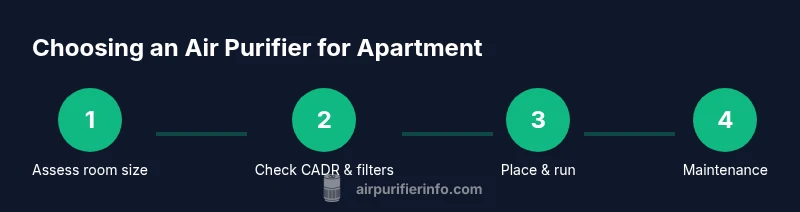
Identify the room where air quality improvements will matter most (living area, bedroom, kitchen). Measure dimensions to estimate volume and guide CADR selection. Understanding space ensures you don’t buy a purifier that’s too small or oversized for daily use.
Tip: Write down exact room dimensions and note any areas with persistent odors or dust. - 2
Check CADR and filter types
Review CADR ratings for smoke, dust, and pollen. Ensure the device uses a true HEPA filter and consider a carbon filter for odors. Confirm filter replacement intervals and total cost of ownership.
Tip: Prefer models with combined HEPA and activated carbon filters to simplify maintenance. - 3
Plan placement for airflow
Place the purifier on a stable surface with several inches of clearance on all sides. Position it where air can circulate to cover the largest area of the room, not tucked behind furniture.
Tip: Avoid placing it directly against walls or behind heavy curtains that block intake or outlet airflow. - 4
Prepare for setup and initial run
Plug in the unit, install any provided filters per the manual, and run on a low setting to verify operation. Use auto or night modes if available to balance comfort and air cleaning.
Tip: Record the initial noise level at your typical seating height to gauge comfort. - 5
Monitor performance and adjust
Observe odor and particle feel after 24 hours and adjust speed as needed. If odors persist after a few days, reassess placement or consider a higher CADR model.
Tip: Keep a simple log of days when odors or dust are noticeable to track improvements. - 6
Schedule maintenance
Set reminders for filter replacements and cleanings. Replace pre-filters regularly and HEPA/carbon filters on the manufacturer’s recommended schedule.
Tip: Replace filters promptly when indicators show replacement is due to maintain effectiveness.
Questions & Answers
What size air purifier do I need for my apartment?
Start with the room’s square footage and ceiling height to estimate the needed CADR. Review models with CADR values for smoke, dust, and pollen, and pick one that covers your primary living area. Consider multi-room open layout considerations when selecting a single unit.
For apartments, pick a purifier with CADR appropriate for your main living area, especially if your space is open-plan. Look for smoke and dust CADR and ensure it matches room size.
Are carbon filters necessary in an apartment?
If odors from cooking, pets, or VOCs are a concern, a purifier with a carbon filter is helpful. If odors are minimal, a true HEPA filter alone may suffice, but carbon adds odor control convenience.
Yes, carbon filters help with odors and gases. If you don’t notice smells, HEPA alone can still improve particle cleaning.
Can I use an air purifier in a rental property?
Definitely. Choose plug-and-play models that don’t require mounting or modifications. They’re portable and can be moved between rooms as needed, which suits most rental setups.
Air purifiers are great for rentals because you can move them around without going through a landlord.
Do air purifiers remove all pollutants?
Purifiers reduce many airborne particles and odors but aren’t a substitute for ventilation or moisture control. Regular cleaning, cooking ventilation, and humidity management complement purifier use.
They reduce most airborne particles and odors, but good ventilation is still important.
How often should I replace filters?
Replacement frequency depends on usage, room conditions, and filter type. Follow the manufacturer’s schedule and monitor indicators to maintain effectiveness.
Follow the manufacturer’s guidance and watch the filter indicator to know when to replace.
Are there energy-efficient options for apartments?
Yes. Look for models with Energy Star certification and low operating costs. Energy efficiency helps keep monthly power bills manageable in small living spaces.
Choose Energy Star models to keep long-term power use down.
What about purifier placement near bedrooms?
Place the purifier to balance airflow across common living areas and sleeping spaces without excessive noise. In bedrooms, a quieter setting improves comfort while maintaining air quality.
In bedrooms, pick a low-noise mode and keep some distance from the bed if possible.
Can purifiers replace ventilation or HVAC maintenance?
No. Purifiers supplement ventilation and HVAC systems but do not replace routine ventilation, humidity control, or professional HVAC maintenance.
They help, but they don’t replace proper ventilation or HVAC upkeep.
Watch Video
Main Points
- Size the purifier to the room using CADR ratings and room dimensions.
- Prioritize true HEPA filtration and carbon filtering for odors.
- Place the unit for optimal airflow and minimal disturbance.
- Factor in maintenance costs and filter replacement intervals.
- Choose portable, plug-and-play models for renters.