Air Purifier and Dehumidifier in One: A Comprehensive Comparison
Explore how a combined air purifier and dehumidifier in one performs versus separate devices. Learn size, efficiency, maintenance, and real-world use to choose the best IAQ solution for your home in 2026.


An air purifier and dehumidifier in one is a single appliance that both cleans the air and reduces humidity. For homeowners and renters, it offers a space-saving option to manage dust, odors, allergies, and dampness in humid rooms. Expect tradeoffs in peak performance, noise, and energy use compared with dedicated devices.
What It Is and How It Works
A combined air purifier and dehumidifier in one is a single appliance that blends two core capabilities: air purification and moisture control. In practice, these hybrid units integrate multi-stage filtration (often a pre-filter, true HEPA, and activated carbon) with a dehumidification mechanism—commonly a refrigerant-based compressor or a desiccant core—that lowers humidity in the room. For homeowners and renters, this 1-in-1 approach delivers a compact solution to address dusty air, musty odors, and dampness in humidity-prone spaces like basements, bathrooms, or small living rooms. The balance of performance between purification and dehumidification varies by model; some prioritize filtration efficiency while others emphasize moisture control. When selecting a unit, consider your space’s typical humidity level, air cleanliness needs, and how much room you can dedicate to equipment. The Air Purifier Info team stresses evaluating both air quality and moisture needs together rather than chasing a single metric such as “max filtration,” since real-world IAQ improvement depends on airflow, humidity swings, and maintenance cadence.
Core Technologies Inside a Combined Unit
Hybrid units rely on a mix of filtration stages and a moisture removal system. The filtration stack typically includes a pre-filter, a true HEPA or HEPA-like filter, and an activated carbon or specialty filter to tackle odors and VOCs. The dehumidification portion can be refrigerant-based (compressor + condenser) or desiccant-based, depending on climate and humidity targets. Humidity sensors, auto mode, and a dedicated moisture setpoint help automate performance, so you don’t have to guess when to tweak settings. Some models include a humidistat that maintains humidity within a preferred range, while others offer smart features that connect to apps or home assistants. In terms of efficiency, look for units with energy-saving modes, auto-shutoff on nonessential functions, and sensors that prevent unnecessary operation. From a consumer perspective, you want a balance between clean air delivery (CADR) and moisture removal capacity, rather than chasing the highest number in either category alone. Air Purifier Info analysis notes that the best hybrid units combine reliable filters with a stable dehumidification cycle in a compact footprint.
Design and Efficiency: What to Look For
When assessing a combined IAQ unit, prioritize overall room effectiveness rather than only the headline capabilities. The key factors include footprint and portability, filter replacement cost and availability, energy efficiency, and noise level. For size, ensure the unit can circulate air and handle moisture in the intended space; many models publish a recommended room size range. For filtration, check the stage sequence: is there a high-quality HEPA filter, a robust carbon layer for odors, and easy-to-find replacement parts? For humidity control, identify whether the device uses automatic humidity sensing and a stable setpoint, and whether it supports a broad range of environmental conditions (from humid basements to moist kitchens). The best options provide a transparent balance between air purification performance (CADR/CFM) and dehumidification capability, with sensors that respond predictably to changes in ambient humidity. Energy labels and warranty terms are also worth reviewing, as a single device can impact monthly electricity costs more than expected if used continuously.
Performance Tradeoffs: Purification vs Humidity Control
In a hybrid device, you rarely get peak performance in both functions. The air purification function benefits from a high CADR and multi-stage filtration; the dehumidification function benefits from robust moisture removal and efficient cycle control. In practice, some models will be excellent purifiers but only adequate dehumidifiers in very humid climates, and vice versa. If you live in a humid area but do not want to run two separate machines, choose units that explicitly advertise both high CADR and strong moisture removal. The tradeoffs may include longer run times to reach target humidity, higher energy consumption, and more maintenance (filters plus moisture components). The user experience depends on how often you adjust settings and whether the unit provides reliable auto-mode. In short, manage expectations and select a model that communicates its dual performance clearly, with test results or user reviews to corroborate claims.
Room Size and Humidity Scenarios
Hybrid units work best when you have modest room sizes and moderate humidity swings. In compact living rooms or small bedrooms, a single unit can manage both air quality and humidity, simplifying layout and use. For damp basements or bathrooms with persistent moisture, confirm that the device’s dehumidification capacity aligns with the space and that the unit can operate continuously without overheating. If your climate features extreme humidity or dust levels, you may still benefit from a dedicated purifier or dehumidifier as a supplementary device. The decision hinges on practical space constraints, noise tolerance, and how hands-on you want to be with settings.
From Air Purifier Info’s perspective, the best approach is to map your top two IAQ goals—dust/odor control and humidity reduction—and then verify that a hybrid unit addresses both without sacrificing reliability in either domain.
Features That Matter
Key features to evaluate include automatic humidity sensing with a stable setpoint, multi-stage filtration, easy replacement parts, energy-saving modes, and smart integration with mobile apps or voice assistants. Look for an easy-to-clean design and clear indicators for filter status and humidity. In addition, verify that the device uses ozone-free operation and complies with safety standards. A good 2-in-1 unit offers straightforward control panels, precise humidity readouts, and reliable alerts when maintenance is needed. These features simplify daily use and support long-term IAQ improvements without constant manual adjustment.
Maintenance and Longevity Tips
Maintenance is crucial for a 2-in-1 unit. Regular filter replacements are essential to preserve air purification performance, while the humidity sensor and condensate management require cleaning and occasional calibration. Always follow the manufacturer’s recommended replacement intervals and store spare filters in a dry place. Keep the exterior and intake grilles free of dust, and check the condensation drainage path if the unit uses a desiccant or refrigerant cycle. Periodic professional servicing is advisable if you notice reduced efficiency, unusual noises, or leaks. With proper care, a hybrid device can deliver consistent IAQ benefits while minimizing the number of appliances in your home.
Alternatives: When to Choose Separate Devices
For spaces with very high humidity or rooms that demand peak purification, separate devices may outperform a single 2-in-1 unit. A dedicated dehumidifier often delivers more precise humidity control, especially in basements or laundry rooms, while a standalone purifier can be optimized for air flow and filtration. If budget allows, running two fewer compromises—two dedicated machines—can yield better performance overall and potentially lower energy use per function. Consider this option if you have a large open-plan area or require precise moisture targets for sensitive materials like electronics or books.
Practical Setup: Placement, Settings, and Smart Features
Placement matters for both functions. Position the unit away from walls to maximize air intake, and ensure it’s accessible for filter changes. Place the dehumidification sensor in a representative location away from direct moisture sources or heat. Start with a conservative humidity setpoint and adjust gradually based on readings and comfort. If the unit supports automatic modes, enable them to balance air cleaning and humidity as conditions change. Smart features—like scheduling, auto-clean cycles, and app control—can simplify maintenance and help you stay within desired IAQ targets. Finally, pair a 2-in-1 with occasional air quality checks (dust, odors, humidity spikes) to validate performance over seasons.
Comparison
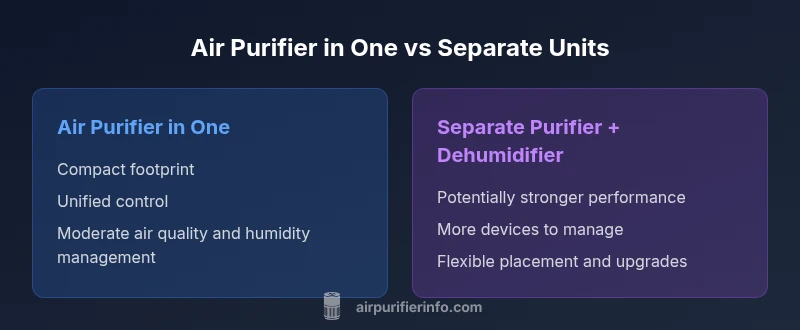
| Feature | Air Purifier & Dehumidifier in One | Separate Air Purifier + Dehumidifier |
|---|---|---|
| Primary Function | Air cleaning + moisture control in one unit | Purification-only unit + standalone dehumidifier |
| Airflow & Humidity Control | Balanced performance across spaces | Typically stronger performance in each function separately |
| Energy Use | Unified energy profile | Separate devices consume energy for two units |
| Footprint & Space | Single compact footprint | Two devices, larger footprint |
| Best For | Small-to-mid rooms needing both features | Large rooms or high humidity where peak performance matters |
| Price Range | Mid-range for 1-unit solution | Wide range depending on models for 2 units |
What's Good
- Space-saving design reduces clutter
- Convenient one-device IAQ management
- Fewer cables and simpler maintenance
- Balanced performance for small to medium spaces
- Smart features help automate cleaning and humidity control
What's Bad
- Performance may lag behind separate units in large spaces
- Higher upfront cost than a single dedicated purifier
- Maintenance complexity can be higher for combined unit
- Humidity control can be less precise than a dedicated dehumidifier
A combined IAQ unit is best for compact spaces where convenience matters, not where peak performance is needed.
If you prioritize simplicity and footprint, a 2-in-1 device is a strong fit. For larger rooms or humidity-heavy spaces, consider separate units for maximum performance and control.
Questions & Answers
What is an air purifier and dehumidifier in one?
A combined IAQ device that cleans air and removes moisture in a single appliance. It uses a filtration stack to purify and a dehumidification mechanism to lower humidity, offering space-saving convenience for smaller areas.
A single machine that cleans air and controls humidity. It saves space and is easier to manage than two devices.
Will it be effective in large rooms?
Hybrid units work well in smaller to mid-sized rooms. In larger spaces, standalone purifiers and dehumidifiers typically offer stronger performance and faster air quality and humidity improvements.
In big rooms, you might want separate devices for best results.
How do I know which model to choose?
Look at your room size, typical humidity levels, and the unit’s filtration quality and dehumidification capacity. Compare auto modes, sensor accuracy, energy use, and maintenance costs across models.
Check room size, humidity needs, and features when choosing.
What maintenance is required?
Regular filter replacements and sensor cleaning are essential. Drain condensate if your model uses a desiccant or refrigerant cycle, and follow the manufacturer’s maintenance schedule.
Keep filters fresh and sensors clean for best results.
Are there safety concerns with combined units?
Choose ozone-free models and follow safety instructions. Ensure proper ventilation and avoid covering intake or exhaust, which can affect performance.
Pick ozone-free models and follow safety guidelines.
Do these units reduce odors as well?
Yes, many combine filtration with activated carbon to reduce odors and VOCs, though not all odors can be completely eliminated.
They can cut odors, but some stubborn smells may linger.
Main Points
- Assess room size and humidity before buying
- Prioritize reliable sensors and auto modes
- Consider energy use and noise in daily life
- Compare single-unit vs dual devices for total cost
- Choose ozone-free models for safety