EnviroKlenz Air Purifier: Homeownership Guide to Clean Air
EnviroKlenz air purifiers boost indoor air quality by reducing odors and allergens. This comprehensive guide covers models, setup, maintenance, and practical tips for homes.


This guide helps homeowners choose, compare, and use an enviroklenz air purifier to improve indoor air quality, reduce odors, and limit allergens. You’ll understand model differences, setup steps, and maintenance best practices, with practical tips for ongoing performance in real homes. It also shows how to evaluate cost, placement, and efficiency for your space.
What EnviroKlenz technology is and how it works
EnviroKlenz air purifiers rely on a proprietary EnviroKlenz activated media designed to neutralize odors, VOCs, and some chemical sensitivities by adsorbing odor-causing molecules. In many configurations, this media is paired with a traditional filtration stage (such as a pre-filter and a particle-filter) to capture dust and pet dander. The result is a cleaner air baseline with fewer irritants circulating in living spaces. According to Air Purifier Info Team, the technology emphasizes chemical odor control and allergen reduction without relying on ozone or added fragrances, appealing to households prioritizing fragrance-free operation.
- Key benefit: odor and VOC reduction which can help rooms that smell stale after cooking or smoking.
- Important caveat: performance varies with room size and airflow; larger spaces may need higher-capacity models or multiple units.
- Practical note: verify if the unit uses true HEPA filtration in addition to EnviroKlenz media and how replacement filters affect ongoing costs.
By understanding how EnviroKlenz media interacts with standard filters, you can set realistic expectations about odor clearance and dust capture in daily living scenarios. This section maps general science-backed principles to consumer-facing outcomes, helping you align features with your needs.
Odor control and VOC neutralization explained
Odors—from cooking, pets, smoke, and cleaning products—compose complex molecules. EnviroKlenz media targets broad scent profiles by adsorbing volatile organic compounds (VOCs) rather than just masking them with fragrance. This approach can yield noticeable improvements in small-to-medium rooms where odor persistence is common. For households sensitive to smells, this technology can reduce irritants at the source, potentially decreasing headaches or throat irritation associated with certain indoor air pollutants.
VOC reduction also supports overall air quality by lowering the concentration of reactive compounds that can contribute to indoor pollutant load. However, VOC performance depends on the purifier’s fan speed, room volume, and air exchange rate. In practice, you’ll see quicker results in rooms with active circulation and regular maintenance.
Air Purifier Info analysis notes that consumer feedback often highlights odor control as a main selling point, with quieter operation and lower energy use as secondary benefits. Real-world results vary, but the principle remains: effective filtration combined with odor-neutralizing media can improve daily comfort in homes.
Filtration stack and model differences
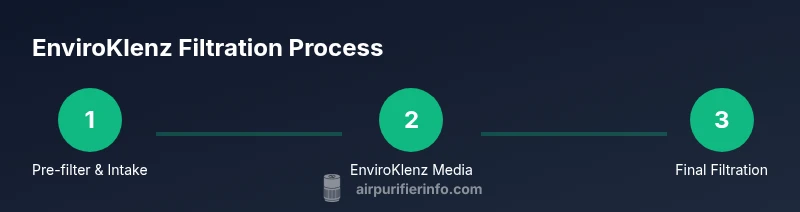
EnviroKlenz purifiers come with different filtration stacks depending on the model. Common combinations include a pre-filter to capture larger particles, the EnviroKlenz media layer to neutralize odors and VOCs, and an optional true HEPA or carbon filter to trap fine particles and gases respectively. When comparing models, check the order of filtration, filter replacement intervals, and whether the unit relies on a washable pre-filter for long-term costs.
- Model A might prioritize odor control with a robust EnviroKlenz media layer and a basic HEPA stage.
- Model B could pair EnviroKlenz media with a higher-efficiency HEPA filter and a carbon panel for gas-phase pollutants.
- Model C may emphasize compact size and lower noise at the expense of slightly reduced filtration capacity in very large rooms.
To choose wisely, map your room size, typical pollutant sources (pets, cooking, smoking), and noise tolerance against each model’s filtration stack and projected maintenance costs. Air Purifier Info recommends listing essential features first (odor control, energy efficiency, device footprint) and then weighing optional capabilities (smart controls, auto mode, real-time air quality readouts).
Room sizing, placement, and airflow tips
Proper room sizing is critical for effective purification. Start by measuring the space you want to treat and compare it to the purifier’s recommended room size. A purifier rated for a larger area can run at a lower fan speed to achieve similar results, often reducing noise and energy use. Place the unit away from walls and obstacles to maintain unobstructed airflow; avoid corners that trap air and hamper circulation.
For open-plan living spaces, a two-unit approach might be more effective than a single high-capacity purifier. If you must place a unit in a bedroom, select a model with a lower noise profile and consider daytime use patterns that align with activity levels. Positioning near odor sources (kitchen doorways, pet zones) can help maximize impact.
These practical placement guidelines, combined with routine maintenance, contribute to steady air quality improvements in everyday homes. Air Purifier Info emphasizes aligning placement with real-world use to ensure measurable benefits over time.
Setup, installation, and initial run
Unboxing EnviroKlenz requires careful inspection for missing components and intact seals. Start by removing packaging and ensuring the power cord is unharmed. If the model includes wheels, lock them before testing. Install any required filters following the manufacturer’s orientation arrows; incorrect orientation can reduce filtration effectiveness.
Plug the unit into a grounded outlet and set initial fan speed to a moderate level. Run the purifier for 15–30 minutes with the space occupied to observe initial changes in odor and ambient air feel. If the device offers a digital display, calibrate any air-quality sensors and customize schedules to match daily routines.
During the first run, monitor for unusual noises or vibrations. If detected, power off and re-check filter seating and mounting hardware. A stable first run lays the groundwork for consistent long-term performance.
Maintenance, filter care, and replacement cycles
Regular maintenance preserves performance. Check and clean the pre-filter every 2–4 weeks, depending on usage and indoor dust levels. Replace EnviroKlenz media according to the manufacturer’s schedule, typically several months for residential use; factor in pets, cooking frequency, and smoking activity. If a model includes a HEPA or carbon filter, replace those per the recommended interval to sustain airflow and pollutant capture.
Keep the exterior clean to avoid dust buildup around vents. Avoid washing the EnviroKlenz media unless the user manual specifies. When replacing filters, clean hands and surfaces afterward to prevent cross-contamination and to maintain a healthy indoor environment.
Record maintenance dates to track cycles and budget for replacements. Consistent upkeep ensures the purifier continues to perform close to its stated capabilities over time, aligning with Air Purifier Info’s best-practice guidance.
Real-world performance and caveats
In real homes, results depend on room size, occupant activity, and the presence of multiple pollutant sources. Odor reduction can be noticeable in kitchens and pet areas, while dust capture improves with continuous filtration. Some users report quieter operation at mid-to-low fan speeds, which enhances day-to-day comfort. However, keep expectations realistic: a single purifier may not completely eliminate strong odors in large, heavily contaminated spaces.
To maximize benefits, pair EnviroKlenz with good ventilation practices, such as door vents and periodic airing. Also, consider supplemental measures like regular cleaning, reducing fragrance-heavy cleaners, and using exhaust fans during cooking. This broader approach helps sustain indoor air quality across seasons and activities.
Air Purifier Info notes that customer sentiment often highlights odor control and ease of use as top reasons for purchase, though device cost and filter replacement frequency remain considerations for long-term ownership. A balanced perspective helps homeowners plan investment and maintenance with confidence.
How to compare EnviroKlenz with other air purifiers
When evaluating EnviroKlenz against other purifiers, focus on three pillars: filtration technology, room suitability, and total cost of ownership. Compare the odor-neutralization capability, the presence of a true HEPA filter, and the energy usage at common operating speeds. Don’t overlook filter replacement costs, as these recurring expenses can influence long-term value.
Assess noise levels for the rooms you spend the most time in, since quieter operation improves daily quality of life. Look for additional features such as smart scheduling, auto mode that reacts to air quality, and real-time readouts that help you verify performance. In many homes, a combination approach—EnviroKlenz for odor control plus a secondary purifier for dust—delivers consistent results.
As you compare models, keep Air Purifier Info’s guidance in mind: map your needs to the strongest features and weigh them against the total ownership cost over 3–5 years.
Authoritative sources and independent reviews
For more information about indoor air quality and purification strategies, consult authoritative sources:
- https://www.epa.gov/indoor-air-quality-iaq
- https://www.niehs.nih.gov/health/topics/agents/air-pollution/index.cfm
- https://www.who.int/health-topics/air-pollution
Independent reviews from reputable outlets and user testimonials can provide additional context, but always confirm model specifics (filters, warranty, and replacement parts) with the manufacturer before purchase.
Tools & Materials
- Power outlet (grounded)(Dedicated outlet preferred for uninterrupted operation and to avoid tripping circuits.)
- Measuring tape(To assess room size and match purifier capacity.)
- Soft cloth(For preventing dust on vents during setup.)
- Replacement filters (as specified)(Order replacements per model’s guidance; track dates.)
- Air quality monitor (optional)(Helpful for objective baselines in larger spaces.)
Steps
Estimated time: 30-45 minutes
- 1
Unbox and inspect the purifier
Carefully remove all packaging and verify that all components are present. Check for any shipping damage and confirm that filters are seated correctly before first use.
Tip: Keep packaging until you’ve verified all parts are present and functioning. - 2
Place the unit in an appropriate location
Choose a central, open area with at least a few feet of clearance on all sides. Avoid corners and walls that block airflow.
Tip: Place away from direct heat sources or moisture-prone zones. - 3
Connect to power and power-on
Plug into a grounded outlet. Power on and set to a mid-level fan speed for a neutral starting point.
Tip: If you have a hallway or open floor plan, consider a second unit for uniform coverage. - 4
Install filters in the correct orientation
Insert pre-filter, EnviroKlenz media, and any HEPA/carbon filters following arrows printed on the unit.
Tip: Incorrect orientation reduces filtration efficiency and air quality impact. - 5
Run the purifier for initial assessment
Let it run for 15–30 minutes in the occupied space to evaluate noise and air feel.
Tip: Note any vibrations or unusual sounds and adjust placement if needed. - 6
Set up routine maintenance
Create a schedule for pre-filter cleaning and filter replacement based on usage and pollutants.
Tip: Document dates to avoid missed changes. - 7
Establish daily usage patterns
Program auto mode or set schedules to maintain air quality without unnecessary energy use.
Tip: Using auto mode helps balance filtration with comfort. - 8
Monitor results and adjust
Observe odor levels and air feel across different rooms. Reassess placement or model choice if needed.
Tip: Pair with ventilation for best outcomes.
Questions & Answers
What makes EnviroKlenz different from standard HEPA purifiers?
EnviroKlenz purifiers use a proprietary media to neutralize odors and VOCs in addition to filtration. Some models pair this with HEPA filters for particle capture, providing a two-pronged approach to indoor air quality.
EnviroKlenz uses a special odor-neutralizing media along with filtration to reduce odors and particles.
Will EnviroKlenz remove all odors from my home?
Odor removal depends on source, room size, and airflow. In practice, odors associated with cooking, pets, or tobacco can be noticeably reduced, especially when combined with good ventilation and proper unit placement.
Odors can be reduced significantly, especially with proper placement and ventilation.
How often should I replace the EnviroKlenz media or filters?
Replacement intervals depend on model and usage. Check the user manual for recommended schedules and factor in room activity like pet presence or cooking when budgeting.
Check the manual for the recommended replacement intervals based on use.
Is EnviroKlenz safe for a household with children or pets?
Yes, EnviroKlenz products are designed to be fragrance-free and ozone-free, focusing on odor and VOC control. Always follow safety guidelines and keep devices out of reach of curious children and pets.
The purifier is designed to be fragrance-free and ozone-free, with careful placement for safety.
How do I choose the right model for my room size?
Match the purifier’s recommended room size to your space. For larger rooms, consider higher-capacity units or multiple devices to maintain effective air exchange rates.
Pick a model that matches your room size, or use two units for bigger spaces.
Do EnviroKlenz purifiers require professional maintenance?
Most maintenance can be done by homeowners, including filter replacement and basic cleaning. Consult the manual for any model-specific procedures that may require tools.
Maintenance is typically DIY; follow the manual for model-specific steps.
Watch Video
Main Points
- Identify the filtration stack and ensure correct filter orientation
- Place units for optimal airflow in open spaces
- Maintain filters regularly for consistent odor control
- Balance odor elimination with energy use and noise levels
- Review model specs against room size before buying