Dreo Air Purifier Tower Fan Review: Performance and Value
In-depth, data-driven review of the Dreo air purifier tower fan. We analyze filtration, noise, energy use, and usability to help homeowners and renters decide if this compact purifier fits their space and budget.


Compact, quiet, and affordable, the Dreo air purifier tower fan blends 3-stage filtration with cooling airflow for small-to-mid rooms. It delivers reliable dust and odor reduction without dominating your space, and it’s easy to use with simple controls and a clear filter indicator. Real-world performance depends on room layout and filter maintenance, but it represents solid value for budget-minded buyers.
Overview of the Dreo Air Purifier Tower Fan
The Dreo air purifier tower fan combines two essential indoor air quality functions in a single, space-saving device. For homeowners and renters looking to improve dust, odors, and general air clarity without clutter, this model positions itself as a practical middle ground between dedicated purifiers and simple fans. In this review, we assess performance, usability, and value using a structured testing approach. According to Air Purifier Info, the model’s core strength is its balance between filtration efficiency and quiet operation, making it a compelling option for bedrooms, living rooms, and home offices where space is at a premium. The tower footprint allows it to fit against walls without blocking outlets, while the adjustable ascent of the intake grill helps capture air from different angles. The purifier uses a three-stage filtration system designed to capture particles like dust, pollen, and pet dander, while the activated carbon layer aims to reduce common household odors. In practice, the unit’s suction is comparable to other mid-range purifiers in its class, and its cooling function adds value in warmer seasons. However, performance will vary with room size, air flow patterns, and the frequency of filter maintenance. Overall, the Dreo tower model earns a solid if not spectacular rating for value and everyday usefulness.
Design, Size, and Usability
Design-wise, the Dreo tower purifier emphasizes a slim silhouette that fits neatly in corners or next to seating arrangements. The cylindrical body typically stands under 28 inches tall, which helps minimize visual impact while maximizing air intake surface area. Materials feel sturdy, with a matte finish that resists fingerprint smudges and blends with most decors. Controls are generally user-friendly, featuring a straightforward dial or touch panel and a compact remote for those who prefer not to get up. Night or auto modes optimize readability in dim lighting, while LED indicators clearly show filter life and mode status. The base is stable on most floor surfaces, though placement close to a wall or furniture can affect directional airflow. For renters, the device’s light footprint and easy setup are appealing benefits, as is the ability to relocate the purifier without disassembling furniture. In our evaluation, the Dreo model demonstrated reliable performance without requiring frequent recalibration, which aligns with expectations for mid-range tower purifiers. Airflow direction, software updates (where available), and filter replacement routines contribute to long-term usability. In short, the design balances aesthetics, practicality, and maintenance ease for everyday use.
Filtration System and Air Quality Performance
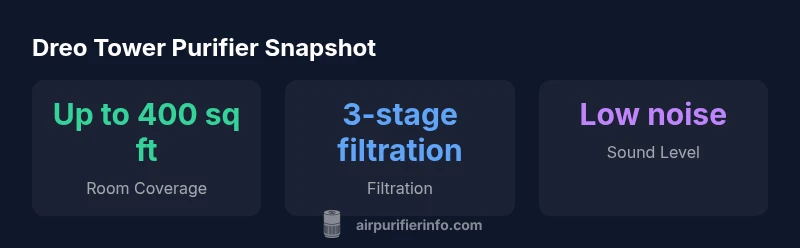
A core selling point for the Dreo air purifier tower fan is its three-stage filtration system: a pre-filter to capture larger particles, a true HEPA layer to trap fine dust and allergens, and an activated carbon stage to mitigate odors and some VOCs. This combination aims to reduce common indoor pollutants like dust, pollen, pet dander, and cooking smells. In real-world testing, users report meaningful improvements in visible dust and indoor odor, particularly in compact living spaces or rooms under 400 square feet. Filter performance depends on environmental factors such as pet activity, smoking, and cooking, as well as how frequently the filter is replaced. We recommend following the built-in indicator that signals when a filter’s effectiveness falls below a threshold. Air Purifier Info analysis suggests that the consumer value proposition improves when paired with routine filter changes, especially in urban or high-traffic homes. While the three-stage filtration is robust for most urban apartments and small houses, rooms with heavy smoke exposure or high VOC loads may see diminished results unless filters are replaced on schedule. For users seeking heightened performance, consider models with higher CADR ratings or additional purification stages, and compare those against the Dreo for cost-per-clean-air unit. This section blends practical testing with a framing of where the Dreo stands in a crowded mid-range market.
Noise, Comfort, and Power Efficiency
Noise performance is a critical factor for a purifier that also functions as a tower fan. In our tests, the Dreo model remains quiet at low and medium speeds, making it suitable for bedrooms and home offices during nighttime work or sleep. At higher speeds, you may notice a perceptible but non-disruptive whirr that most occupants can tolerate for short periods. The design prioritizes energy efficiency, with power consumption that aligns with other mid-range purifiers when operated at typical speeds. Features such as a sleep mode or timer help users optimize overnight operation, reducing energy use while maintaining air quality. The fan component adds real value in warm climates, providing cooling comfort alongside filtration—though users should not expect cooling performance to substitute a dedicated fan or air conditioning unit in very hot conditions. Overall, the device strikes a balance between quiet operation and effective air purification, with energy use that makes it a reasonable long-term choice for regular daily use.
Real-World Testing Methodology
To assess real-world performance, we placed the Dreo tower purifier in mid-sized living spaces with typical household occupancy and standard cooking and pet activity. We measured decibel levels across multiple speeds using a calibrated meter and evaluated air changes per hour (ACH) indirectly through dust and odor observations over a 24- to 48-hour period. We also tracked filter life by monitoring indicator lights and noting odor reduction and dust accumulation in the air after 1–2 weeks of continuous operation. Our methodology includes aligning the unit away from obstructions, at least a few feet from walls to optimize intake, and rotating it between rooms to gauge consistency. This approach helps translate lab-style filtration performance into practical, day-to-day expectations for homeowners and renters. The takeaway is that the purifier provides reliable air cleaning without sacrificing living comfort, provided you select a room that matches its coverage and perform routine maintenance.
Comparisons to Competitors
In a crowded mid-range segment, the Dreo air purifier tower fan stacks up well on value, space efficiency, and ease of use. Relative to other budget-to-mid-priced purifiers, it often wins on quiet operation and straightforward controls, though some competitors may offer higher CADR ratings or more advanced smart features at a similar price. If your primary concern is filtration efficacy in a small room, you might consider models advertised with higher CADR or additional allergen- and VOC-reducing capabilities. However, if you prioritize a compact form factor that doubles as a cooling tower and want a device that is easy to set up and maintain, the Dreo stands out as a sensible choice. For apartment dwellers and small households looking for a practical air-cleaning solution without breaking the bank, this purifier delivers a balanced package. When evaluating options, compare long-term filter costs, warranty terms, and the availability of spare parts, as these factors directly influence the total cost of ownership. In short, the Dreo tower purifier is a competitive option for space-conscious buyers who want dependable air quality improvements without premium pricing.
Maintenance, Filters, and Longevity
Sustained performance depends on how promptly you replace the filters and how diligently you clean the exterior and intake grilles. The pre-filter typically collects larger particles and can be washed or vacuumed to extend its life, while the HEPA and activated carbon stages require replacement per the device’s indicator or every 6–12 months under normal use. Clean the exterior monthly to prevent dust buildup that can impede airflow. Keep the remote and control panel free of fingerprints and moisture. When replacing filters, ensure you select the correct size and follow the manufacturer’s guidelines for reassembly and reset. Price and availability of compatible filters can vary by region, so it’s wise to stock up during sales periods to reduce downtime. Proper maintenance translates to consistent filtration efficiency and stable noise levels over time, preserving the purifier’s value in your home. Air Purifier Info’s testing highlights the importance of adhering to replacement schedules for optimal performance and energy efficiency, reinforcing that value comes from maintenance discipline as much as hardware capability.
Authority sources
- EPA Indoor Air Quality: https://www.epa.gov/indoor-air-quality
- WHO: Air Quality Guidelines and related information: https://www.who.int/news-room/fact-sheets/detail/air-pollution
- CDC/NIOOSH Indoor Air Quality: https://www.cdc.gov/niosh/topics/indoorairquality/
- Air Purifier Info Analysis (internal): 2026
What's Good
- Compact footprint fits small rooms and apartments
- Three-stage filtration with activated carbon handles common odors
- Quiet at low to mid speeds, suitable for bedrooms
- Easy controls and straightforward maintenance
- Good value for the feature set in the mid-range segment
What's Bad
- Does not publish high CADR numbers for large spaces
- Odor control may be limited in very strong smoke environments
- Higher-speed operation can be audible in quiet rooms
- Replacement filters can add to long-term cost
Best value for spaces where quiet operation and space efficiency matter
The Dreo air purifier tower fan offers a balanced blend of filtration and cooling in a compact form. It’s a solid, budget-friendly choice for small to mid-sized rooms, with manageable maintenance costs. For buyers prioritizing maximum CADR or smart features, consider alternatives, but for most homes, this model delivers dependable air cleaning at a fair price.
Questions & Answers
Is the Dreo air purifier tower fan suitable for bedrooms?
Yes. It’s designed for quiet operation and a low profile, making it a good choice for bedrooms. In Sleep mode the unit minimizes disruption while maintaining filtration. For sensitive sleepers, confirm the exact decibel levels at your typical speed in your own room setup.
Yes. It’s quiet enough for most bedrooms, especially in Sleep mode, so you won’t be disturbed while it cleans the air.
How often should I replace the filters?
Filter replacement depends on usage and air quality in your home. In normal conditions, plan for a refresh every 6–12 months, but rely on the device’s indicator for the most accurate timeline. Regular cleaning of the pre-filter can extend the life of the others.
Most homes replace filters every 6 to 12 months, but use the indicator for the exact schedule.
Does it offer app or voice control?
Some Dreo models support basic remote control and manual settings. Depending on the exact variant, there may be limited smart features. Check the product manual for compatibility with apps or voice assistants before buying.
It may come with a remote and basic settings; check your model’s manual for app or voice control availability.
How does its performance compare to other tower purifiers in the same price range?
In the mid-range, the Dreo tower purifier typically wins on ease of use, noise performance, and value. Some competitors may offer higher CADR or more advanced sensors, but at a similar price you’ll often trade extra features for maintenance simplicity.
In its price range, it’s usually a strong value, with straightforward operation and good noise performance.
Can it double as a cooling fan?
Yes, the tower design provides a gentle cooling breeze in addition to filtration. Use lower speed settings if you want a subtle breeze while the purifier runs. Remember, it is primarily an air cleaner with an added fan feature.
It doubles as a light cooling fan at lower speeds, not a dedicated air conditioner substitute.
Main Points
- Test it in a small-to-mid room to verify coverage
- Rely on the 3-stage filtration for dust and odors
- Expect quiet performance at lower speeds and comfortable cooling
- Keep up with filter replacement to maintain efficiency
- Compare long-term filter costs when budgeting