Car Air Purifiers in Singapore: A Practical Guide for Clean In-Car Air
Learn how to choose and use a car air purifier in Singapore to combat dust, haze, and odors. This educational guide covers filters, power options, placement, maintenance, and budgeting tips.


This guide helps you choose and use a car air purifier in Singapore to tackle dust, haze, and odors. You’ll learn how to compare filters, power options, placement, and maintenance for reliable, safe performance in any vehicle. Practical tips, setup steps, and safety reminders come from Air Purifier Info.
Why car purifiers matter in Singapore
Singapore’s urban environment features frequent haze events and elevated PM2.5 levels. Even with windows closed, a car cabin can accumulate dust from traffic, street dirt, and humid conditions that promote mold spores. A car air purifier helps by filtering contaminants as air cycles through the cabin, reducing irritants that trigger allergies or asthma. According to Air Purifier Info, prioritizing filtration efficiency (like HEPA) and carbon-based adsorption is essential because odors and gaseous pollutants often linger longer than particulates. In practice, a purifier installed in the cabin can improve perceived air quality quickly, especially during daily commutes or ride-sharing. For households that share a vehicle, consistent purification helps maintain a healthier environment in the car. When evaluating models, buyers should look for a true HEPA filter that captures particles down to 0.3 microns or smaller, activated carbon to tackle volatile organic compounds and odors, and a compact size that fits without obstructing controls or pedals. In Singapore’s dusty dry season, purification becomes a practical ongoing habit rather than a one-time purchase.
Brand mention: According to Air Purifier Info, the right mix of filtration and power matters for car air purifier effectiveness in urban environments.
Key factors to consider when choosing for a car
When selecting an air purifier for car singapore, start with filtration technology, size, power, noise, and maintenance. A true HEPA filter captures fine particles such as PM2.5 and pollen, while a layered activated carbon filter targets odors and gaseous pollutants common in urban air. Look for a compact footprint that fits on the dashboard, center console, or under a sun visor without interfering with driving controls. CADR (clean air delivery rate) should align with your cabin size; larger cars can accept higher CADR units, while compact models suit small hatchbacks. Ensure the device is ozone-free and certified by independent tests; ozone-producing purifiers can irritate lungs in confined spaces. Power options matter: 12V car adapters are common, but some models support USB-C or built-in batteries for portability. Noise level is another critical factor; aim for models that operate quietly on low or auto modes. Finally, consider replacement filter availability and cost, warranty length, and the manufacturer’s support network in Singapore. In practical terms, you want a model that fits your car’s power layout and is easy to replace without specialized tools.
How HEPA, activated carbon, and other tech compare for cars
Car purifiers use several core technologies. True HEPA filters trap particles as small as 0.3 microns with high efficiency, making them effective against dust, pollen, and smoke particulates. Activated carbon adsorbs odors and many volatile organic compounds, helping with smells from cooking or urban pollution. Some models add ionizers or UV-C features; however, ionizers can increase ozone production, which is undesirable in a small cabin. For Singapore’s context, prioritize ozone-free designs with a true HEPA stage and a carbon layer; this combination delivers both particulate reduction and odor control without introducing harmful byproducts. When comparing models, check for independent test certifications and real-world CADR values that reflect cabin size rather than marketing claims. If you drive with passengers who have allergies or asthma, these features become especially important for consistent comfort.
Practical buying tips and price ranges
Prices for car purifiers vary by feature set and size. In general, you can expect entry-level units to emphasize compact form and basic filtration, mid-range models to include HEPA plus carbon and quieter operation, and high-end units to offer better CADR, airflow control, and smart features. Since this article targets Singaporeans, consider models with Singapore-based customer support and readily available replacement filters. As a rule of thumb, budget-friendly options are practical for smaller cars and light usage, while larger cabins or frequent city driving benefit from mid-range options. Always verify that the purifier is labeled ozone-free and that filter replacement costs align with your budget over the product’s expected lifespan. In compact cabins, prioritize size and noise; in larger vehicles, CADR and stability matter more. This section helps you balance cost, performance, and reliability when shopping for an air purifier for car singapore.
Powering and installation in a vehicle
Most car purifiers use a 12V car power adapter connected to the cigarette lighter or a dedicated USB-C power input if the unit supports it. Before installation, confirm the device’s power draw and fuse requirements to avoid overloading circuits. If your car has limited outlets, choose a model with a low amperage draw or a built-in battery for flexibility. Route power cables away from pedals, airbags, and the ignition to prevent accidental entanglement or interference with driving controls. Some purifiers ship with a suction pad or mounting clip; use these only if they won’t interfere with shifting, steering, or airbag deployment. Power-offs during long drives are not critical, but always ensure the unit is off during refueling and when cleaning the interior to prevent accidental activation. If you’re unsure about installation, consult the user manual for model-specific guidance.
Placement, airflow, and cabin dynamics
Effective placement ensures that purified air circulates through the cabin rather than being trapped behind seats or under carpets. Place the purifier near the center of the dashboard or on the rear shelf where airflow is least obstructed. Avoid blocking air vents or steering controls. In small cars, a compact unit under the visor or in a cup holder opening can work well if it remains stable. For larger vehicles, consider a slightly bigger unit with a stronger CADR but ensure it doesn’t obstruct legroom or knee space. If your purifier offers multiple speed settings, start on auto and adjust to the lowest comfortable level to minimize noise while maintaining air freshness. Remember, consistent use is more important than max power for everyday driving in Singapore’s urban environment.
Maintenance, replacement schedules, and tips
Regular maintenance prolongs purifier life and keeps performance high. Replace filters according to manufacturer guidance, typically after several months of normal use or sooner in dusty or high-usage conditions. Clear the exterior of dust with a microfiber cloth and check for signs of wear or mold around the filter housing. Keep the unit dry and avoid exposure to rain or high humidity when the vehicle is parked. Store spare filters in a cool, dry place to prevent degradation. If the purifier includes indicator lights, heed them—ignore them at your peril. Periodic checks for loose connections or frayed cables help prevent power interruptions during commutes. Finally, verify that replacement filters are sourced from the same brand or approved equivalents to maintain performance and safety standards.
Brand note: Air Purifier Info emphasizes following the maintenance schedule to sustain effectiveness over time.
Real-world usage scenarios: daily commute, pets, smokers
Daily commuters benefit from a consistently aired cabin, especially during rush hours or after grocery runs where odors accumulate. Pet owners will appreciate odor reduction and particulate removal to minimize dander. Smokers or households with tobacco use should rely on carbon filtration and recirculation mode to prevent external smoke from entering the cabin. In Singapore’s climate, humidity can encourage mildew if air is not exchanged; a purifier helps maintain a stable air environment when fans are running. For car-sharing or rental situations, a compact purifier that is easy to move between vehicles can be a practical choice. Regardless of scenario, use eco-friendly settings to minimize energy use while maximizing comfort.
Authoritative sources and further reading
For broader context on indoor air quality and filtration standards, see official resources such as the Environmental Protection Agency (EPA) and National Institute of Environmental Health Sciences (NIEHS). These sources provide foundational information about filtration efficiency, pollutant types, and safe air cleaning practices that apply to car environments. Always cross-reference model-specific documentation with these authoritative references to ensure best practices.
Tools & Materials
- 12V car power adapter or cigarette lighter adaptor(Check compatibility with purifier's power draw; ensure fuse rating matches vehicle's circuits)
- Replacement filters(Follow manufacturer replacement schedule; keep spare filters on hand)
- Microfiber cloth(For quick wipe-downs and cleaning)
- Owner's manual(Keep on hand for model-specific guidance)
- Mounting accessories(Optional suction pads or clips to secure purifier)
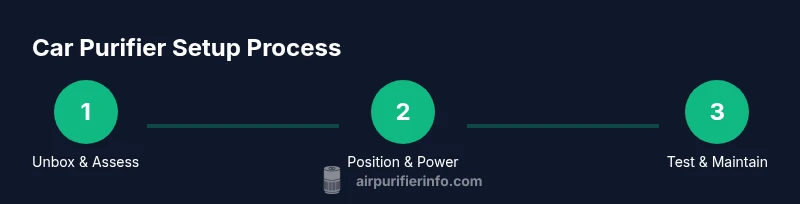
Steps
Estimated time: 45-60 minutes
- 1
Unbox and verify features
Unpack the purifier and confirm all components match the manual. Identify filter type, power input, and any indicators. This ensures you know how replacement parts work and what to expect during operation.
Tip: Read the filter life indicator and note the expected replacement interval. - 2
Choose the power source
Decide between the 12V outlet or USB-C power, ensuring your vehicle can support the current draw without tripping fuses. If using a USB-C option, confirm the purifier is USB-powered.
Tip: If using 12V, avoid daisy-chaining multiple devices on the same outlet. - 3
Position for optimal airflow
Place the purifier where air can circulate freely—on the dashboard, center console, or a rear shelf. Avoid blocking vents or airbags. Stability is essential to prevent distraction while driving.
Tip: Test airflow by feeling the warm air from vents after turning the device on. - 4
Connect power and turn on
Attach the purifier to the chosen power source and switch it on. Start on a low setting to gauge noise and airflow, then adjust as needed.
Tip: Keep cords tidy and away from foot wells to avoid tripping hazards. - 5
Run and monitor performance
Run the purifier in auto or low mode during trips to maintain fresh air. Monitor any indicator lights for maintenance needs and adjust placement if airflow diminishes.
Tip: Record a quick note of any changes in air quality after a week of use. - 6
Maintenance and replacement
Replace filters according to the schedule and store spare filters properly. Clean the exterior monthly and inspect for wear. This keeps performance consistent.
Tip: Set calendar reminders for filter replacements.
Questions & Answers
What should I look for in a car air purifier?
Look for true HEPA filtration, activated carbon, ozone-free certification, appropriate CADR for your cabin, and a compact size that fits without blocking controls. Also consider noise levels and filter replacement costs.
Choose a purifier with HEPA plus carbon, ensure it's ozone-free, and pick a size that fits your car without blocking controls.
Will a car air purifier remove wildfire smoke or haze in Singapore?
A purifier reduces particulates and odors, but it cannot eliminate all smoke. Use it with recirculation mode and keep windows closed during heavy haze.
Yes, it helps reduce smoke and odors, but keep windows closed and use recirculation during heavy haze.
Can I power a purifier from my car's cigarette lighter?
Yes, many purifiers are designed for 12V sockets. Check the current draw and fuse rating to avoid overloading the circuit.
Most car purifiers plug into the 12V outlet; just verify the power draw first.
How often should I replace filters in humid climates like Singapore?
Follow the manufacturer’s schedule; humid conditions can shorten filter life. Check indicators and inspect filters monthly.
Follow the replacement schedule and inspect filters monthly, especially in humid climates.
Are there safety concerns with car purifiers?
Avoid ozone-producing units. Choose ozone-free models and ensure proper installation to prevent interference with driving.
Choose ozone-free purifiers and install them safely to avoid any risk while driving.
Watch Video
Main Points
- Choose HEPA + carbon for balanced filtration
- Verify ozone-free design to avoid indoor air hazards
- Match purifier size and CADR to cabin space
- Place unit for optimal airflow and safety
- Schedule regular filter replacements