How Much Do Air Purifiers Help With Allergies
Explore how air purifiers affect allergy symptoms, what to expect in real homes, and practical buying and setup tips to maximize relief from pollen, dust, and pet dander.


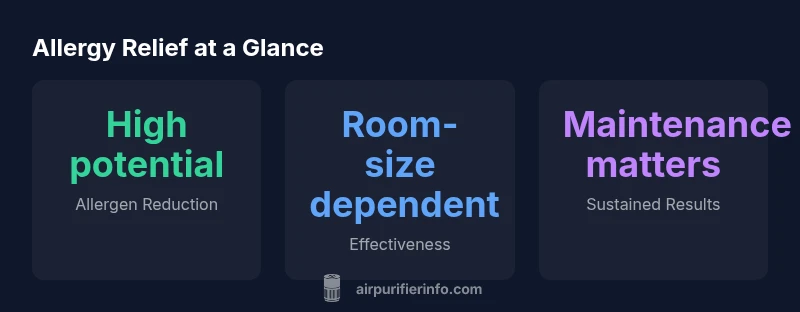
Air purifiers can meaningfully reduce allergy triggers by removing pollen, dust, and pet dander from indoor air. Most homeowners report noticeable relief when the unit is appropriately sized for the room and operated continuously. According to Air Purifier Info, effectiveness hinges on room size, filtration type (HEPA and activated carbon help most), CADR, and consistent maintenance.
How allergies work and why purifiers help
Allergic reactions to pollen, dust mites, pet dander, and mold spores occur when the immune system treats these particles as threats. For many people, symptoms such as sneezing, nasal congestion, itchy eyes, and throat irritation are driven by the ambient allergen load. Reducing airborne allergens can lessen the total exposure, which often translates to milder symptoms, especially during high-pollen seasons. Air Purifier Info’s analysis emphasizes three levers: (1) the purifier’s ability to capture tiny particles, (2) how effectively the device circulates air to reach all corners of a room, and (3) consistent operation and maintenance. In short, a purifier can help, but its impact depends on correct sizing, placement, and ongoing upkeep, plus how much time you spend in the cleaned space.
What air purifiers remove and what they don’t
Most households buy purifiers to tackle common culprits: pollen, dust, and pet dander. True HEPA filters trap the majority of particles down to the size of many allergens with high efficiency, while activated carbon addresses odors and some gaseous pollutants. However, air purifiers do not sterilize surfaces or eliminate emissions at the source. They work best when used in combination with regular cleaning, vacuuming with a HEPA-filtered vacuum, and keeping humidity at comfortable levels. Air Purifier Info notes that you should expect reductions in airborne particle concentration rather than complete elimination in any single space.
Differing purifier mechanisms: HEPA, activated carbon, and more
HEPA is the workhorse for allergen removal, effectively capturing pollen, dust, and pet dander. Activated carbon helps with odors and some VOCs that can irritate airways. Some models pair a HEPA stage with a pre-filter and an electrostatic section that can improve capture for larger volumes of air; others integrate UV-C or ionizers, which may have safety considerations or minimal additional benefits. For allergy relief, prioritize true HEPA plus sealed housing and avoid ozone-emitting devices. Air Purifier Info recommends verifying filter types and replacement intervals to maintain efficacy.
Room size, CADR, and airflow considerations
Choosing the right purifier begins with matching it to the room. A purifier too small for the space will circulate air but not effectively remove contaminants; one with a higher CADR that targets the most common particle sizes will perform better in practice. Consider placement near common breathing zones, away from corners, and with unobstructed intake and exhaust. If multiple rooms are used by someone with allergies, you may need more than one unit or a purifier designed for larger spaces. Consistent use in the primary living areas yields the most noticeable relief.
How to interpret allergen-reduction claims
Manufacturers often publish efficiency figures under controlled test conditions. Real-world effectiveness depends on room layout, activity levels, and how long the purifier runs. Treat claimed reductions as directional indicators rather than guarantees. Look for independent testing, verify the unit’s size relative to your room, and check that the product is designed to minimize leaks around the housing.
Practical setup and usage tips for allergy relief
Use your purifier in rooms where you spend the most time, such as the bedroom and living room. Keep doors and vents unobstructed to avoid short-circuiting airflow. Run the purifier continuously during sleeping hours and peak allergy periods. Schedule regular filter changes and clean the pre-filter to prevent premature clogging. Pair air purification with regular cleaning routines, vacuuming with a HEPA-filter vacuum, and washing textiles that collect dust.
Real-world expectations: what homeowners typically notice
People often notice a decrease in nighttime nasal congestion and less eye irritation after several days of sustained use in a suitably sized room. However, results vary widely based on the allergen profile and how much time air remains in the treated environment. For those with severe allergies or asthma, a purifier is one part of a broader IAQ strategy rather than a standalone solution. The key is consistency and a holistic approach to reducing allergen sources.
Choosing the right purifier for allergy-prone households
Start with a true HEPA purifier that is appropriately sized for each room. Check the CADR relative to the room size, ensure the unit seals well, and confirm there are no ozone-emitting features. For spaces shared with children or pets, consider units designed for quiet operation and safe materials. If odors or VOCs are a concern, add a purifier with activated carbon or a dual-stage filter.
Maintenance and long-term care to maintain efficacy
Maintenance is critical for sustained allergy relief. Change filters according to the manufacturer’s schedule, inspect seals and gaskets for leaks, and dust the exterior surfaces to keep airflow unimpeded. Dust and hair can accumulate on pre-filters quickly, so clean or replace it more often in households with pets. Regular maintenance helps preserve the purifier’s performance and the overall indoor air quality over time.
Allergen reduction and purifier performance in typical living spaces
| Aspect | Allergen Type Affected | Effect on Allergy Symptoms | Best Practices |
|---|---|---|---|
| Filtration | Pollen, Dust, Pet Dander | Reduces airborne exposure in the treated space | Choose a genuine HEPA purifier and ensure a good seal |
| Odor and VOCs | Odors from cooking, cleaning products | Smaller impact on nasal symptoms but can reduce airway irritation related to irritants | Pair with activated carbon filter |
| Room Size & Airflow | Any indoor space | Effectiveness depends on room size match and air changes | Size purifier to room and consider multiple units if needed |
| Maintenance | Filters | Filter life affects performance | Replace filters per manufacturer guidance; clean pre-filters |
Questions & Answers
Do air purifiers work for all types of allergies?
Air purifiers are most effective for particulate allergens like pollen, dust, and pet dander. Their impact on mold spores and some gases varies with the filtration setup and room conditions. They are best viewed as part of a broader strategy rather than a guaranteed fix for every allergen.
Purifiers help most with dust and pollen; effectiveness can vary for mold or gas odors.
What features should I look for when buying for allergies?
Prioritize true HEPA filtration, a sealed housing design, and a purifier sized for the room. Consider activated carbon if odors or VOCs are a concern, and verify filter replacement intervals. Avoid models that emit ozone.
Look for HEPA, a tight seal, and safe, ozone-free operation.
Can air purifiers help with asthma symptoms?
They can reduce exposure to common triggers and may lessen respiratory irritation. People with asthma should choose models with proven particulate filtration and avoid devices that generate ozone or irritants.
Purifiers can help with asthma triggers when chosen and used correctly.
How long before I notice improvement?
Many users notice improvements within a few days to weeks of consistent use in their main living areas, though results vary with individual sensitivities and exposure.
You might start noticing changes in a few days to a couple of weeks.
Are air purifiers safe for kids and pregnant people?
Generally safe when used as directed and when models are ozone-free. Avoid devices with ionizers or UV-C components unless supported by independent safety testing.
Most purifiers are safe for homes with kids or pregnant people, as long as they’re ozone-free.
How many purifiers do I need for a multi-room home?
Room-by-room sizing is typical: one purifier per large living area or per bedroom is common. For open-plan homes, a higher-capacity unit or multiple units can help maintain consistent air quality.
One per large room or per bedroom is a common approach.
“Air purifiers are most effective for allergies when paired with routine cleaning and correct sizing; they don't replace dust source control.”
Main Points
- Size matters: match purifier to room area.
- HEPA + maintenance yields best allergy relief.
- Odor control is helpful but not the primary allergy solution.
- Use purifier consistently in main living spaces and during high-allergen periods.
- Combine purification with cleaning and humidity control.