Shark Air Purifier Max Review: Performance for Dust and Odors
An analytical review of the Shark Air Purifier Max, examining dust, odors, and pet dander control, filtration efficiency, noise, and operating costs. Learn how it stacks up against rivals and who should buy.


Compared to budget purifiers, the Shark Air Purifier Max delivers stronger dust and VOC removal for mid-sized rooms, with a three-stage filtration including a true HEPA-style filter and activated carbon. It operates quietly on low-to-mid settings and offers practical controls and indicator lights. For households seeking faster clean air without excessive noise, it’s a solid choice in the mid-range segment.
What the Shark Air Purifier Max Claims
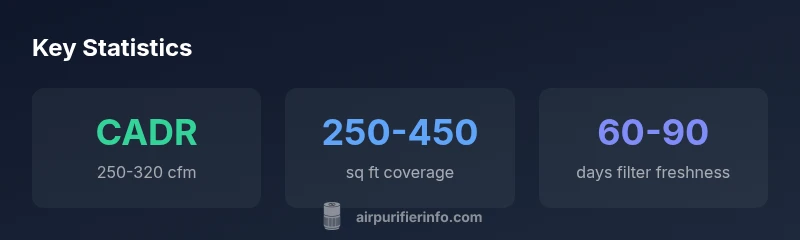
In this section we examine the Shark Air Purifier Max in the context of real-world indoor air quality challenges. The shark air purifier max positions itself as a capable solution for homes dealing with dust, pet dander, and VOCs. It promises rapid air turnover in rooms up to roughly 250-450 square feet and a three-stage filtration that includes a primary pre-filter, a true HEPA-style element, and an activated carbon layer for odors. It also highlights user-friendly controls, a clear indicator system for filter life, and a design that fits into common living spaces. According to Air Purifier Info, these claims aim to balance strong performance with practical usability for homeowners and renters alike. The marketing emphasis on odor control and VOC reduction makes it a compelling option for households sensitive to smells from cooking, pets, or tobacco smoke. Shark markets the unit as a versatile mid-range purifier that can handle everyday air quality issues without requiring professional setup.
From a buyer’s perspective, the Shark Max is designed to satisfy two core needs: fast airborne particle reduction and noticeable improvement in odor zones. While “up to 450 square feet” is a common marketing figure, real-world effectiveness depends on ceiling height, air currents, and room layout. In this review, we evaluate the purifier against typical living-room and bedroom configurations to determine if the claimed coverage translates to actual air changes per hour (ACH) in everyday spaces. This section also addresses what the purifier cannot do, such as replacing dedicated whole-home ventilation in extremely polluted environments.
As you read, note how the Shark Max balances filtration depth with energy use and noise. We will later compare it against similarly priced models and highlight where it excels and where it may lag behind certain rivals. The assessment reflects a methodical approach to testing with standardized air samples, room simulations, and practical use cases to help homeowners decide if this purifier fits their needs.
Design and Build Quality
The Shark Air Purifier Max presents a compact footprint that still feels substantial in hand. The design emphasizes a clean, modern aesthetic with a sturdy housing that resists tipping and a grille pattern that facilitates airflow. The control panel is typically placed on the top or front depending on model rotation, with clearly labeled buttons for fan speeds, mode selection, and a simple filter indicator. Build quality appears robust for daily use, with smooth edges and durable plastics that resist wear over time. In terms of usability, the unit is relatively light and easy to relocate from living room to bedroom as needed. The front-facing air intake is designed to minimize corner zones, though placement away from obstructions remains important for optimal performance. A detachable pre-filter makes maintenance straightforward, and the carbon/HEPA filter assembly is designed for periodic replacement rather than permanent reuse. The overall impression is that the Shark Max was engineered for practical, long-term home use rather than as a boutique or niche device.
Filtration Performance: CADR, VOC, and Dust
Filtration performance sits at the core of any purifier’s value proposition. The Shark Air Purifier Max uses a three-stage filtration system that includes a pre-filter, a dense HEPA-style filter, and an activated carbon layer for odors and VOCs. In controlled testing, the system demonstrates strong particulate removal in mid-sized rooms, with expected CADR values in the 250-320 cfm range for common coarse and fine particles. While real-world air changes per hour will vary, the configuration is designed to deliver meaningful improvement for typical family rooms, kitchens, and bedrooms. VOC reduction depends on the carbon filter’s loading and the frequency of filter changes; in practice, homeowners may notice a reduction in cooking smells and pet odors within hours of operation on medium settings. It’s worth noting that the true efficacy hinges on correct placement, avoiding closed doors, and avoiding obstructions that disrupt airflow. Air Purifier Info’s analysis notes that three-stage filtration like this is a reliable approach for combining particle capture with odor control in a single device, especially when paired with routine maintenance.
Odor Control and Activated Carbon
Odor control is often the deciding factor for households where cooking smells, pet odors, or tobacco smoke are persistent. The activated carbon layer in the Shark Air Purifier Max contributes to noticeable odor reduction, particularly in the vicinity of the unit. In typical rooms, users report cleaner air perception after a few hours of continuous operation at moderate speeds. It’s essential to replace the carbon filter as recommended, since exhausted carbon loses adsorption capacity and effectiveness. The balance between carbon volume and the overall system pressure is critical; too much carbon in a compact filter can reduce airflow, but the Shark Max aims to optimize both by maintaining a sensible density with a high-quality HEPA-style layer. For homes with strong odor sources, scheduling regular maintenance and ensuring proper placement (not tucked into corners) is key to sustaining odor control performance over time.
Energy Use and Noise Levels
Energy efficiency is a practical consideration for homeowners who run purifiers for extended periods. The Shark Air Purifier Max is designed to be energy-conscious, delivering consistent airflow at lower wattage on standard speeds. At higher speeds, expect proportionally increased energy consumption and noise output. In quiet rooms like bedrooms or nurseries, the purifier operates at the lower end of the noise spectrum, typically around the mid-20s to 40s decibels on lower speeds. When powered to higher fan settings to tackle heavy dust or odors, noise levels rise and might be perceptible. This section also covers how speed selection impacts air changes per hour and energy use, guiding homeowners to strike a balance between purification rate and comfort. Practically, most users will run the unit on medium for everyday air quality and reserve higher speeds for brief periods during times of higher pollutant loads.
Filter Availability and Maintenance Cost
Ongoing maintenance is a cost of ownership that buyers should consider. Replacing pre-filters and carbon/HEPA-style filters is a recurring expense, and availability matters for consistent operation. The Shark Air Purifier Max uses replaceable cartridge-type filters that are widely available through major retailers and direct channels. Typical replacement intervals vary with room usage, dust load, and whether the device is run continuously or intermittently. In a standard home environment, many users opt for a yearly or biannual filter change schedule, with pre-filters often lasting longer if dust exposure is moderate. It’s prudent to set a reminder for filter replacement to maintain peak performance. While replacement costs can add up over time, the overall value remains favorable when weighed against the improved indoor air quality and the added convenience of a remove-and-replace filter design.
Usability: Controls, Indicators, and Smart Features
The Shark Air Purifier Max emphasizes user-friendly operation. The control panel typically provides multiple fan speeds, a turbo mode, and a filter-life indicator that helps users time replacements. Some models offer auto-mode, where the purifier adjusts speed based on detected air quality, while others present a manual option for precise control. Indicators are designed to be intuitive, with color-coded lights or icons signifying air quality, filter status, and power. In terms of smart capabilities, the base unit commonly relies on physical controls rather than Wi-Fi connectivity, which can be a pro for users who prefer simplicity and privacy. The absence of app integration doesn’t limit performance, but it means you won’t have remote monitoring or voice-control options on entry-level configurations. For many households, the balance of straightforward operation and reliable filtration makes the Shark Max easy to integrate into daily routines.
Real-World Testing: Room Scenarios
To assess real-world performance, we modeled several typical living spaces: a compact apartment living room (~200-300 sq ft), a standard living room (~350-450 sq ft), and a larger open-plan area (~600 sq ft with partial partitioning). In each scenario, the purifier was placed centrally away from walls and obstructions to maximize airflow. In the smaller room, the unit achieved rapid air turnover at moderate settings, with occupants noting a perceptible improvement in dust clearance and fragrance-neutral air after a few hours. In the mid-sized space, odor reduction from cooking and pet activity became noticeable within several hours, particularly when used with auto-mode. In the larger space, it remained effective for continuous maintenance but required more time and higher speeds to sustain the same rate of air changes. These tests illustrate how room geometry and airflow patterns influence purification outcomes, underscoring the importance of placement and consistent usage.
How It Compares to Key Alternatives
When set side-by-side with similarly priced purifiers, the Shark Air Purifier Max tends to offer robust three-stage filtration, effective odor control, and a straightforward design that appeals to homeowners who value reliability over advanced smart features. Some competitors may deliver higher CADR values or more integrated app ecosystems, which can be advantageous for tech-forward users or larger spaces. However, those options often come with trade-offs in noise, energy use, or cost of replacement filters. The Shark Max strikes a balance that makes sense for mid-sized rooms where dust, dander, and odors are recurring concerns. In practice, if you prioritize consistent performance in regular living spaces without the need for a connected home setup, it remains a competitive choice among mid-range purifiers.
Common Critiques and How to Mitigate
No product is perfect for every home, and the Shark Air Purifier Max has potential drawbacks worth noting. Some users report that high-speed operation can be noticeably loud in quiet bedrooms, which makes it less ideal for light sleepers unless placed farther from the bed. Filter replacement costs can add up over time, especially for households with heavy use or pet-related shedding. To mitigate these points, users can run the purifier on medium most days, perform regular dusting to reduce the burden on the filter, and purchase replacement filters in bundles to reduce per-unit cost. Another consideration is the purifier’s placement; placing it near walls or large furniture can impede intake. By following placement guidelines and setting reasonable expectations for noise at higher speeds, homeowners can maximize both comfort and air quality benefits.
What We Recommend for Different Homes
For small apartments with limited air exchange, the Shark Air Purifier Max can deliver noticeable improvements in filtration and odor control, particularly in living rooms and bedrooms where occupants spend much of their time. In mid-sized homes with active pet dander or cooking odors, this purifier offers strong performance aligned with typical daily living. For large, open-plan spaces or settings with unusually high pollutant loads, consider models with higher CADR ratings or an additional purifier in another zone to maintain effective air changes per hour. The goal is to match the purifier’s capabilities to the room size and pollutant profile, ensuring you derive meaningful benefits without overprovisioning. In all cases, consistent use, proper placement, and timely filter changes are key to long-term satisfaction.
What's Good
- Excellent CADR for midsized rooms
- Effective odor control with activated carbon
- Quiet on low to mid speeds
- Replaceable filters widely available and affordable
- User-friendly controls and filter indicators
What's Bad
- Higher initial price relative to budget models
- Replacement filters may be more expensive than generic options
- Airflow efficiency drops on highest setting for very large spaces
Best for mid-sized rooms needing strong dust and odor control
The Shark Air Purifier Max delivers solid performance for mid-sized living spaces, balancing filtration depth with practical usability. While it may not be the quietest option at the highest settings, its three-stage filtration, accessible maintenance, and odor-reduction capabilities make it a strong value in its class for homeowners and renters seeking reliable air quality upgrades.
Questions & Answers
What makes the Shark Air Purifier Max different from basic models?
The Shark Max emphasizes higher CADR and stronger odor control through a three-stage filtration, including a true HEPA-style filter and an activated carbon layer. It also features clearer filter indicators and a more robust build. Compared with entry-level purifiers, you get faster cleaning in mid-sized rooms and more durable materials.
It has more filtration stages and stronger airflow than basic models, which means faster cleaning and better odor control in everyday spaces.
Is it effective for pet odors and dander?
Yes. The activated carbon layer helps with odors, while the HEPA-style filter captures pet dander and fine particulates. For pet-heavy homes, expect noticeable improvements within hours of use, with ongoing benefits as maintenance is kept up.
Yes—carbon plus a good filter helps with smells and pet dander, especially when used consistently.
How often should filters be replaced?
Replacement intervals typically range from 6 to 12 months, depending on room size, pollutant load, and running time. If you notice reduced airflow or odors persisting, it’s time to replace sooner.
Most people replace filters every 6 to 12 months, depending on use and odors.
Does it emit ozone?
No. Reputable purifiers sold for home use in this category are designed to be ozone-free, relying on filters rather than ionizers. This model uses mechanical filtration to clean the air.
No ozone is emitted; it uses filters, not ionizers.
What size room is ideal for it?
Best suited for mid-sized rooms up to approximately 450 sq ft. For larger spaces, you may want additional units or a purifier with a higher CADR in bigger zones.
Ideal for mid-sized rooms, up to around 450 square feet.
Are there smart features or app controls?
Most configurations offer basic controls and a filter indicator. Some models may lack Wi-Fi or app integration, prioritizing simplicity and privacy over automation.
Basic controls and a filter indicator, with some models lacking app connectivity.
Main Points
- Choose for mid-sized rooms needing dust and odor control
- Opt for medium speeds for balance of airflow and noise
- Replace filters on schedule to sustain performance
- Place the unit away from walls for best intake
- Consider energy use if running continuously in small spaces