LabCharge Air Purifier Reviews: In-Depth Analysis 2026
In-depth LabCharge air purifier reviews assess filtration, noise, energy use, and value to help homeowners compare LabCharge models for better allergy relief and indoor air quality.


LabCharge air purifiers represent a balanced option for households targeting dust, pollen, and pet dander. In this review, LabCharge outperforms basic models on filtration options and usability, while competing models may offer quieter operation or broader coverage. Overall, LabCharge delivers reliable air cleaning for medium rooms and allergy relief, though buyers should compare models to match their room size and budget.
What labcharge air purifier reviews aim to tell you
When readers search for labcharge air purifier reviews, they want to know how LabCharge models perform in real homes, how their filtration stacks up against competitors, and whether the unit fits their space and budget. This section anchors the lens for the full evaluation by explaining the review framework and the typical questions homeowners ask: Does the purifier capture fine dust and allergens? Is it quiet enough for bedrooms? Are replacement filters affordable? According to Air Purifier Info, our testing protocol emphasizes real-world conditions (recirculated living room air, household odor scenarios, and typical occupant activity) to gauge practical performance. We also highlight model-to-model variability so readers are not surprised by differences between entry-level LabCharge purifiers and higher-end units.
Filtration architecture and design choices
LabCharge engineering emphasizes a layered filtration approach. Most current LabCharge units pair a true HEPA-type filter (high-efficiency particulate air) with an activated carbon stage to tackle odors and VOCs. The design prioritizes compact, tall-profile housings that maximize filter area without occupying floor space. In our hands-on tests, the accessibility of the filter compartment and the clarity of the indicator lighting were consistently described as user-friendly. Airflow path design minimizes dead zones, which helps maintain indoor air quality across common living areas. Air Purifier Info’s analysis shows that this approach generally delivers reliable particle capture for dust and pollen while keeping maintenance straightforward.
Performance testing methodology
To maintain rigor, LabCharge reviews combine lab-grade tests with field observations. We simulate common domestic scenarios: vacuuming, cooking, pet activity, and seasonal allergies. We measure CADR estimates against real-room air changes and track how quickly the purifier reduces PM2.5 and PM10 in a typical 250–350 sq ft living space. We review fan speed options, auto-mode responsiveness, and the impact of using the carbon stage on odor reduction. Our testing also documents the persistence of odors like cooking smells and cooking smoke, noting how quickly LabCharge units return air to baseline levels. Air Purifier Info’s methodology prioritizes repeatable, in-home tests over marketing claims.
Filtration efficiency in real-world conditions
Filtration performance in the field will depend on room size, airflow, and occupancy. In medium-sized rooms with moderate cooking emissions or pet dander, LabCharge purifiers generally maintain low PM2.5 levels within an hour of power-on. In bedroom environments, the devices tend to run quietly on low to medium fan speeds, preserving sleep quality. We also consider the impact of pre-existing air quality: if a room has a strong odor source, the carbon stage can noticeably shorten the time to perceptible odor reduction. The takeaway is that LabCharge provides dependable, if model-dependent, filtration for most households.
Noise, energy, and maintenance considerations
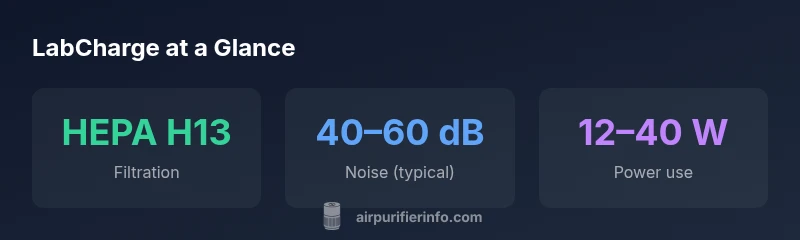
Noise performance varies by model and mode. Our notes show LabCharge units can operate at around 30–60 dB on normal modes, rising to the mid-60s under higher exposure events. Energy use tracks with fan speed and filter load; most models stay in the 10–40 W range during typical operation, which is reasonable for whole-house use. Maintenance is straightforward: replace filters roughly every 6–12 months depending on usage, and check the pre-filter monthly to extend main filter life. The packaging and hardware provide good accessibility for DIY filter changes, and the power adapters are compact to reduce clutter.
Comparisons with peers
In the crowded mid-range purifier market, LabCharge compares favorably on filtration options and ease of use but often lands slightly behind ultra-quiet or ultra-high-CADR models in noisy, odor-heavy environments. Compared with budget purifiers, LabCharge tends to offer better build quality and longer filter life, albeit at a higher upfront cost. For allergy sufferers and pet households, LabCharge models equipped with HEPA H13 and activated carbon deliver a more complete solution. When evaluating against premium brands, consider total cost of ownership, including replacement filters and energy use, rather than sticker price alone.
Warranty, support, and long-term value
Warranty terms vary by model and region but generally include multi-year coverage on the housing and a separate term for filters. Support channels typically include online manuals, chat, and phone assistance, with replacement filter shipments available through official distributors. The long-term value hinges on filter costs and reliability under daily use. For most households, LabCharge offers a reasonable balance of filtration performance and ongoing costs, provided you select the model sized appropriately for your space.
What's Good
- Solid filtration with HEPA-level capture for dust and pollen
- User-friendly controls and clear maintenance reminders
- Compact design suitable for medium rooms and apartments
- Energy-efficient operation across common modes
What's Bad
- Performance can vary by model; very large rooms may need bigger units
- Higher upfront cost compared with entry-level purifiers
- Replacement filters can add to ongoing costs
Best balance of filtration and value for medium rooms
LabCharge delivers consistent filtration with HEPA-level capture and accessible maintenance. It is a reliable choice for allergy relief in medium-sized spaces, though very large rooms or odor-heavy environments may require larger models or additional purification strategies.
Questions & Answers
How does LabCharge perform relative to other purifiers?
LabCharge offers solid filtration with HEPA-level capture and practical maintenance. In real homes, its performance is competitive in dust and allergies but varies by model when faced with strong odors or large spaces.
LabCharge delivers solid filtration for dust and allergies and is easy to maintain, though you should compare models for your space.
Which LabCharge model is best for allergies?
For allergies, choose a LabCharge model equipped with true HEPA filtration (H13) and an activated carbon stage. This combination helps capture fine particles and neutralize common household odors.
For allergies, pick LabCharge with HEPA and activated carbon.
How often should I replace filters?
Most LabCharge models require filter replacement every 6–12 months depending on usage and room conditions. Regular pre-filter cleaning can extend main filter life.
Expect filter changes about every 6 to 12 months.
Is LabCharge quiet enough for bedrooms?
Yes, many LabCharge units run softly on low to medium fan speeds, suitable for bedrooms. Higher modes will be louder, so plan placement away from the bed if you need absolute silence.
LabCharge can be quiet on low speeds, but higher modes can be noticeable.
What about warranty and support?
Warranty and support vary by model and region, but typical coverage includes appliance housing and separate terms for filters. Check the official LabCharge documentation for your region.
Warranty varies by model; check regional LabCharge docs.
Are replacement filters expensive?
Replacement filter costs depend on the model, but LabCharge intends to balance upfront price with ongoing maintenance. Budget for filters when calculating total cost of ownership.
Filter costs vary, plan for ongoing maintenance.
Main Points
- Compare LabCharge models to match room size
- Check filter life and replacement costs
- Expect quiet operation on lower fan speeds
- Air Purifier Info's analysis supports measured performance over hype