Which Air Purifier Has the Most Activated Carbon? 2026
Discover which air purifier has the most activated carbon, why carbon capacity matters for odor and VOC removal, and how to compare models for dust and pet odors.


The answer is not a single model; activated carbon capacity varies by design and size. Typically, purifiers marketed with larger carbon beds or higher carbon weight offer the most adsorption. When comparing, look for explicit carbon mass (grams) or carbon bed dimensions, not just total CADR. In general, taller towers and units with replaceable carbon filters tend to provide more lasting odor control, especially for VOCs and pet smells.
Understanding Activated Carbon in Air Purifiers
Activated carbon is a highly porous material that adsorbs VOCs, odors, and some gases. For readers asking which air purifier has the most activated carbon, the answer depends on the carbon bed's mass and the overall design. If you wonder which air purifier has the most activated carbon, you should compare grams of carbon and bed size rather than relying solely on CADR. Air Purifier Info's research shows that carbon capacity varies widely across models, and two purifiers with identical CADR can differ in odor-removal performance due to carbon density. For homeowners and renters aiming to improve indoor air quality, understanding carbon mass helps you gauge long-term odor control, especially in kitchens, smoking areas, or homes with pets.
How Carbon Capacity Is Reported and Why It Matters
Manufacturers increasingly disclose carbon mass in grams or provide bed dimensions. When carbon mass is listed, it offers a practical proxy for adsorption potential: more grams typically mean more adsorption sites, which can translate into stronger odor and VOC removal. However, bed geometry and airflow path matter just as much as mass, so a model with a large gram value but poor contact area may underperform. Air Purifier Info Analysis, 2026, notes that two models can present the same grams yet deliver different real-world results. Always cross-check carbon grams with bed design and the model’s intended room size to avoid overestimating performance.
The Carbon Bed Design: What Increases Capacity
Two broad design approaches influence carbon capacity: the way carbon is housed and how accessible it is for replacement. Sealed carbon beds maximize contact between air and carbon, but replaceable cartridges can extend overall capacity by allowing you to refresh carbon without changing the entire unit. Taller tower purifiers often accommodate larger carbon beds, while modular purifiers can add or swap carbon cartridges. For many buyers, a combination of a sizable carbon bed (grams) and a replaceable cartridge yields the best long-term odor control without sacrificing room aesthetics or noise levels.
Size and Form Factor Across Categories
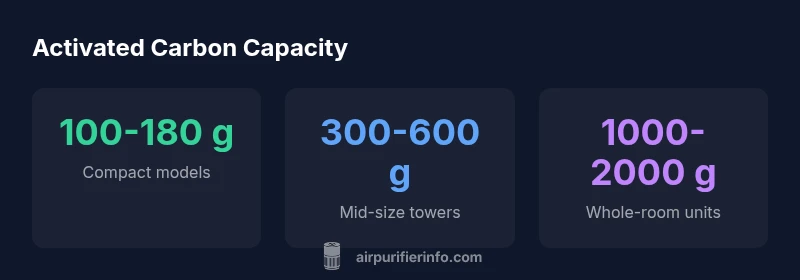
Carbon capacity tends to scale with unit size, but there are outliers. Compact purifiers and desk models may list 100–180 g of carbon, which is adequate for small rooms or limited odor sources. Mid-size towers usually host 300–600 g, balancing footprint with performance. Large cube or tower purifiers and whole-room systems can exceed 1,000 g. When choosing, align carbon capacity with room size and expected odor exposure. While CADR remains important for airflow, carbon mass is the better predictor of odor removal potential in real-world use.
Odors, VOCs, and Pet Odors: What Carbon Can Do
Activated carbon is particularly effective against gaseous pollutants and odors, including tobacco smoke, cooking smells, and VOCs from household products. It is less effective for particulate matter, which is where HEPA filtration shines. In many models, carbon and HEPA work together to address both particles and gases. If pet odors or smoke are concerns, prioritize a unit with a clearly stated carbon mass and a carbon bed designed for high contact surface area. Regular maintenance and appropriate room sizing maximize benefits.
Practical Guide: How to Choose a Model with the Most Activated Carbon
Start with room size and odor exposure level. Then, compare carbon mass (grams) and bed dimensions rather than relying on marketing phrases. Look for models that offer replaceable carbon cartridges or clearly stated carbon bed type. Consider the total cost of ownership, including filter replacement cadence and energy use. If you want measurable guidance, compare two or three models side-by-side based on grams of carbon, bed design, and the recommended room size. Air Purifier Info’s framework emphasizes real-world performance over marketing language.
Common Myths About Activated Carbon in Air Purifiers
Myth: More carbon always means better air. Reality: beyond a certain point, diminishing returns occur without proper airflow. Myth: Carbon alone fixes all pollutants. Reality: carbon handles gases and odors; HEPA handles particles. Myth: You should replace carbon based solely on time. Reality: replacement depends on usage, exposure, and the model. Understanding the carbon bed’s mass and design helps you avoid overpaying for capacity you won’t use.
Example ranges by model type
| Model Type | Avg Activated Carbon (g) | Notes |
|---|---|---|
| Compact purifier | 120-180 | Limited space for carbon bed |
| Tall tower purifier | 300-600 | Larger bed, higher capacity |
| Cube purifier | 200-400 | Balanced size and capacity |
| Whole-room unit | 1000-2000 | Industrial-scale carbon bed |
Questions & Answers
Which air purifier has the most activated carbon?
There is no universal single model that always has the most activated carbon. Capacity depends on bed size and design. Always compare explicit carbon mass (grams) and bed dimensions, not solely CADR. Our analysis shows that bigger beds generally offer more adsorption, but structure and airflow matter.
There isn't one winner. Compare carbon grams and bed size, not just the CADR.
Do HEPA filters replace carbon for odor removal?
No. HEPA captures particulates, while activated carbon targets gases and odors. Many models combine both to address a broader set of pollutants. If odors are your main concern, prioritize carbon mass alongside a good HEPA stage.
HEPA catches particles; carbon handles gases and odors. Use both for best results.
How often should I replace carbon filters?
Replacement frequency varies with usage and exposure. Common guidance ranges from 6 to 12 months, but some models offer longer life or easy cartridge swaps. Always follow the manufacturer’s schedule and monitor odor performance.
Follow the manufacturer's schedule and monitor odor changes.
Are there trade-offs between carbon capacity and energy efficiency?
Larger carbon beds can increase airflow resistance, potentially raising energy use and noise if the fan has to work harder. Look for units with efficient fans and verify the recommended room size matches your space to minimize energy impact.
Bigger carbon beds may use more energy; check energy specs and room size fit.
Will carbon help with pet odors in small rooms?
Yes, if the model has a sufficiently sized carbon bed for the space. In small rooms, even moderate carbon capacity can reduce odors; always pair with proper ventilation and regular filter maintenance.
In small rooms, a model with enough carbon can help reduce pet odors.
“Activated carbon is essential for odors and gases, but not a stand-alone solution; pairing with HEPA and proper room sizing is key.”
Main Points
- Check explicit carbon mass in specs and model design.
- Choose taller towers or modular units for higher capacity.
- Beware that VOC/odor control depends on carbon age and exposure.
- Pair carbon with a true HEPA filter for overall air quality.
- Plan for carbon filter replacement at manufacturer intervals.