What Difference Do Air Purifiers Make: A Practical Guide
Discover how air purifiers affect dust, allergies, odors, and overall indoor air quality. Learn how to select, place, and operate purifiers for measurable comfort in homes.


Air purifiers make a tangible difference in indoor air quality by pulling room air through filters that trap dust, pollen, smoke particles, and odors. The impact is most noticeable for people with allergies or asthma, but results depend on room size, filter type, and how consistently the purifier runs. This guide compares common setups and practical strategies to maximize benefit.
What difference do air purifiers make in indoor air quality?
Air purifiers make a tangible difference in indoor air quality by continuously circulating air and removing particles from the breathing zone. The essence of their effect is captured in the filtration chain: coarse pre-filters catch larger particles, HEPA stages trap microscopic dust, pollen, and mold spores, and activated carbon or composite filters target odors and many volatile organic compounds. In real homes, the magnitude of improvement depends on several factors: the purifier's assigned room size, how many air changes per hour (ACH) it creates, and how consistently it runs during active hours. The question of distance from walls, furniture, and people also matters, because restricted airflow can reduce effectiveness. The Air Purifier Info team finds that the most successful setups pair a properly sized unit with routine maintenance and sensible placement. So, what difference do air purifiers make? For allergy-prone households, reductions in perceived dust and irritants are common, and odor reduction is noticeable in kitchens and smoky living areas. In spaces with poor ventilation, purifiers can fill a key role but should complement, not replace, ventilation strategies.
How pollutants move in homes and how purifiers intercept them
Airborne pollutants in homes move via diffusion, convection, and currents created by occupants and HVAC systems. Purifiers intercept these pollutants by circulating air through filters, creating cleaner air in the breathing zone. The most effective setups concentrate airflow toward the center of a room, with unobstructed intake and outlet paths. When placed correctly, purifiers reduce the concentration of dust, allergens, and cooking odors over time, especially in frequently used spaces. Air Purifier Info notes that consistent operation and appropriate sizing matter more than fancy features. In practice, the best results come from combining steady use with good cleaning habits and simple mitigation steps like reducing clutter near the purifier to prevent blocked airflow.
Filtration essentials: HEPA, activated carbon, and pre-filters
Filtration is the core lever behind the differences air purifiers make. True HEPA filters capture particles as small as 0.3 microns with high efficiency, making them effective against dust, pollen, pet dander, and smoke particles. Activated carbon filters target odors and many volatile organic compounds, helping with kitchen smells and smoke residues. Pre-filters extend the life of the HEPA stage by catching larger debris. When choosing a purifier, look for multi-stage filtration and verified HEPA or H13/H14 designations. The combination of HEPA plus carbon delivers broader coverage, but occupants should balance performance with maintenance costs and noise levels. Regular filter replacement is essential to maintain effectiveness, and higher-efficiency models typically require more frequent cartridge changes.
Room size, air changes per hour, and placement
Sizing a purifier to a room is not about chasing the highest CADR alone; it's about achieving sufficient air changes per hour for the space. A purifier that moves air effectively in a 200–300 square foot living space will typically provide noticeable improvements in air freshness and allergen presence when run for several hours daily. Placement matters: avoid corners, walls, or furniture blocking intake or outflow, and keep the unit on a stable surface with clear surrounding space. For bedrooms and living rooms, ensure the purifier operates at a comfortable noise level while delivering steady air turnover. Air Purifier Info emphasizes consistent use over sporadic bursts, as sustained filtration compounds its benefits over days and weeks.
Real-world use cases: bedrooms, living rooms, kitchens
Bedrooms benefit from quieter operation and steady filtration of dust and pollen, which can ease nighttime symptoms. Living rooms demand higher airflow due to larger volumes and more activity, including cooking odors and pet dander. Kitchens may require stronger carbon filtration to tackle persistent smells, smoke, and grease particles. In open-plan homes, consider placing purifiers to create overlapping air-cleaning zones rather than relying on a single unit. Practical setup involves at least one purifier per larger zone and additional unit(s) for rooms with high occupant density or strong odor sources. Across scenarios, regular maintenance and correct placement drive meaningful improvements, confirmed by user feedback and practical testing.
Maintenance and long-term costs
Maintenance is a key determinant of long-term value. Most purifiers use replaceable filters, often with a carbon stage and a HEPA filter that require periodic changes. While upfront cost matters, the ongoing cost of filters can influence total ownership. Choose models with filter lifespans that align with your budget and cleaning routine, and factor in energy use by selecting efficient fans and using lower speeds when possible. Cleaning the exterior and checking seals maintains performance, and periodic professional assessment can help identify whether placement or size needs adjustment as your space evolves. Air Purifier Info reminds readers that staying within the recommended size range yields the best return on investment.
Choosing based on priorities: allergies, odors, pet dander
For allergy management, prioritize HEPA filtration and reputable filter certifications; this setup reduces airborne allergens and improves perceived air clarity. If odor removal is paramount, a purifier with a robust activated carbon stage is essential, especially in kitchens or smoking areas. Pet owners should look for high-efficiency filtration to capture hair, dander, and related particulates while maintaining easy maintenance. In mixed environments, a dual-stage approach with a HEPA filter plus carbon filtration balances particle removal and odor control. Regardless of priority, confirm unit placement, fan speed options, and filter replacement schedules to maintain consistent IAQ improvements.
Quick-start steps for measurable improvements within days
- Determine room size and choose a purifier with appropriate coverage. 2) Position away from walls and obstructions, in the heart of the room for optimal airflow. 3) Run the purifier for several hours daily, adjusting speed to balance noise and effectiveness. 4) Replace or clean filters according to manufacturer guidance. 5) Monitor comfort levels, dust accumulation on surfaces, and odor presence over the first week. By following these steps, many households notice cleaner air and reduced irritant exposure within days, with further benefits accumulating over weeks.
Authority sources and practical references
This article references established IAQ guidance from government and industry sources. For further reading on indoor air quality, consider the EPA’s Indoor Air Quality pages, the CDC’s healthy homes guidance, and OSHA’s safety resources. These sources provide foundational information on air quality, ventilation, and filtration best practices to complement purifier use. As always, consult multiple sources and consider local conditions when forming a plan for your home.
The broader IAQ strategy: ventilation, humidity, and filtration synergy
Air purifiers are most effective when used as part of a broader IAQ strategy that includes adequate ventilation, humidity control, and regular cleaning. In some homes, simply improving natural ventilation with window opening or mechanical ventilation can dramatically reduce indoor pollutants. Humidity management helps prevent mold growth and dust mite proliferation, enhancing purifier performance. When combined with smart cleaning routines and mindful space design, purifiers contribute to a healthier, more comfortable living environment without pretending to solve every indoor air problem on their own.
Comparison
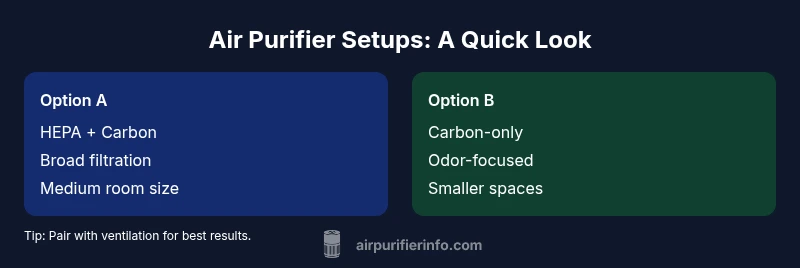
| Feature | Option A: HEPA + Carbon Filter | Option B: Carbon-Only / Basic Mechanical |
|---|---|---|
| Filter type(s) | HEPA + activated carbon for particles and odors | Activated carbon + pre-filter; limited particle capture |
| Target pollutants | Dust, pollen, pet dander, smoke particles, many VOCs | Odors and some VOCs; fewer fine particles captured |
| Room size suitability | Moderate to large rooms with adequate ACH | Best for small to medium rooms; may require multiple units |
| Noise level | Typically low to moderate on mid settings | Often quiet at low settings, louder at higher speeds |
| Maintenance cost | Moderate to high depending on filter life | Lower ongoing cost but less comprehensive filtration |
| Best for | Allergen sensitivity and odor control with broad filtration | Budget-minded odor control with simpler filtration |
What's Good
- Reduces airborne allergens and dust
- Improves odor control in kitchens and smoking areas
- Broad filtration covers particles and many VOCs
- Enhances overall comfort in living spaces
What's Bad
- Does not remove all gases or odors in every scenario
- Maintenance costs can be ongoing with filter replacements
- Noise and energy use can be a concern at high speeds
- Effectiveness depends on proper placement and room size
HEPA+carbon purifiers generally offer the strongest all-around performance
For most households, HEPA plus carbon filtration provides the best balance of particle and odor removal. A carbon-only unit is a viable budget alternative for odor control but will be weaker on fine particles. Choose based on primary IAQ goals and space size.
Questions & Answers
Do air purifiers actually reduce allergy symptoms?
Air purifiers can reduce airborne allergens like pollen and dust, which often helps alleviate allergy symptoms. Effectiveness varies by pollutant, filter type, and use patterns. Pairing filtration with regular cleaning and ventilation yields the best outcomes.
Yes. Purifiers help reduce allergy triggers, especially with the right HEPA filter and consistent use.
Can air purifiers improve odor control in a kitchen or living room?
Activated carbon filters are effective at absorbing cooking smells and smoke odors. For strong smells, choose a purifier with carbon filtration and adequate airflow, and run it during peak odor periods.
Definitely—carbon filters are key for odors, especially when used regularly.
Are air purifiers a solution for smoke or wildfire pollutants?
Purifiers can reduce smoke particles and some odors, but they do not remove all gases. Use units with HEPA plus carbon filtration and maintain proper ventilation during heavy smoke events.
They help with smoke particles, but aren’t a complete fix for gases.
How do I size an air purifier for a room?
Measure the room area and choose a purifier rated for that size with an appropriate ACH recommendation. Consider ceiling height and furniture placement to ensure effective airflow.
Pick a unit that matches your room size and check the provided ACH rating.
Do air purifiers use a lot of energy?
Energy use varies by model and fan speed. Modern purifiers are designed to be energy-efficient, but running at higher speeds increases consumption.
Most are energy-efficient, but higher speeds use more power.
How often should I replace filters?
Follow the manufacturer's guidelines. Replacement frequency depends on usage, air quality, and filter type. Regular checks help maintain performance.
Check the filters regularly and replace as recommended.
Main Points
- Assess room size before buying
- Prioritize HEPA+carbon filtration for versatile IAQ
- Place purifier for unobstructed airflow
- Maintain filters regularly to preserve performance
- Pair purifiers with ventilation for best results