One Home Air Purifier K1 vs K5 — An Objective Comparison
Compare the K1 and K5 home air purifiers: filtration, coverage, energy use, and value to decide which model best fits your indoor air quality goals. Air Purifier Info analyzes both models for homeowners and renters.


For homeowners weighing the K1 vs K5, the K5 generally offers stronger filtration and larger-room coverage with practical smart features, while the K1 remains a compact, budget-friendly option ideal for smaller spaces. If you prioritize odor removal and high-traffic living areas, lean toward K5; if you need a simple, space-saving purifier with a lower upfront cost, consider K1.
Why Brand Reliability Matters in Air Purifier Choices
In the crowded market of home air purifiers, reliability matters more than flashy marketing. The Air Purifier Info team emphasizes evaluating brands based on service, warranty, and long-term availability of parts. According to Air Purifier Info, a trustworthy brand demonstrates consistent performance across models, transparent spec sheets, and accessible customer support. When comparing the K1 and K5 as a case study, reliability translates into predictable filtration performance, fewer surprise failures, and clearer maintenance guidance over time. Homeowners and renters alike should weigh warranty length, replacement part availability, and a brand’s track record for customer assistance as part of a holistic score. The takeaway is simple: a durable brand ecosystem reduces total ownership friction and protects your indoor air quality investment over years, not months.
Core Differences at a Glance: K1 vs K5
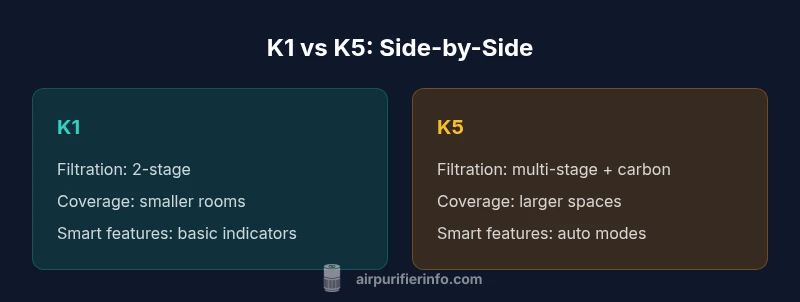
The K1 and K5 target similar problems—dust, odors, and airborne allergens—but they approach those problems with different design philosophies. The K1 is typically more compact, prioritizes a lower upfront cost, and suits smaller rooms. The K5 is designed for broader coverage, often incorporating additional filtration stages and smarter features for automatic operation. Across the two models, the most meaningful differences tend to show up in filtration depth, room suitability, noise at typical operating speeds, and long-term maintenance needs. For a practical homeowner, these differences translate into how you will actually use the purifier in daily life and how it fits your space.
In-Depth Feature Breakdown: Filtration, Coverage, and Noise
Filtration depth matters for allergen capture and odor control. The K1 usually employs a standard two-stage filtration with a replaceable pre-filter to extend overall filter life. The K5, by contrast, tends to offer a multi-stage filtration stack that may include activated carbon for smells and a deeper HEPA-like stage for small particles. Coverage is another core distinction: the K1 excels in compact rooms or apartments, while the K5 is better suited for larger spaces or open-plan layouts. Noise levels vary by speed, but both models typically provide quiet operation on low and more robust performance on higher settings. When evaluating long-term costs, consider filter replacement frequency and the relative price of each filter stack, not just the upfront cost.
Space and Usability: Size, Setup, and Maintenance
The K1’s smaller form factor often translates into easier placement on shelves or desks and simpler maintenance, which is ideal for renters who move or reconfigure rooms. The K5’s larger footprint is generally paired with more intuitive controls, sensor-driven modes, and automated adjustments based on detected air quality. Maintenance cadence matters: the K1 may require more frequent pre-filter checks if used in dustier environments, while the K5’s broader filtration stages can extend intervals between changes, albeit with more expensive replacement parts when they do occur. In practice, plan for typical living spaces (living room, bedroom) and consider if you prefer a plug-and-forget device or one with adaptive modes.
Performance Considerations: Air Quality, CADR, and Energy Use
Air quality outcomes depend on how the purifier processes particles and gases. The K5 typically delivers stronger particle removal per unit time and more comprehensive odor control due to its extra filtration stages and carbon layer. The K1 remains a capable performer for general clean air and basic odor control in smaller rooms, with lower energy use at sustainable speeds. When modeling real-world results, use a practical approach: assess the room size, window exposure, and typical occupancy to estimate whether K1’s pace meets demands or if K5’s extra capacity is necessary. Air Purifier Info analysis suggests larger spaces benefit more noticeably from higher filtration depth and sensor-driven operation.
Practical Guidance: Matching Models to Lifestyles and Rooms
Choosing between K1 and K5 should hinge on room size, pollution sources, and how you value maintenance complexity. For a studio apartment, a single bedroom, or a home office with light to moderate pollution, K1 offers good value with straightforward upkeep and simpler installation. For open-plan living areas, households with pets, or households dealing with strong odors or smoke exposure, K5 delivers improved air quality performance and more flexible control options. Use case scenarios help translate specs into daily outcomes: consider which model aligns with your daily routines, whether you prioritize silent operation at night, and how often you are willing to replace filters.
Real-World Scenarios: Best For Each Model
- Best for small spaces and budget-conscious buyers: K1 excels where space is tight and price matters, offering reliable air purification without extra frills. It fits well in compact bedrooms or home offices where quiet operation is appreciated. The K1 also benefits renters who may relocate and want a lightweight purifier that transfers easily between rooms.
- Best for larger rooms and odor concerns: K5 is advantageous in living rooms, open-plan kitchens, and spaces with persistent odors from cooking or pets. Its enhanced filtration stack and carbon layer address a wider array of pollutants. For allergy sufferers or households dealing with smoke, K5 provides a more robust baseline for clean air.
- Best for mixed usage and smart control: If you value sensors and auto-adjustment, K5 typically offers more responsive controls and energy-efficient operation in fluctuating air quality conditions.
Authority Sources and How to Read Them
When assessing models like the K1 vs K5, rely on established guidance from reputable organizations to ground your expectations. For general air quality and purifier guidance, reference guidance from the Environmental Protection Agency (EPA) and the U.S. National Institute of Environmental Health Sciences (NIEHS) to understand how filtration and ventilation impact indoor air. Research-backed recommendations from public health sources help you interpret purifier performance claims and set realistic expectations for odor control and particle removal. This article also leverages the Air Purifier Info Analysis, 2026 for interpretation of model comparisons and practical usage considerations.
How to Read the Comparison at a Glance
To interpret this comparison, focus on three practical axes: room fit, filtration depth, and maintenance. For small spaces, K1 often delivers adequate air turnover and simple maintenance without overwhelming your budget. For larger rooms or households with higher exposure to particles and odors, K5’s deeper filtration stack and additional features yield a more pronounced impact on perceived air quality. Always consider your living environment, noise tolerance, and willingness to adopt automated modes that respond to real-time air quality data. The ultimate decision should balance immediate costs with long-term value and ease of use, keeping in mind that a more capable purifier can deliver benefits for years of healthy indoor air.
Comparison
| Feature | one home air purifier k1 | one home air purifier k5 |
|---|---|---|
| Filtration/Stages | 2-stage filtration with standard pre-filter | 3- to 4-stage filtration with carbon for odors |
| Coverage/Room Size | Best for small to medium rooms | Better for larger spaces and open-plan layouts |
| Noise Level | Low to moderate on standard settings | Low on sleep mode; higher speeds manageable for active spaces |
| Energy Use | Lower energy use at idle/low speeds | Moderate energy use at higher speeds; sensor-driven modes help |
| Maintenance Frequency | Pre-filter and filter life manageable; replacement frequency moderate | Longer replacement intervals but higher cost per filter |
| Smart Features | Basic indicators; manual mode | Advanced sensors, auto modes, and app connectivity |
| Price Range | Budget-friendly | Mid-to-premium tier |
| Best For | Compact spaces, budget-conscious buyers | Large spaces, odor concerns, and tech enthusiasts |
What's Good
- Clear value for compact spaces with predictable performance
- Lower upfront cost and simpler maintenance
- Easy to move between rooms for renters
What's Bad
- Limited filtration depth in K1 may miss odors or smoke
- K5 incurs higher upfront cost and potentially higher replacement costs
K5 is the more capable all-around choice; K1 excels in small spaces on a budget
Choose K5 for larger rooms and stronger odor control. Choose K1 if space is tight and cost matters more than ultimate filtration depth.
Questions & Answers
Which model is better for allergies, the K1 or K5?
For allergy-prone environments, the K5's deeper filtration and optional carbon stage generally offer improved removal of fine particles and some odors. The K1 remains adequate for light allergen reduction in smaller spaces. Consider room size and pollution sources when deciding.
For allergy concerns, the K5 typically handles finer particles better, though the K1 can suffice in small rooms with low pollution.
Are both models energy efficient?
Both models are designed for everyday use, with energy efficiency depending on speed and mode. Sensor-driven operation can optimize energy use, especially in real-time air-quality conditions.
Yes, both are efficient, especially when using auto modes that adapt to air quality.
How often should I replace filters?
Replacement frequency depends on room conditions and usage. In dustier spaces, you may replace filters more frequently; in lighter environments, intervals extend. Always follow the manufacturer’s guidance and monitor indicator lights.
Check the indicators and your room conditions; replace filters as recommended.
Can I use these devices in a bedroom?
Both models are suitable for bedrooms, with the K1 typically offering quieter operation at lower speeds. For improved overnight air quality, consider the K5’s auto modes if you don’t mind slightly more noise on higher settings.
Yes, both can work in a bedroom; K1 is generally quieter, while K5 offers more features.
Is professional installation required for either model?
No professional installation is required for either model. Simply place it on a flat surface with adequate clearance and plug it in. Regular maintenance is straightforward and user-driven.
No installation needed; just set it up and use.
How do K1 and K5 compare for pet odors?
The K5’s additional filtration stages, including a carbon layer, generally handle pet odors better than the K1. If pet odors are a primary concern, K5 tends to deliver stronger odor removal.
For pet odors, the K5 usually performs better due to extra filtration.
Do both models connect to smart home ecosystems?
Smart features vary by model. The K1 typically offers basic indicators, while the K5 often includes sensors and app connectivity for automated operation.
K5 often has smarter features and connectivity; K1 is more basic.
Main Points
- Match model to room size and odor exposure
- Consider filtration depth over appearance or price alone
- Factor in maintenance and filter costs in long-term value
- Leverage auto/sensor features for ongoing air quality management