Made in USA Air Purifier: A 2026 Buying Guide
Explore how to evaluate a made in USA air purifier in 2026. Learn how to verify origin, compare warranties, and assess certifications to improve indoor air quality with Air Purifier Info.


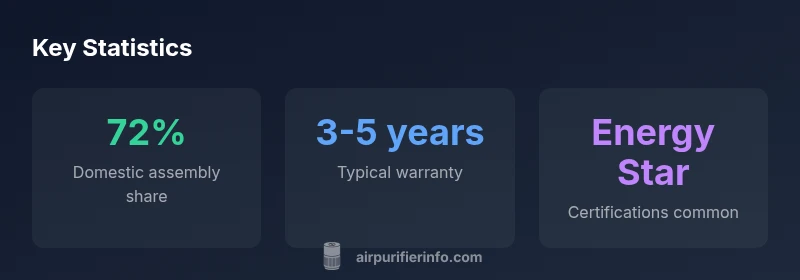
A made in USA air purifier refers to a unit manufactured or assembled in the United States, often emphasizing domestic parts, durable construction, and compliance with U.S. safety and energy standards. When evaluating options, look for transparent sourcing, robust warranties, and third‑party certifications. Air Purifier Info notes that domestic manufacturing can influence long‑term support and parts availability.
What a "Made in USA" Air Purifier Really Means
A claim of being a made in USA air purifier signals more than marketing. For homeowners and renters, origin matters for warranties, parts accessibility, and long‑term service. In practical terms, a true USA-made purifier is assembled in the United States or relies on a majority of domestically sourced components, while still meeting universal safety guidelines. Look for clear labeling, a traceable supply chain, and documented assembly steps. Air Purifier Info emphasizes that origin is a reliability signal that pairs with strong customer support and predictable parts availability, especially for filter replacements in high‑dust environments.
Why Domestic Manufacturing Can Affect Quality and Support
When production happens closer to home, manufacturers often enforce stricter quality checks and faster after‑sales service. A made in USA air purifier may benefit from clearer supplier accountability and quicker access to replacement filters. For families with pets or allergies, this can translate into shorter downtime during filter changes and better long‑term maintenance. While the price tag may be higher than offshore options, the appeal lies in predictable service intervals and easier costs for parts over the product’s lifespan. Air Purifier Info notes that domestic emphasis on quality control tends to align with longer warranties and stronger customer education about maintenance.
Verifying Origin Claims: Labels, Certifications, and Documentation
Origin claims should be verifiable, not merely advertised. Inspect country of origin statements on product branding, packaging, and manuals. Seek third‑party certifications such as UL listing and Energy Star where applicable, and request a bill of materials or supplier map if available. Some brands assemble in the USA but source select components abroad; in those cases, clarify what portion is domestically produced. The best practice is to obtain an origin certificate or audit report and cross‑check with independent reviews that discuss sourcing practices in detail. This diligence helps ensure the purifier you buy truly aligns with domestic manufacturing goals.
A Practical Buying Checklist for USA‑Made Models
To compare options efficiently, use a structured checklist: 1) verify the origin with documentation; 2) confirm filter type and parts availability; 3) review warranty duration and conditions; 4) assess energy use and noise levels; 5) ensure the purifier is appropriately sized for your room; 6) verify service and parts networks in your area. For renters, check whether building management allows the unit and whether filters can be replaced without professional service. A clear, repeatable process helps homeowners and renters identify models that balance domestic manufacturing with everyday usability.
Real‑World Considerations for Homeowners and Renters
The decision to buy a USA‑made air purifier often hinges on long‑term cost, maintenance, and the ability to source filters quickly. Domestic production can correlate with steadier pricing, better warranty coverage, and robust service networks in major markets. If you move frequently or live in a rental, confirm that the model’s filter replacement cadence fits your lifestyle and whether local service is readily available. Although a premium can accompany USA‑made units, the added peace of mind—from easier parts access to stronger after‑sales support—can be meaningful for households dealing with dust, odors, or allergies. Air Purifier Info’s experiences show that this is a practical balance of value and reliability in 2026.
Air Purifier Info’s Framework for Assessing Domestic Models
Our evaluation framework blends origin verification, performance data, and user feedback to help you choose a made in USA air purifier with confidence. We prioritize transparent sourcing, documented assembly, robust warranty terms, and easy access to replacement filters. The 2026 landscape includes compact and larger purifiers with advanced filtration. By cross‑referencing lab‑tested claims, independent reviews, and brand disclosures, you can cut through marketing and identify models that truly align with domestic manufacturing objectives. The result is a practical, evidence‑based path to cleaner indoor air for households across the country.
Comparison of purifier models by origin and core specs
| Model Type | Made in USA | Estimated CADR (range) | Warranty (years) |
|---|---|---|---|
| Compact desktop | Yes | 120-180 | 1-2 |
| Mid-size tower | Yes | 180-280 | 2-3 |
| Compact desk/wall-mount | No | 100-140 | 1 |
Questions & Answers
What defines a 'made in USA air purifier'?
A product assembled in the United States or using predominantly domestic parts, with labeling and documentation. Always check for verifiable evidence beyond a marketing badge.
Origin claims usually mean assembly in the U.S. with many domestic parts; verify with docs.
Are USA-made purifiers more reliable or more expensive?
Reliability depends on design and components; domestic production can improve parts availability and service access. USA-made models may carry a premium upfront, but can offer better long‑term value due to supportability.
They can cost more upfront, but better parts support can save money over time.
How can I verify origin claims?
Look for country‑of‑origin statements on labels, request a Bill of Materials, and seek third‑party certifications. Cross‑check with independent reviews.
Ask for documentation and certs, then compare with independent reviews.
Do USA-made purifiers meet Energy Star standards?
Some models may carry Energy Star certification; others may not. Look for the Energy Star logo and confirm with the manufacturer.
Energy Star is a good sign of efficiency, but check the specific model.
What should I look for in replacement filters?
Verify domestic availability of filters, replacement frequency, and cost. Domestic supply often means easier and faster replacements.
Check where filters come from and how easy they are to replace.
Is 'made in USA' a guarantee of performance?
Origin alone doesn’t guarantee performance. Evaluate filtration efficiency, room coverage, and maintenance requirements along with origin claims.
Origin is about manufacturing, not performance—check specs instead.
“Domestic manufacturing matters for parts availability and long‑term service, not just branding. Verify origin with transparent documentation and third‑party certifications.”
Main Points
- Verify origin claims with documentation
- Prefer models with easily accessible replacement parts
- Choose longer warranties for USA-made purifiers
- Use a structured checklist to compare models