IKEA Air Purifier Table: A Comprehensive Comparison for 2026
Compare IKEA air purifier table options with standalone purifiers. This analytical buying guide covers design, performance, maintenance, and practical tips for homeowners and renters seeking compact, stylish air-cleaning solutions.


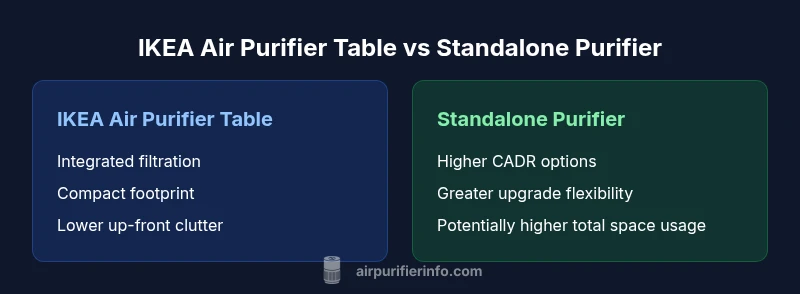
An IKEA air purifier table is a space-saving, cohesive option that mixes furniture and filtration in one unit. It suits small rooms and modern interiors, but often delivers lower CADR and fewer upgrade choices than standing purifiers. Choose it for style and compact living spaces; opt for a standalone purifier if top performance matters.
IKEA air purifier table: concept and market context
The idea of integrating air purification into furniture mirrors a wider shift toward space-efficient, low-clutter homes. An IKEA air purifier table places a compact filtration core inside a regular coffee or console table, letting you air-clean your space without cluttering the floor with a separate device. For many homeowners and renters, this kind of product promises a streamlined aesthetic—one piece of furniture that delivers both function and form. The Air Purifier Info team notes that this approach reflects a growing consumer demand for multi-functional furniture that keeps cords hidden and rooms open. In evaluating these products, you should consider room size, purifier capacity, noise, and how the design interacts with existing decor. Accessibility is another practical factor—filters should be easy to replace, and the table should remain stable during operation. Together with independent reviews, these factors help determine whether an IKEA air purifier table delivers real value or merely a stylish façade. According to Air Purifier Info, the key decision factor is balancing aesthetics with performance, especially in living rooms and bedrooms where comfort matters most.
Core design features to evaluate when buying
When you assess any air purifier table, start with core design features that affect both performance and daily use. Look for a purifier module that fits inside the table footprint without crowding the surface or blocking ventilation slots. Durable, easy-to-clean finishes are important for households with kids and pets. Filtration options matter: a true HEPA filter paired with an activated carbon layer provides both particle reduction and odor control. Consider how you access the filters—front-loading or side-access panels are typically more convenient than designs that require removing the tabletop entirely. Noise levels are a practical concern; for bedrooms, prefer models with quiet modes or automatic speed adjustments. Energy efficiency should also factor into your decision, particularly if the table runs continuously. Finally, safety features—stable feet, anti-tip design, and accessible filter compartments—can prevent accidents in busy living spaces. In our framework, these features translate into real-world implications: easier maintenance, more reliable performance, and a cleaner room aesthetic.
Performance considerations: filtration, noise, and airflow
Air quality performance hinges on how well the integrated purifier moves air in a given room. Because the purifier is embedded in a table, airflow paths and intake/exhaust placement matter a lot. Ensure the design does not create dead zones where air stagnates, and that the exhaust does not blow directly onto seating or electronics. Filtration efficiency matters beyond mere particle capture; carbon layers should address common odors and volatile organic compounds, especially in kitchens or smoking areas. Noise behavior is another critical factor: look for a model with a quiet mode during the night and auto-adjusting speeds based on measured air quality. These considerations are especially relevant for the IKEA air purifier table, where space constraints can influence how aggressively the fan runs. In general, integrated units offer satisfactory performance for moderate room sizes, but very dusty environments or large spaces can push standalone purifiers ahead in CADR and speed of air changes. Air Purifier Info analysis shows that room-fit and placement are as important as the purifier’s spec sheet.
Materials, build quality, and safety: durability and child/pet considerations
Durability matters when electronics live inside furniture. Look for a solid frame, reinforced joints, and a tabletop that resists warping or staining. The purifier module should be securely anchored so that vibration from the motor does not loosen components over time. For households with children or pets, safety features become essential: rounded edges, cable management channels, and easily accessible filter compartments help minimize accidents. Material choice also impacts maintenance; powder-coated steel or durable engineered wood can withstand daily use and occasional spills, while glass elements may introduce breakage risk around curious pets. In addition, verify that the ventilation outlets are positioned away from seating areas and that the unit includes safeguards such as auto-shutoff in case of tipping. Proper design choices translate into years of convenient, safe operation.
Maintenance and operating costs: filters, energy use, and replacement cadence
Maintenance is a major determinant of long-term value. An integrated purifier table typically requires periodic filter replacements, with both HEPA and carbon stages needing attention. Replacement cadence depends on usage intensity and air quality; in dustier homes or kitchens with strong odors, filters may require more frequent changes. Energy use is generally modest, though it can accumulate if the table runs at high speed often. Many compatible filters are sold in bundles, which simplifies budgeting and reduces downtime. The upfront cost of an integrated unit may be competitive when you value furniture consolidation, but ongoing maintenance costs—filters and potential repairs—should factor into the total cost of ownership. Air Purifier Info recommends planning maintenance schedules before purchase and choosing a model with clear filter indicators and accessible parts for easy replacement.
Space planning and aesthetics: sizing, placement, and furniture harmony
An IKEA air purifier table shines when it integrates seamlessly with your interior. Begin by measuring available floor space and ensuring the unit fits where people sit or work without obstructing doors or pathways. Height alignment matters: the purifier should not direct airflow at head level when seated. Aesthetics count too; select finishes that match or complement your existing furniture—from light oak to matte black to white laminates. The overall look should feel intentional, not like a separate gadget intruding on your room’s vibe. Renters especially benefit from compact, movable designs that can be relocated easily without wall modifications.
Real-world use cases: living rooms, offices, and bedrooms
Living rooms often benefit from a centrally located IKEA air purifier table that serves multiple seating zones, delivering cleaner air where people gather. In bedrooms, prioritize quiet modes and a low-profile footprint to minimize sleep disruption. Home offices benefit from placement that avoids direct airflow onto computer screens while maintaining air circulation. Pet owners may notice more fur around intake slots, so schedule periodic inspections and filter changes accordingly. We also discuss how an integrated unit might prompt a rethink of room layout: you may choose smaller seating clusters around a compact table rather than a bulky freestanding purifier. Real-world scenarios illustrate when this design table works best and when a modular approach—adding a separate purifier or a larger stand-alone unit—could provide higher air-change rates.
Practical buying guide: questions to ask and how to compare
Before buying, use a practical checklist. Ask about filter types (HEPA plus carbon), filter replacement ease, availability of replacement parts, noise levels at various speeds, and the purifier’s performance relative to room size. Clarify warranty terms and service options, and look for models with transparent performance data. Compare the IKEA air purifier table option to standalone purifiers by considering total cost of ownership, convenience, and performance in your room. Finally, read independent reviews and ask about upgrade paths as technology improves. A careful, informed comparison helps ensure you choose a solution that balances aesthetics, air quality, and long-term value.
Authoritative sources and ongoing learning
To ground the discussion in established guidance, consult authoritative sources on indoor air quality. These provide context for how integrated furniture solutions should perform and what to expect in real-world use. The EPA and CDC offer foundational information on indoor air quality, while NIEHS provides research-based insights into air pollutants and health impacts. While a furniture-integrated purifier can help, it should be viewed as part of a broader strategy to improve indoor air quality through ventilation, filtration, and regular maintenance. For further reading, refer to the sources listed at the end of this article.
Comparison
| Feature | IKEA air purifier table | Traditional standalone purifier setup |
|---|---|---|
| Filtration stack | HEPA + carbon in table unit | Standalone purifier with dedicated housing |
| CADR/airflow efficiency | Moderate for compact spaces | Higher for larger rooms and customization |
| Noise at typical operating speeds | Low to moderate, depending on design | Can be optimized with larger, slower fans |
| Setup and rearrangement | Integrated, requires nothing extra | Separate purifier and table; more flexible placement |
| Maintenance access | Front-access filter (varies by model) | Standard purifier with replaceable filters |
| Space impact | One-piece solution minimizes clutter | Requires space for purifier and table separately |
| Best for | Small spaces, cohesive look | Larger spaces or performance-focused needs |
What's Good
- Space-saving design that combines table and purifier
- Cleaner aesthetics with a cohesive look
- Reduced cable clutter and easier placement
- Potential cost savings vs buying separate purifier + table
What's Bad
- Limited purifier capacity relative to standalone units
- Less flexible filtration upgrades or replacements
- Harder to upgrade or replace when models discontinue
- Higher upfront price for integrated design in some cases
Integrated IKEA air purifier table is best for small spaces and a cohesive look, with tradeoffs on performance.
Choose it for a sleek, space-saving setup and easy maintenance. If you prioritize maximum air changes per hour (CADR) or upgrade flexibility, a standalone purifier may offer clearer long-term value.
Questions & Answers
What exactly is an IKEA air purifier table and how does it work?
An IKEA air purifier table combines a compact air purification unit with a furniture surface, delivering filtration in a single, space-saving piece. It works by drawing air through a filtration stack and exhausting cleaned air back into the room through discreet vents. Performance depends on the model’s filtration quality and the room’s size.
It’s a table that cleans your air—compact and stylish, but performance depends on room size.
Is an integrated purifier table better for small spaces than a standalone purifier?
For micro-apartments or rooms with limited floor space, an integrated table can reduce clutter and simplify placement. For larger rooms or high-pollution environments, a standalone purifier with higher CADR may offer faster air changes.
If space is tight, the integrated table helps keep things neat; for big rooms, a standalone might be smarter.
What maintenance should I expect with an IKEA air purifier table?
Maintenance includes periodic filter replacement and occasional cleaning of intake/exhaust areas. The cadence depends on usage, room air quality, and filter type. Look for front-access filtering and clear maintenance indicators from the model you choose.
You’ll replace filters as needed and keep the vents clean to maintain performance.
Can I upgrade the filtration or replace parts easily?
Upgrade flexibility varies by model. Some integrated tables use standardized filter cartridges, while others use proprietary modules. Check replacement part availability and whether the top surface can be detached without tools.
Check how easy it is to source replacements before buying.
Are there safety concerns with an air purifier table around kids or pets?
Look for rounded edges, stable bases, and accessible filter compartments. Avoid designs with exposed cords or small detachable parts that could be hazardous. Always place the table away from direct heat sources and ensure proper airflow around seating areas.
Safety first: make sure it’s stable and child/pet-friendly.
Main Points
- Choose space-saving practicality when floor space is tight
- Evaluate CADR and noise in context of room size
- Prefer front-access filters for easier maintenance
- Consider upgrade flexibility vs furniture cohesion