How to Oil an Air Filter with Spray: A Practical Guide
Discover when and how to oil an air filter with spray the right way. Learn compatibility checks, proper technique, drying times, and maintenance for oil-friendly filters to protect your purifier or engine.


According to Air Purifier Info, this guide explains how to oil an air filter with spray only when the filter is designed for oil. Misapplying oil can clog the purifier or engine intake. If permitted, spray a thin, even veil over the filter surface, allow it to absorb fully, remove excess, and reinstall. Always follow the manufacturer’s oil type and spray technique.
Is oiling an air filter ever the right move?
Oiling an air filter is not a universal maintenance step. In many consumer air purifiers, filters are designed to operate dry or with moisture but not with oil. The only time you should oil a filter is when the manufacturer explicitly specifies an oil-friendly or oil-impregnated design. The danger of oiling a non-compatible filter includes reduced airflow, sticky dust accumulation, and potential damage to the purifier’s motor or HVAC blower. According to Air Purifier Info, understanding your filter’s design is the first and most crucial step. If the label or manual doesn’t mention oil compatibility, do not oil the filter. Instead, follow standard cleaning or replacement procedures. This keeps your indoor air quality stable and preserves equipment longevity.
wordCount": 169
Tools & Materials
- Air filter oil (spray)(Use oil formulated for air filters only; avoid household oils and solvents.)
- Fine-mist spray bottle(Set nozzle to a light mist; avoid heavy stream to prevent pooling.)
- Nitrile gloves(Protect skin from oils and solvents; wash hands after.)
- Lint-free cloth(Wipe away excess oil and check coverage evenness.)
- Ventilated workspace or mask(Work in a well-ventilated area; avoid inhalation of spray mist.)
- Manufacturer’s filter manual(Helpful to confirm compatibility and drying times.)
Steps
Estimated time: 15-25 minutes
- 1
Confirm compatibility
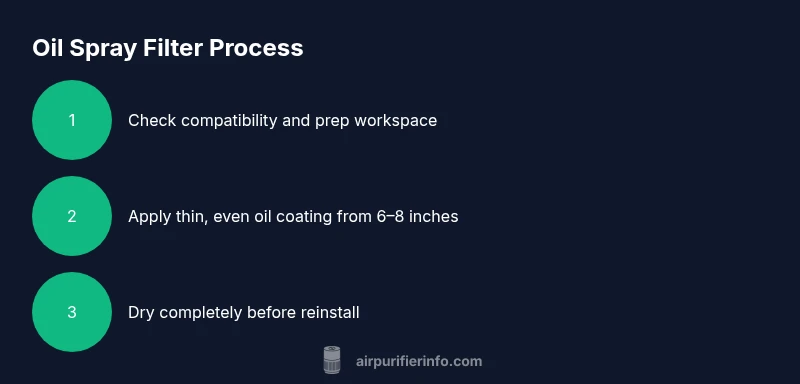
Check the filter’s label or manual to verify that it is oil-compatible. If there is any doubt, do not oil the filter. This prevents irreversible damage and preserves warranty if applicable.
Tip: Double-check the model number and filter family before proceeding. - 2
Prepare the workspace
Lay down a protective surface, wear gloves, and ensure good ventilation. Remove nearby sources of heat and keep the area dry to prevent accidental ignition of spray oils.
Tip: Keep a lint-free cloth nearby to wipe any drips quickly. - 3
Position the filter safely
Place the filter on a stable, non-absorbent surface; avoid bending or flexing the filter frame during handling. A secure position reduces spill risk and ensures even coating.
Tip: If possible, remove the filter from its housing to access all surfaces evenly. - 4
Apply a thin, even coat
Spray from a distance of about 6–8 inches, applying a light mist across the entire surface. Avoid pooling or saturating any one area; the coating should look like a uniform dew.
Tip: Do not spray directly into the filter core; aim for the outer media surface for even distribution. - 5
Dry and reassemble
Allow the filter to dry completely per the manufacturer’s guidance (typically 5–15 minutes in a ventilated area). Reinstall carefully, ensuring a proper seal and unobstructed airflow path.
Tip: Do not re-install until the filter shows no visible dampness and the scent of solvent has dissipated.
Questions & Answers
Is spraying oil safe for all air filters?
No. Only filters explicitly labeled as oil-friendly should be oiled. Many filters are not designed for oil and can be damaged by it. Always check the manual first.
No. Only oil-friendly filters should be oiled. Most filters aren’t designed for oil, so check the manual first.
What type of oil should I use?
Use oil that the manufacturer specifies for air filters. Avoid household oils or silicone spray unless the manual explicitly allows them.
Use the oil the manufacturer specifies. Avoid other household oils unless the manual says it’s okay.
How long does the oil need to dry?
Drying time depends on humidity and airflow, but a typical air may dry within 5–15 minutes in a ventilated space. Do not reinstall until fully dry.
Drying usually takes about 5 to 15 minutes in a ventilated area; wait until completely dry before reuse.
Can oiling damage my purifier or engine?
Yes, if the filter isn’t designed for oil or if oil is applied too thickly. This can clog the airflow path and strain the motor. Always adhere to official guidance.
Yes, applying oil to the wrong filter or too much oil can cause damage. Follow the guidelines.
Should I oil a filter after every clean?
Only if the manufacturer instructs, and only on oil-friendly filters. Most filters do not require oiling after cleaning.
Only oil if the manual says to, otherwise cleaning is enough.
What are signs I should stop and replace the filter?
If the filter shows damage, tearing, or if oil pooling persists after drying, replace rather than re-oiling. Poor seal or airflow issues indicate replacement is needed.
If you see damage or persistent oil pooling after drying, replace the filter.
Watch Video
Main Points
- Verify oil compatibility before any application
- Follow manufacturer guidelines for oil type and drying times
- Apply a thin, even coat to avoid airflow restrictions
- Allow full drying before returning filter to service
- If in doubt, opt for cleaning or replacement instead of oiling