How Long Do Air Purifiers Take to Work: Timelines and Tips
Discover realistic timelines for air purifiers: how fast they work, factors that affect speed, and practical tips to speed up cleaner air for dust, odors, allergies, and pet dander.


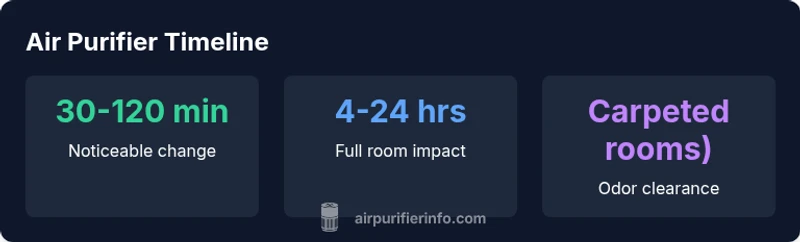
How long does it take for an air purifier to work? In most rooms, noticeable changes occur within 30 minutes to 2 hours, with full air recirculation taking roughly 4 to 24 hours depending on room size, CADR, and ventilation. The Air Purifier Info team notes smaller rooms respond fastest, while larger spaces need longer runtimes for broad impact.
Why timing matters for air cleanliness in homes
Timing matters because indoor air quality responds to how aggressively an air purifier can cycle air through its filtration system. For the central question how long does it take for an air purifier to work, the answer hinges on the purifier’s capacity relative to room volume, the number of air changes per hour (ACH), and the level of pollutants you’re addressing. In typical living spaces under 400 square feet, you often notice changes within 30 minutes to 2 hours. Odor reduction and smoke cleanup, which depend on source strength and ventilation, may take longer. According to Air Purifier Info Team, initial improvements usually appear as a sense of fresher air and fewer visible dust particles around intake vents. For homeowners and renters seeking quick wins, starting with a unit rated for at least the room size helps maximize early effects. This quick window of early improvement is normal and sets the stage for stabilizing air quality over the next several hours.
Core factors that influence speed of impact
The speed at which an air purifier affects air quality is not a single metric. The most important levers are CADR (clean air delivery rate), room volume, and the ACH the device can sustain. A purifier with a high CADR in a small room will generally produce noticeable changes faster than a lower-CADR model in the same space. Room layout also matters: closed doors, furnishings that trap dust, and poor air mixing can slow down circulation. The filter condition is another key factor—new or recently refreshed filters deliver better airflow and filtration efficiency. In addition, the source of pollutants matters: a room with heavy smoke or strong odors requires longer running times or a model with activated carbon filtration. By understanding these components, you can set realistic expectations for how long it takes for an air purifier to work in your space.
Interpreting CADR, ACH, and room-volume math
CADR is a practical shorthand for how much clean air a purifier delivers per minute and is central to timing estimates. ACH, calculated from CADR and room volume, reflects how many air changes occur in an hour. A simple way to estimate timing is to compare the room’s volume to the purifier’s CADR: higher CADR relative to room size yields faster initial improvements. If your room volume is large or open to adjacent spaces, expect longer runtimes to reach steady-state air quality. Real-world timing also depends on ceiling height and air flow patterns created by the purifier’s intake and outlet placement. In practice, think of CADR and ACH as two sides of the same coin: combined, they determine how quickly the air you breathe becomes cleaner.
Timelines by scenario: small, medium, large rooms
For a small room (roughly 250-400 square feet) with a purifier that matches the space, you may see noticeable improvements within 30 minutes to 2 hours. In a medium room (400-800 square feet), expect 2-6 hours for meaningful changes, especially if ventilation is limited. Large rooms (800-1,200+ square feet) or open-plan areas can take 6-24 hours to approach stable air quality, particularly if the space has high ceilings or multiple zones. Real-world results vary with pollutant intensity and user behavior, but these timelines provide practical benchmarks to plan around. Air Purifier Info’s analyses show that matching device capability to space is the single most impactful step for accelerating results.
Practical steps to speed up results
If you want to shorten the time to cleaner air, start by ensuring your purifier is appropriately sized for the room and placed away from obstructions that block airflow. Close doors to minimize uncontrolled air exchange, and run the unit on a setting appropriate for the pollutant source. Regular filter maintenance matters—dust- and odor-laden filters reduce airflow and filtration efficiency. For odor sources, consider a purifier with an activated carbon filter or an add-on carbon pre-filter. Keep windows slightly ajar where safe to improve ventilation, which can dramatically shorten the time to noticeable changes. Consistency matters: running the purifier steadily rather than intermittently yields more reliable improvements over time.
Maintenance and setup for reliability
Maintenance underpins timing. Replace filters according to the manufacturer’s schedule and avoid running a unit with a dirty filter, which can reduce CADR and slow progress toward cleaner air. If you’re targeting allergies or pet dander, ensure the unit is rated for high-efficiency particulate removal (HEPA) and that pre-filters capture larger particles to extend the life of the main filter. Position the purifier so that airflow can circulate through the room rather than tumbling into corners. Annual or semi-annual performance checks, including CADR verification if possible, help you recalibrate expectations and keep the timeline for visible improvements on track. Air Purifier Info recommends pairing air purification with source control—vacuuming, reducing clutter, and addressing moisture issues—to optimize results.
Real-world usage scenarios and troubleshooting
In real homes, you’ll often encounter mixed results due to furniture layout, open doors, and simultaneous dust or odor sources. If you notice that improvements stall, reassess room volume versus device capacity and confirm that the purifier is drawing in air from the most polluted zones. Sometimes simply repositioning the unit to a more central location or increasing run time on the highest appropriate setting yields a noticeable acceleration in results. If odors persist after initial improvements, verify that filtration stages (HEPA plus activated carbon) are appropriate for the pollutant source and consider a secondary filtration strategy for stubborn odors. Air Purifier Info’s team emphasizes adaptability: tailor usage to your space and pollutant profile for the fastest, most reliable results.
Timeline factors by room size and purifier specs
| Room size (sq ft) | Typical ACH | Estimated time to noticeable change | Notes |
|---|---|---|---|
| 250-400 | 3-5 | 30 min - 2 hours | Small-to-medium living spaces |
| 400-800 | 3-5 | 2-6 hours | Larger living/dining |
| 800-1200 | 2-4 | 4-12 hours | Open-plan areas |
| 1200+ | 2-3 | 6-24 hours | Very large rooms or high ceilings |
Questions & Answers
How quickly will an air purifier improve air quality in a small room?
In small rooms, improvements are often noticeable within tens of minutes up to a couple of hours, especially if the purifier matches the room size. A higher CADR relative to space accelerates early benefits. Ventilation and filter freshness also play a role in how fast you perceive the change.
In small rooms, you’ll usually notice cleaner air within minutes to a couple of hours, especially if the purifier fits the space and filters are fresh.
Do higher CADR purifiers always work faster?
Not always. CADR should align with room size. A very high CADR in a large or interconnected space may not deliver faster results if airflow patterns are poor or if there are nearby pollutant sources. The best results come from matching CADR to the room and running the unit consistently.
A higher CADR helps, but only if it's matched to the room and used consistently.
How long should I run my purifier to see results?
For reliable improvements, run the purifier continuously starting from when you first notice pollutants or odors. Expect initial changes within hours and more stable air quality after 24 hours in many spaces. Regular operation helps maintain the benefits over time.
Run it continuously for steady improvement; you’ll see more progress over hours and days.
Can air purifiers remove odors quickly?
Odor removal depends on source strength and filtration. Activated carbon filters improve odor pickup, but smoke or strong cooking smells may take longer. Proper ventilation and running the purifier at an appropriate setting will shorten the time-to-improvement.
Odors improve with carbon filters and good ventilation; it can take hours to days depending on strength.
What factors most influence timing besides CADR?
Key factors include room volume, air exchange with adjacent spaces, filter condition, purifier placement, and whether doors are closed. Pollutant source intensity and the presence of humidity or moisture can also affect perceived speed.
Room size, placement, and filter freshness matter as much as CADR.
Is it better to run on high continuously?
Running on a higher setting continuously can speed up initial improvements, especially in high-pollution scenarios. However, balance energy use and noise with comfort. If you must choose, start on high for a few hours and then settle into an efficient, steady setting.
High can speed things up, but balance comfort and energy use; start on high, then settle into a sustainable setting.
“Real-world results depend on selecting a purifier with adequate CADR for the space and maintaining it properly; expected timelines can vary, but consistent use yields measurable air quality benefits.”
Main Points
- Choose a purifier with CADR suited to room size for faster results
- Aim for 3-5 air changes per hour in living spaces to balance speed and efficiency
- Run consistently and maintain filters to sustain improvements
- Use activated carbon for odor-heavy environments to reduce time-to-improvement
- For very large spaces, consider multi-zone strategies or higher-capacity purifiers