How Air Purifiers Work Step by Step: A Practical Guide
Learn how air purifiers work step by step, from filtration stages to placement and maintenance, with practical tips for dust, odors, and allergies in homes.


According to Air Purifier Info, this guide helps you understand how air purifiers work step by step, from filtration stages to placement and maintenance. You’ll learn what to look for in a unit, how to size it for a room, and how to read labels and safety certifications to improve indoor air quality. The steps cover filtration, room fit, placement, and ongoing care to keep air clean in real homes.
How air purifiers work: core principles
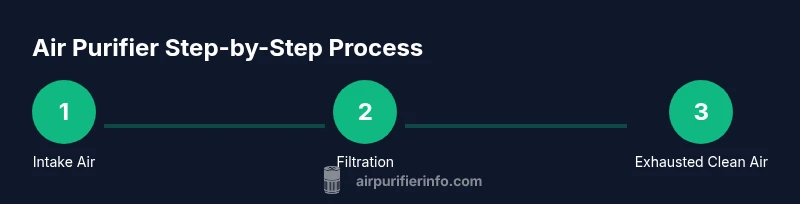
Air purifiers move indoor air through a filtration system to remove particles, odors, and sometimes gases. At a high level, they pull air in, pass it through one or more filters, and emit cleaner air out the other side. The core idea is simple: effective air cleaning requires sufficient air turnover in the room, a well-designed filtration stack, and a cabinet that minimizes bypass leaks. The Air Purifier Info team notes that a common, effective configuration combines true HEPA filtration with an activated carbon stage to tackle both particles and odors. HEPA captures tiny particles such as dust, pollen, and pet dander, while carbon targets cooking smells, tobacco smoke, and many volatile organic compounds. Some units add UV-C or ionizers, which can offer extra benefits but may introduce safety or maintenance trade-offs. In most homes, start with a well-rated purifier placed for good airflow, and observe how air quality responds over several days. This approach aligns with practical, real-world use and avoids overreliance on flashy features.
The first lesson is to understand that air purifiers do not create clean air out of nothing—they move it and filter it. In the context of a typical living room or bedroom, an effective purifier should be capable of turning the air over several times per hour. A good starting point is to think in terms of room size, filtration efficiency, and consistent operation rather than peak performance alone. The Air Purifier Info team also reminds readers to consider noise levels, energy use, and the unit’s physical footprint when choosing a purifier for daily living. When you combine proper sizing with steady operation, you’ll notice a tangible improvement in perceived air freshness and fewer irritations linked to dust and odors.
Filtration stages explained: pre-filter, HEPA, carbon
Most home purifiers rely on a filtration stack that includes a pre-filter, a true HEPA filter, and an activated carbon or other adsorption stage. The pre-filter catches large particles like hair and dust, extending the life of the deeper filters. The HEPA stage is the workhorse for fine particles; it traps a high percentage of microscopic contaminants such as dust, pollen, smoke particles, and pet dander. The activated carbon layer targets odors and many gases produced by cooking, cleaning products, and off-gassing from furniture. Some models add a secondary media, such as zeolite or specialized carbon blends, to broaden gas capture. It’s worth noting that several common
Tools & Materials
- Measuring tape(to measure room dimensions (length, width, height))
- Notebook or digital note-taking device(to record room size, target CADR, and maintenance schedule)
- Electrical outlet near purifier(for safe setup and to keep interference from cords and blocked vents)
- Access to product manuals or spec sheets(helps verify CADR, filter types, and replacement intervals)
- Optional air quality monitor(useful for baseline and after setup testing)
Steps
Estimated time: 60-90 minutes
- 1
Define your air-cleaning goal
Identify the primary pollutants you want to reduce (dust, pollen, smoke, or odors) and decide which rooms to prioritize. This will guide your purifier size, CADR needs, and how many units you’ll use. Establish a baseline by noting current air quality indicators if you have access to a monitor.
Tip: Write down the top pollutants and the target rooms to keep your shopping focused. - 2
Measure your space for proper sizing
Measure the length, width, and ceiling height of the target room to compute its volume. Compare this to the purifier’s recommended room size and CADR rating. A unit that can cycle the room air several times per hour will perform more consistently.
Tip: If you’re between sizes, choose the larger model for better performance and future needs. - 3
Compare filtration options and certifications
Prioritize true HEPA filtration for particles and a robust activated carbon layer for odors and gases. Look for independent verifications (like AHAM) and ozone-free design. Read the energy-use and warranty information to avoid hidden costs.
Tip: Avoid models with vague filter specs or “ionizer” features that may introduce ozone. - 4
Check room placement and airflow paths
Choose a location that allows unobstructed airflow around the intake and exhaust. Avoid corners or behind furniture. In larger rooms, consider more than one unit or a purifier with a broad airflow pattern.
Tip: Keep at least 2–3 feet of clearance on all sides for optimal performance. - 5
Set up, test, and calibrate
Unbox, install filters correctly, plug in, and power on. If your model requires calibration, complete it before measuring air changes. Run it on a steady setting for a baseline period of 3–7 days to gauge impact.
Tip: Use a simple air quality monitor to track PM2.5 or VOCs during this period. - 6
Plan for maintenance and filter life
Document filter replacement dates and check pre-filters monthly. Replace HEPA and carbon filters as recommended by the manufacturer and adjust timelines based on room usage, pets, and smoking activity.
Tip: Keep spare filters on hand to avoid downtime when replacements are due. - 7
Review results and optimize over time
After an initial period, reassess air quality and odor levels. If needed, reposition units or add a second purifier to improve coverage. Consider combining purifiers with fresh ventilation for best results.
Tip: Periodic checks help ensure ongoing effectiveness and comfort.
Questions & Answers
What does an air purifier actually do?
An air purifier draws in room air, passes it through filtration media to remove particles and odors, and releases cleaner air back into the space. The most effective models combine a true HEPA filter for particles with activated carbon for odors and gases.
An air purifier cleans the air by pulling it through filters to trap particles and odors, then sends cleaner air back into the room.
Which filtration stages are most important?
True HEPA filtration is essential for particles, and a robust activated carbon layer addresses odors and gases. Avoid relying solely on ionizers or UV-C unless the device is ozone-free and safety-certified.
HEPA plus carbon filtration is the core combination for particles and odors.
How do I know a purifier is right for my room?
Calculate your room size and compare it to the device’s recommended coverage and CADR. Check for independent certifications and ensure the unit is ozone-free.
Match the purifier’s coverage to your room and look for safety certifications.
Can air purifiers remove viruses?
HEPA filtration can capture many virus-containing particles, but purification is not a guaranteed elimination method. Proper ventilation helps, and filters should be well-maintained for best results.
HEPA can trap many airborne particles, including some viruses, but ventilation matters too.
How often should I replace filters?
Follow the manufacturer’s schedule; carbon filters typically require replacement sooner than HEPA filters. Check monthly and replace as recommended to maintain performance.
Follow the replacement schedule and monitor filter condition.
Are there safety concerns with air purifiers?
Choose ozone-free units and avoid devices with aggressive ionizers. Ensure the purifier is certified for safety and that it has a quiet operation mode for bedrooms or nurseries.
Pick ozone-free models and consider noise levels for bedrooms.
Watch Video
Main Points
- Size the purifier to the room based on CADR and volume.
- Prioritize true HEPA plus activated carbon for versatile cleaning.
- Place the unit for unobstructed airflow and consistent operation.
- Schedule maintenance and filter replacements on a regular cadence.
- Air Purifier Info recommends ozone-free designs and certified filtration for safety.