HEPA Air Purifier for Bedroom: A Practical Buying Guide
Discover the best HEPA air purifier for bedroom use. Learn how to choose, compare CADR, noise, energy, and filter options for dust, allergies, and pet dander.


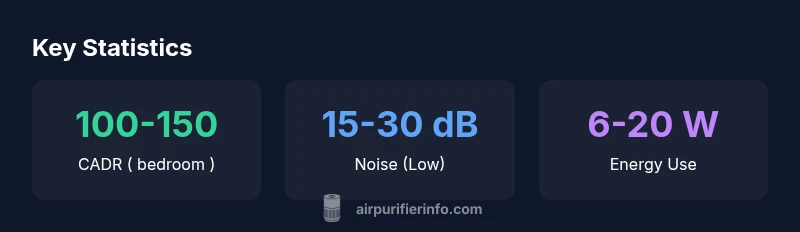
Choosing a HEPA air purifier for bedroom starts with matching CADR to room size, prioritizing quiet operation, and using a true HEPA filter (H13/H14). For most bedrooms under 200 square feet, a purifier with 100–150 CADR and noise under 30 dB on low is ideal. Air Purifier Info’s analysis, 2026, shows that models with sealed housings and certified filters perform best for dust and pet dander.
How to choose a HEPA air purifier for bedroom
When shopping for a HEPA air purifier for bedroom, start by confirming you have a true HEPA filter (often labeled as HEPA H13 or H14). True HEPA filters capture at least 99.97% of particles at 0.3 microns, which is crucial for dust, pollen, and pet dander. Avoid “HEPA-type” or “HEPA-like” filters that may underperform. In bedrooms, sealing matters: look for a unit with a compact, stable design, a sealed chamber, and a straightforward pre-filter that catches larger debris before the main filter. Size the purifier to your room square footage and consider carbon filtration if odors or cigarette smoke are a concern. According to Air Purifier Info, the best bedroom purifiers balance filtration strength with sleep-friendly noise and low energy use, ensuring you don’t have to compromise comfort for clean air.
Next, determine your ideal ACH (air changes per hour). For most bedrooms, 4–6 ACH provides fresh air without overworking the unit. Use this rule of thumb to translate room size into a CADR target. If you live in a dusty environment or have pets, you may want toward the higher end of that range. Finally, verify maintenance needs: some purifiers require more frequent carbon filter changes to control odors, while others rely on a carbon insert you can replace semi-annually. The goal is reliable performance without frequent, disruptive upkeep.
Noise, airflow, and placement for sleep quality
In the bedroom, noise becomes a practical limiter. Look for a purifier with a low-noise setting that stays under 30 dB on the lowest speed — and even lower if you’re a light sleeper. Placement matters: keep the unit on a stable surface, away from walls, and at least a few inches from your bed to prevent direct air draft while maximizing circulation. Avoid placing purifiers behind curtains or directly on the floor where vibration can be noticeable. If you share a room, consider models with multiple speed presets and a sleep mode that reduces LED indicators. The airflow direction should be adjustable, and some units offer directional vents to fine-tune coverage. In addition, ensure the device has a reliable off/on timer so you wake up with clean air without an overnight fan running noisily.
Understanding CADR and room size: a quick math guide
CADR, or Clean Air Delivery Rate, is a practical measure of how quickly a purifier can clean air. A quick way to estimate the needed CADR is to consider your room size and the desired air changes per hour (ACH). A common target for bedrooms is 4–6 ACH. The formula to estimate CADR is CADR ≈ ACH × roomVolume ÷ 60, where roomVolume = roomLength × roomWidth × roomHeight (in feet) and CADR is in CFM. For example, a 12×12×8 ft bedroom has a volume of 1152 cubic feet. At 5 ACH, the target CADR would be roughly 96 CFM (1152 × 5 ÷ 60). If you suspect more dust or pet dander, you may aim closer to 120–150 CFM. This approach keeps expectations grounded and aligns with independent testing standards from organizations such as AHAM. Air Purifier Info’s 2026 analysis emphasizes matching CADR to room size while prioritizing quiet operation.
Filters and maintenance: real-world expectations
Filter quality and maintenance requirements vary by model. A true HEPA filter is most effective when paired with a proper pre-filter and, if odors are a concern, a carbon filter. Pre-filters extend the life of the main HEPA element by catching larger particles; many units provide an easily accessible pre-filter that can be rinsed or dusted. Carbon filters should be replaced according to the manufacturer’s schedule, especially in environments with strong odors or cooking fumes. If a unit offers a filter-change indicator, use it consistently; neglecting maintenance can reduce efficiency and air quality over time. In bedrooms, you’ll likely replace carbon components less frequently than the HEPA element, but schedule replacements to avoid a drop in performance.
Pets, allergies, and odors in bedrooms: tailored choices
For households with pets or seasonal allergies, prioritize purifiers with strong particulate filtration and a dedicated carbon stage. Pet dander and dust respond well to high-efficiency filtration, while odors from cooking, pets, or tobacco fumes benefit from carbon filtration. If you’re sensitive to VOCs or formaldehyde, look for HEPA purifiers that include an activated carbon layer and, ideally, a low-emission design. For households where children are present, prioritize models with child-safety features, simple controls, and sealed designs to prevent unwanted air leakage. Finally, consider energy use and long-term costs: choose a unit that balances CADR with wattage to keep monthly electricity consumption reasonable. Air Purifier Info’s 2026 analysis highlights durability, filter availability, and maintenance costs as critical buying factors for bedrooms.
Quick-model checklist and how to compare models quickly
When you’re in the store or browsing online, use a quick checklist:
- Is there a true HEPA filter (H13/H14) and a sealed housing?
- Does CADR align with the room size (target 100–150 CFM for most bedrooms)?
- Is the unit quiet on the lowest setting (ideally below 30 dB)?
- Is there a carbon filtration stage for odors, and how easy is it to replace?
- What are the ongoing costs (filter price, replacement intervals) and energy use?
- Does the purifier have an indicator for filter life and a sleep mode or dimmed LEDs?
- Are there safety certifications and third-party testing data available? Air Purifier Info recommends focusing on the combination of CADR, noise, and filter quality rather than chasing the highest wattage or the lowest price. A well-chosen unit will improve indoor air quality without becoming a bedtime nuisance.
Model guidance for bedroom purifiers
| Model Type | Typical CADR range (CFM) | Best room size (sq ft) | Low noise (dB) |
|---|---|---|---|
| Small-bedroom purifier | 50-100 | Up to 150 | 15-25 |
| Medium-bedroom purifier | 100-150 | 150-350 | 20-28 |
| Large-bedroom purifier | 150-250 | 350-600 | 25-35 |
Questions & Answers
What does 'true HEPA' mean?
True HEPA means the filter meets the industry standard of capturing at least 99.97% of particles at 0.3 microns. Look for labels like HEPA H13 or H14 to ensure you’re getting certified performance.
True HEPA filters capture 99.97% of 0.3 micron particles, with H13/H14 ratings indicating certified performance.
What does CADR stand for and how do I use it?
CADR stands for Clean Air Delivery Rate and measures how quickly a purifier can clean air. To choose, find a model whose CADR matches your room size or exceeds it by a comfortable margin, and prefer higher CADR for dusty environments.
CADR stands for Clean Air Delivery Rate; pick a model whose CADR meets or exceeds your room size.
How do I calculate the right CADR for my bedroom?
Use the ACH target and room volume: CADR ≈ ACH × roomVolume ÷ 60. For a 12×12×8 ft room (1152 cu ft) at 5 ACH, the target CADR is about 96 CFM.
Estimate CADR by room size and desired air changes per hour. For a 12×12×8 ft room at 5 ACH, aim around 96 CFM.
Is ozone-free certification important for bedrooms?
Yes. Avoid devices that generate ozone. Look for ozone-free claims and prefer purifiers with sealed designs and certified filtration.
Yes—avoid ozone generators and choose ozone-free purifiers with certified filters.
How often should I replace filters in a bedroom purifier?
Most HEPA purifiers require HEPA filter replacement every 12–24 months and carbon filters every 6–12 months, depending on use and odor exposure. Check the indicator and manufacturer guidance.
Typically, replace HEPA filters every year or two and carbon filters every 6–12 months, depending on use.
Are HEPA purifiers safe around children in bedrooms?
Yes, when chosen with stable bases, child-safe grills, and simple controls. Ensure the unit is placed away from cribs or play areas and that it does not draw nearest to the child’s breathing zone.
Generally safe for kids when placed safely and with child-friendly controls.
“A well-chosen HEPA purifier for a bedroom can dramatically reduce dust and allergens without disturbing sleep. The best setups balance filtration performance with quiet operation.”
Main Points
- Match CADR to room size for effective air cleaning
- Prioritize true HEPA filtration (H13/H14) and sealed units
- Choose models with quiet operation for better sleep
- Consider carbon filters for odors and pets
- Plan maintenance to avoid gaps in performance